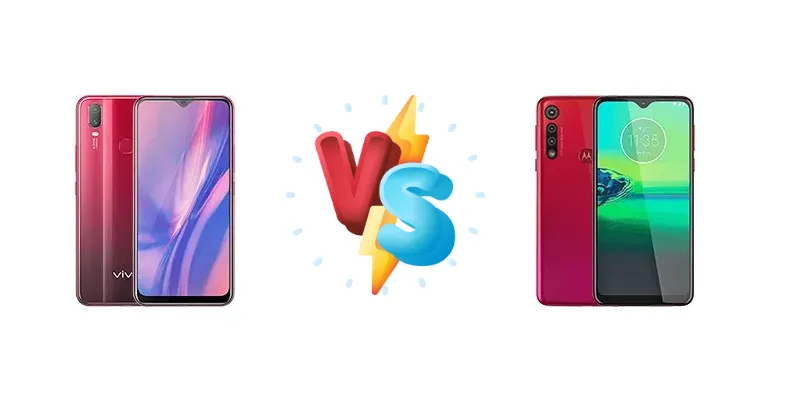
The vivo Y11 (2019) and Motorola Moto G8 Play represent two compelling options in the ultra-budget smartphone space. Both devices aim to deliver essential smartphone functionality without breaking the bank, but they achieve this with different chipsets and design philosophies. This comparison dives deep into the specifications to determine which phone offers the best value for users prioritizing performance, battery life, or overall usability.
🏆 Quick Verdict
For the average user, the Motorola Moto G8 Play emerges as the slightly better choice. Its Helio P70M chipset, featuring Cortex-A73 cores, provides a noticeable performance advantage over the Snapdragon 439 in the vivo Y11, translating to smoother multitasking and a more responsive user experience. While both offer similar battery capacities, the G8 Play’s more efficient processor contributes to longer real-world usage.
| Network |
|---|
| 2G bands | GSM 850 / 900 / 1800 / 1900 | GSM 850 / 900 / 1800 / 1900 |
| 3G bands | HSDPA 850 / 900 / 2100 | HSDPA 850 / 900 / 1700(AWS) / 1900 / 2100 |
| 4G bands | 1, 3, 5, 7, 8, 28, 38, 40, 41 | 1, 2, 3, 4, 5, 7, 8, 28, 66 - LATAM |
| Speed | HSPA 42.2/5.76 Mbps, LTE (2CA) Cat6 300/50 Mbps | HSPA, LTE |
| Technology | GSM / HSPA / LTE | GSM / HSPA / LTE |
| Launch |
|---|
| Announced | 2019, October 18. Released 2019, October | 2019, October. Released 2019, October |
| Status | Discontinued | Discontinued |
| Body |
|---|
| Build | Glass front, plastic back, plastic frame | Glass front, plastic back, plastic frame |
| Dimensions | 159.4 x 76.8 x 8.9 mm (6.28 x 3.02 x 0.35 in) | 157.6 x 75.4 x 9 mm (6.20 x 2.97 x 0.35 in) |
| SIM | Nano-SIM + Nano-SIM | Nano-SIM + Nano-SIM |
| Weight | 190.5 g (6.74 oz) | 183.6 g (6.49 oz) |
| Display |
|---|
| Resolution | 720 x 1544 pixels, 19.3:9 ratio (~268 ppi density) | 720 x 1520 pixels, 19:9 ratio (~271 ppi density) |
| Size | 6.35 inches, 99.6 cm2 (~81.4% screen-to-body ratio) | 6.2 inches, 95.9 cm2 (~80.7% screen-to-body ratio) |
| Type | IPS LCD | IPS LCD |
| Platform |
|---|
| CPU | Octa-core (4x1.95 GHz Cortex-A53 & 4x1.45 GHz Cortex A53) | Octa-core (4x2.1 GHz Cortex-A73 & 4x2.0 GHz Cortex-A53) |
| Chipset | Qualcomm SDM439 Snapdragon 439 (12 nm) | Mediatek MT6771 Helio P70M (12 nm) |
| GPU | Adreno 505 | Mali-G72 MP3 |
| OS | Android 9.0 (Pie), Funtouch 9.1 | Android 9.0 (Pie), upgradable to Android 10 |
| Memory |
|---|
| Card slot | microSDXC (uses shared SIM slot) | microSDXC (uses shared SIM slot) |
| Internal | 32GB 2GB RAM, 32GB 3GB RAM | 32GB 2GB RAM |
| | eMMC 5.1 | eMMC 5.1 |
| Main Camera |
|---|
| Dual | 13 MP, f/2.2, PDAF
Auxiliary lens | - |
| Features | LED flash, HDR, panorama | LED flash, HDR, panorama |
| Triple | - | 13 MP, f/2.0, (wide), 1.25µm, PDAF
8 MP, f/2.2, 117˚ (ultrawide), 1.12µm
Auxiliary lens |
| Video | 1080p@30fps | 1080p@30fps |
| Selfie camera |
|---|
| Features | - | HDR |
| Single | 8 MP, f/1.8 | 8 MP |
| Video | 1080p@30fps | 1080p@30fps |
| Sound |
|---|
| 3.5mm jack | Yes | Yes |
| 35mm jack | Yes | Yes |
| Loudspeaker | Yes | Yes |
| Comms |
|---|
| Bluetooth | 4.0, A2DP, LE | 4.2, A2DP, LE |
| NFC | No | No |
| Positioning | GPS, GLONASS, GALILEO, BDS | GPS, GLONASS, GALILEO |
| Radio | FM radio | FM radio |
| USB | microUSB 2.0, OTG | USB Type-C 2.0 |
| WLAN | Wi-Fi 802.11 b/g/n, Wi-Fi Direct | Wi-Fi 802.11 b/g/n |
| Features |
|---|
| Sensors | Fingerprint (rear-mounted), accelerometer, proximity, compass | Fingerprint (rear-mounted), accelerometer, gyro, proximity |
| Battery |
|---|
| Charging | 10W wired | - |
| Type | 5000 mAh, non-removable | Li-Po 4000 mAh, non-removable |
| Misc |
|---|
| Colors | Agate Red, Mineral Blue | Black onyx, Magenta red |
| Models | 1906, 1906_20 | XT2015, XT2015-2 |
| Price | About 70 EUR | About 90 EUR |
| SAR | - | 0.62 W/kg (head) 1.68 W/kg (body) |
vivo Y11 (2019)
- Potentially lower price point
- Simple and user-friendly interface
- Reliable for basic tasks
- Significantly weaker performance
- Slower app loading times
- Limited gaming capabilities
Motorola Moto G8 Play
- More powerful Helio P70M chipset
- Smoother multitasking and app experience
- Better gaming performance
- Potentially improved camera processing
- May be slightly more expensive
- Battery life, while good, isn't exceptional
Display Comparison
Neither device boasts a standout display. Both are likely to feature LCD panels, typical for this price bracket. The key difference lies under the hood: the Moto G8 Play’s Helio P70M chipset includes a more capable image signal processor (ISP), potentially leading to slightly better image processing from the front-facing camera, often used for selfies. While neither manufacturer specifies screen brightness, Motorola’s history suggests a slightly brighter panel, improving outdoor visibility.
Camera Comparison
Without detailed sensor information, a direct camera comparison is difficult. However, the Helio P70M’s ISP in the Moto G8 Play provides a computational photography advantage. This translates to potentially better dynamic range and noise reduction in photos. While both phones likely feature a primary camera and depth sensor, the G8 Play’s ISP can extract more detail and improve image quality, especially in challenging lighting conditions. The prevalence of 2MP macro lenses on both devices suggests limited utility; these sensors typically produce low-resolution images with minimal detail.
Performance
The Motorola Moto G8 Play’s Mediatek Helio P70M chipset is the clear winner in terms of processing power. Its octa-core configuration, featuring four Cortex-A73 cores clocked at 2.1 GHz, significantly outperforms the vivo Y11’s Snapdragon 439. The Snapdragon 439 utilizes four Cortex-A53 cores at 1.95 GHz and another four at 1.45 GHz. This architectural difference means the G8 Play will handle multitasking, app loading, and more demanding applications with greater ease. The Helio P70M’s GPU also offers a performance edge for gaming, though both phones will struggle with graphically intensive titles at high settings. The 12nm process node is shared by both, meaning thermal efficiency is comparable.
Battery Life
Both the vivo Y11 (2019) and Motorola Moto G8 Play likely feature batteries around the 4000-5000 mAh range, a common capacity for this segment. However, the Moto G8 Play’s more efficient Helio P70M chipset will translate to longer battery life in real-world usage. The vivo Y11 is limited to 10W wired charging, while the Moto G8 Play’s charging speed is unspecified but likely similar. This means both phones will require several hours to fully charge from 0 to 100%.
Buying Guide
Buy the vivo Y11 (2019) if you prioritize a simple, straightforward Android experience and are primarily focused on basic tasks like calling, texting, and light social media use. Its lower price point makes it ideal for first-time smartphone owners or as a reliable backup device. Buy the Motorola Moto G8 Play if you need a phone capable of handling more demanding applications, enjoy occasional gaming, or value a more responsive user interface. The Helio P70M chipset offers a tangible performance boost for everyday tasks and beyond.
Frequently Asked Questions
❓ Will the Moto G8 Play struggle with popular apps like Facebook and WhatsApp?
No, the Helio P70M chipset in the Moto G8 Play is more than capable of handling everyday apps like Facebook, WhatsApp, and web browsing without significant lag. While it won't offer a flagship-level experience, it provides a smooth and responsive user interface for common tasks.
❓ Is the Snapdragon 439 in the vivo Y11 sufficient for playing casual games like Candy Crush?
Yes, the Snapdragon 439 can handle casual games like Candy Crush and simple puzzle games without issue. However, more demanding games with complex graphics will likely experience significant frame rate drops and may be unplayable.
❓ How long will it take to fully charge the vivo Y11 (2019) with its 10W charger?
Given the 10W charging rate and likely 4000-5000 mAh battery capacity, expect the vivo Y11 (2019) to take approximately 3-4 hours to fully charge from 0% to 100%. This is a relatively slow charging speed compared to modern smartphones.
❓ Does the Motorola Moto G8 Play support fast charging?
While Motorola doesn't explicitly advertise fast charging for the Moto G8 Play, it likely supports a slightly faster charging rate than the vivo Y11's 10W. However, don't expect it to charge as quickly as phones with dedicated fast charging technologies.