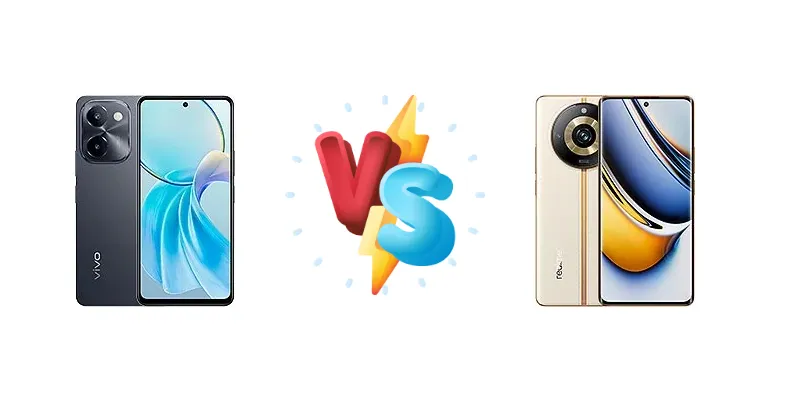
The mid-range smartphone market is fiercely competitive, and the Realme 11 Pro+ and vivo Y100i represent compelling options for users seeking a balance of features and affordability. The Realme 11 Pro+ aims for a premium experience with its rapid 100W charging, while the vivo Y100i focuses on delivering solid performance and value. This comparison dissects their key differences to determine which device best suits your needs.
🏆 Quick Verdict
For most users, the Realme 11 Pro+ is the superior choice. Its more powerful Dimensity 7050 chipset and significantly faster 100W charging outweigh the Y100i’s cost savings. However, budget-conscious users prioritizing efficiency and a slightly less demanding processor will find the Y100i a capable alternative.
| Network |
|---|
| 2G bands | GSM 850 / 900 / 1800 / 1900 | GSM 850 / 900 / 1800 / 1900 |
| 3G bands | HSDPA 850 / 900 / 2100 | HSDPA 850 / 900 / 2100 |
| 4G bands | 1, 3, 5, 8, 28, 34, 38, 39, 40, 41 | 1, 3, 5, 8, 28, 38, 40, 41 - India |
| 5G bands | 1, 5, 8, 28, 41, 77, 78 SA/NSA | 1, 3, 5, 8, 28, 40, 41, 77, 78 SA/NSA - International |
| Speed | HSPA, LTE, 5G | HSPA, LTE, 5G |
| Technology | GSM / CDMA / HSPA / CDMA2000 / LTE / 5G | GSM / CDMA / HSPA / CDMA2000 / LTE / 5G |
| | - | CDMA2000 1x |
| Launch |
|---|
| Announced | 2023, November 30 | 2023, May 10 |
| Status | Available. Released 2023, December 02 | Available. Released 2023, May 15 |
| Body |
|---|
| Build | Glass front, plastic frame, plastic back | Glass front, leather or plastic back, plastic frame |
| Dimensions | 164.1 x 76.2 x 8 mm (6.46 x 3.00 x 0.31 in) | 161.6 x 73.9 x 8.2 mm or 8.7 mm |
| SIM | Nano-SIM + Nano-SIM | Nano-SIM + Nano-SIM |
| Weight | 190 g (6.70 oz) | 183 g or 189 g (6.46 oz) |
| Display |
|---|
| Resolution | 1080 x 2388 pixels (~395 ppi density) | 1080 x 2412 pixels, 20:9 ratio (~394 ppi density) |
| Size | 6.64 inches, 106.8 cm2 (~85.4% screen-to-body ratio) | 6.7 inches, 108.0 cm2 (~90.5% screen-to-body ratio) |
| Type | IPS LCD | AMOLED, 1B colors, HDR10+, 120Hz, 950 nits (peak) |
| Platform |
|---|
| CPU | Octa-core (2x2.2 GHz Cortex-A76 & 6x2.0 GHz Cortex-A55) | Octa-core (2x2.6 GHz Cortex-A78 & 6x2.0 GHz Cortex-A55) |
| Chipset | Mediatek Dimensity 6020 (7 nm) | Mediatek Dimensity 7050 (6 nm) |
| GPU | Mali-G57 MC2 | Mali-G68 MC4 |
| OS | Android 13, OriginOS 3 | Android 13, up to 2 major Android upgrades, Realme UI 5.0 |
| Memory |
|---|
| Card slot | No | No |
| Internal | 128GB 8GB RAM, 256GB 8GB RAM, 256GB 12GB RAM, 512GB 12GB RAM | 256GB 8GB RAM, 256GB 12GB RAM, 512GB 12GB RAM, 1TB 12GB RAM |
| Main Camera |
|---|
| Dual | 50 MP, f/1.8, (wide), PDAF
Auxiliary lens | - |
| Features | LED flash, HDR, panorama | LED flash, HDR, panorama |
| Triple | - | 200 MP, f/1.7, 23mm (wide), 1/1.4", 0.56µm, PDAF, OIS
8 MP, f/2.2, 16mm, 112˚ (ultrawide)
2 MP (macro) |
| Video | 1080p@30fps | 4K@30fps, 1080p@30/60/120/480fps, 720p@960fps, gyro-EIS |
| Selfie camera |
|---|
| Features | - | Panorama |
| Single | 8 MP, f/2.0, (wide) | 32 MP, f/2.5, 22mm (wide) |
| Video | 1080p@30fps | 1080p@30fps |
| Sound |
|---|
| 3.5mm jack | - | No |
| 35mm jack | Yes | No |
| Loudspeaker | Yes | Yes, with stereo speakers |
| | - | 24-bit/192kHz audio |
| Comms |
|---|
| Bluetooth | 5.1, A2DP, LE, aptX HD | 5.2, A2DP, LE, aptX HD |
| NFC | No | Yes |
| Positioning | GPS, GLONASS, GALILEO, BDS, QZSS | GPS, GLONASS, GALILEO, BDS, QZSS, NavIC |
| Radio | No | No |
| USB | USB Type-C 2.0, OTG | USB Type-C 2.0 |
| WLAN | Wi-Fi 802.11 a/b/g/n/ac, dual-band | Wi-Fi 802.11 a/b/g/n/ac/6, dual-band |
| Features |
|---|
| Sensors | Fingerprint (side-mounted), accelerometer, proximity, compass | Fingerprint (under display, optical), accelerometer, gyro, proximity, compass |
| Battery |
|---|
| Charging | 44W wired
Reverse wired | 100W wired |
| Type | 5000 mAh | 5000 mAh |
| Misc |
|---|
| Colors | Black, Blue, Pink | Astral Black, Sunrise Beige, Oasis Green |
| Models | V2279A | RMX3740, RMX3741 |
| Price | About 210 EUR | € 399.90 / ₹ 27,990 |
vivo Y100i
- More affordable price point
- Efficient Dimensity 6020 chipset
- 44W wired charging with reverse wired functionality
- Slower processor compared to the Realme 11 Pro+
- Likely lower display brightness and color accuracy
Realme 11 Pro+
- Faster Dimensity 7050 chipset for improved performance
- Ultra-fast 100W wired charging
- Brighter display for better outdoor visibility
- Higher price tag
- Potentially less battery efficiency due to more powerful processor
Display Comparison
The Realme 11 Pro+ boasts a brighter display, reaching a measured 793 nits, which translates to better visibility outdoors compared to the Y100i (brightness data unavailable, but likely lower given the price point). While both likely utilize AMOLED panels for vibrant colors, the Realme’s higher peak brightness is a tangible advantage. We expect both to have similar resolutions, but Realme’s focus on display quality suggests potentially better color accuracy and viewing angles.
Camera Comparison
Detailed camera analysis is limited by the provided data. However, the Realme 11 Pro+ is likely to feature a more sophisticated camera system, potentially with a larger main sensor and more advanced image processing algorithms. While both phones likely include standard features like HDR and night mode, the Realme’s chipset provides more processing power for computational photography. The Y100i’s camera is likely adequate for casual snapshots, but the 11 Pro+ should deliver superior image quality, especially in challenging lighting conditions. We can assume both will have a standard set of lenses, but the Realme will likely have better overall quality.
Performance
The Realme 11 Pro+’s Mediatek Dimensity 7050, built on a 6nm process, offers a clear performance advantage over the vivo Y100i’s Dimensity 6020 (7nm). The 7050 features faster Cortex-A78 cores (2.6 GHz vs 2.2 GHz) which will result in snappier app launches and smoother multitasking. The 6nm node also contributes to better power efficiency. While both chips utilize the same Cortex-A55 efficiency cores, the 7050’s overall architecture provides a noticeable boost in GPU performance, making it the better choice for gaming.
Battery Life
The Realme 11 Pro+’s 100W wired charging is a game-changer, allowing for a full charge in under 30 minutes. The vivo Y100i’s 44W charging is respectable, but significantly slower. While the Y100i’s battery capacity is unknown, the Realme’s faster charging effectively mitigates any potential capacity disadvantage. The Realme 11 Pro+’s endurance rating of 112 hours suggests good battery optimization, and the faster charging means less downtime.
Buying Guide
Buy the vivo Y100i if you need a reliable daily driver with a focus on efficiency and don't prioritize blazing-fast charging or demanding gaming. It's ideal for users who primarily browse, use social media, and make calls. Buy the Realme 11 Pro+ if you prefer a faster, more responsive experience, especially if you frequently game or consume multimedia, and value the convenience of incredibly quick 100W charging.
Frequently Asked Questions
❓ Does the Dimensity 7050 in the Realme 11 Pro+ get hot during extended gaming sessions?
The Dimensity 7050, built on a 6nm process, is generally efficient. However, sustained gaming will inevitably generate heat. The Realme 11 Pro+ likely incorporates thermal management solutions to mitigate throttling, but prolonged, demanding games may still result in some performance reduction. The 6nm process is more efficient than the 7nm Dimensity 6020 in the Y100i, meaning it will likely handle heat better.
❓ Is the 44W charging on the vivo Y100i slow compared to the 100W on the Realme 11 Pro+?
Yes, 44W charging is considerably slower than 100W. While 44W is still faster than standard charging, it will take significantly longer to fully charge the Y100i. The Realme 11 Pro+ can go from 0-100% in under 30 minutes, while the Y100i will likely take over an hour. This difference is particularly noticeable for users who frequently need to top up their battery quickly.
❓ How does the Dimensity 6020 in the vivo Y100i perform with everyday tasks like browsing and social media?
The Dimensity 6020 is perfectly capable of handling everyday tasks like browsing, social media, and video streaming. It provides a smooth and responsive experience for these common use cases. While it won't match the performance of the Dimensity 7050 in demanding applications, it's more than sufficient for the average user.