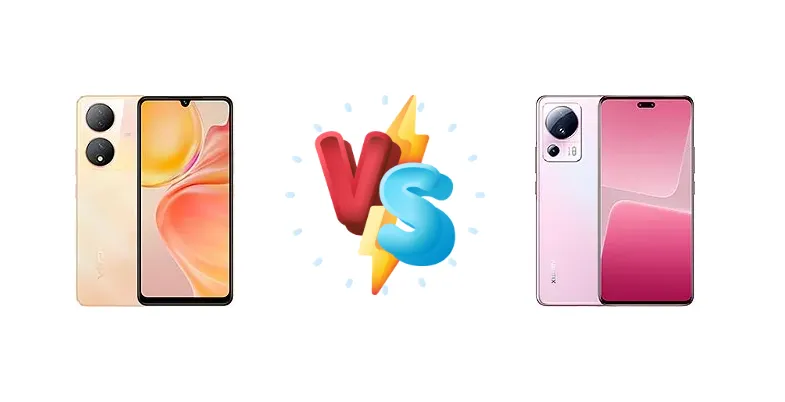
The mid-range smartphone market is fiercely competitive, and the vivo Y100 and Xiaomi 13 Lite represent compelling options for users seeking a balance of features and affordability. While both aim to deliver a premium experience without the flagship price tag, they take different approaches to achieving this, primarily through chipset choice and charging implementation. This comparison dives deep into the specifics to determine which device best suits your needs.
🏆 Quick Verdict
For the average user prioritizing fast charging and a brighter display, the Xiaomi 13 Lite is the stronger choice. Its 67W charging significantly reduces downtime, and the 938 nits peak brightness provides excellent outdoor visibility. However, the vivo Y100 offers a different CPU architecture that may appeal to those seeking a specific performance profile.
| Network |
|---|
| 2G bands | GSM 850 / 900 / 1800 / 1900 | GSM 850 / 900 / 1800 / 1900 |
| 3G bands | HSDPA 850 / 900 / 2100 | HSDPA 800 / 850 / 900 / 1700(AWS) / 1900 / 2100 |
| 4G bands | 1, 3, 5, 8, 38, 40, 41 | 1, 2, 3, 4, 5, 7, 8, 12, 13, 17, 18, 19, 20, 26, 28, 32, 38, 40, 41, 42, 66 |
| 5G bands | 1, 3, 8, 28, 77, 78 SA/NSA | 1, 3, 5, 7, 8, 20, 28, 38, 40, 41, 66, 77, 78 SA/NSA |
| Speed | HSPA, LTE, 5G | HSPA, LTE, 5G |
| Technology | GSM / HSPA / LTE / 5G | GSM / HSPA / LTE / 5G |
| Launch |
|---|
| Announced | 2023, February 16 | 2023, February 26 |
| Status | Available. Released 2023, February 16 | Available. Released 2023, March 08 |
| Body |
|---|
| Build | Glass front, glass back | Glass front (Gorilla Glass 5), glass back, plastic frame |
| Dimensions | 158.9 x 73.5 x 7.7 mm (6.26 x 2.89 x 0.30 in) | 159.2 x 72.7 x 7.2 mm (6.27 x 2.86 x 0.28 in) |
| SIM | Nano-SIM + Nano-SIM | · Nano-SIM + eSIM· Nano-SIM + Nano-SIM |
| Weight | 181 g (6.38 oz) | 171 g (6.03 oz) |
| | IP54, dust and water resistant
Color changing back panel color | IP53, dust and splash resistant |
| Display |
|---|
| Protection | - | Corning Gorilla Glass 5 |
| Resolution | 1080 x 2400 pixels, 20:9 ratio (~413 ppi density) | 1080 x 2400 pixels, 20:9 ratio (~402 ppi density) |
| Size | 6.38 inches, 98.3 cm2 (~84.1% screen-to-body ratio) | 6.55 inches, 103.6 cm2 (~89.5% screen-to-body ratio) |
| Type | AMOLED, 90Hz, HDR10+, 1300 nits (peak) | AMOLED, 68B colors, Dolby Vision, HDR10+, 120Hz, 500 nits (typ), 1000 nits (peak) |
| Platform |
|---|
| CPU | Octa-core (2x2.4 GHz Cortex-A78 & 6x2.0 GHz Cortex-A55) | Octa-core (1x2.4 GHz Cortex-A710 & 3x2.36 GHz Cortex-A710 & 4x1.8 GHz Cortex-A510) |
| Chipset | Mediatek Dimensity 900 (6 nm) | Qualcomm SM7450-AB Snapdragon 7 Gen 1 (4 nm) |
| GPU | Mali-G68 MC4 | Adreno 644 |
| OS | Android 13, Funtouch 13 | Android 12, MIUI 14 |
| Memory |
|---|
| Card slot | microSDXC (uses shared SIM slot) | No |
| Internal | 128GB 8GB RAM | 64GB 8GB RAM, 128GB 8GB RAM, 256GB 8GB RAM |
| | - | UFS 2.2 |
| Main Camera |
|---|
| Features | LED flash, HDR, panorama | Dual-LED dual-tone flash, HDR, panorama |
| Single | 16 MP, f/2.0, (wide) | - |
| Triple | 64 MP, f/1.8, (wide), 0.7µm, PDAF, OIS
2 MP (macro)
Auxiliary lens | 50 MP, f/1.8, 23mm (wide), 1/1.56", 1.0µm, PDAF
8 MP, f/2.2, 119˚ (ultrawide), 1/4.0", 1.12µm
2 MP (macro) |
| Video | 4K@30fps, 1080p@30fps | 4K@30fps, 1080p@30/60/120fps, 720p@960fps |
| Selfie camera |
|---|
| Dual | - | 32 MP, f/2.4, 100˚ (ultrawide), 1/2.74", 0.8µm
8 MP, f/2.3, (depth) |
| Features | - | Dual-LED flash, HDR |
| Single | 16 MP, f/2.0, (wide) | - |
| Video | 1080p@30fps | 1080p@30/60fps |
| Sound |
|---|
| 3.5mm jack | Yes | No |
| 35mm jack | Yes | No |
| Loudspeaker | Yes | Yes |
| | 24-bit/192kHz audio | 24-bit/192kHz audio |
| Comms |
|---|
| Bluetooth | 5.2, A2DP, LE | 5.2, A2DP, LE |
| Infrared port | - | Yes |
| NFC | - | Yes (market/region dependent) |
| Positioning | GPS, GLONASS, BDS, GALILEO, QZSS | GPS (L1), GLONASS (G1), BDS (B1I+B1c), GALILEO (E1), QZSS (L1) |
| Radio | No | No |
| USB | USB Type-C 2.0, OTG | USB Type-C 2.0, OTG |
| WLAN | Wi-Fi 802.11 a/b/g/n/ac, dual-band | Wi-Fi 802.11 a/b/g/n/ac/6, dual-band |
| Features |
|---|
| Sensors | Fingerprint (under display, optical), accelerometer, gyro, proximity, compass | Fingerprint (under display, optical), accelerometer, gyro, proximity, compass |
| Battery |
|---|
| Charging | 44W wired, 60% in 30 min | 67W wired, 100% in 40 min |
| Type | 4500 mAh | Li-Po 4500 mAh |
| Misc |
|---|
| Colors | Metal Black, Twilight Gold, Pacific Blue | Black, Lite Blue, Lite Pink |
| Models | V2239 | - |
| Price | € 97.26 | About 180 EUR |
| Tests |
|---|
| Battery life | - |
Endurance rating 93h
|
| Camera | - |
Photo / Video |
| Display | - |
Contrast ratio: Infinite (nominal) |
| Loudspeaker | - |
-28.5 LUFS (Average)
|
| Performance | - |
AnTuTu: 534143 (v9)
GeekBench: 2936 (v5.1), 2434 (v6)
GFXBench: 33fps (ES 3.1 onscreen) |
vivo Y100
- Potentially more efficient CPU architecture (Dimensity 900)
- Competitive endurance rating (93 hours)
- May offer a unique software experience
- Slower charging speed (44W)
- Display brightness likely lower than Xiaomi 13 Lite
- CPU architecture is older generation
Xiaomi 13 Lite
- Faster 67W charging (100% in 40 minutes)
- Brighter display (938 nits)
- More efficient 4nm Snapdragon 7 Gen 1 chipset
- Endurance rating is the same as the vivo Y100
- Camera details are currently unknown
- Software experience may be less unique
Display Comparison
The Xiaomi 13 Lite boasts a significantly brighter display, reaching a measured peak of 938 nits, compared to an unspecified brightness for the vivo Y100. This difference is crucial for usability in direct sunlight. While both displays are described as having an 'infinite' contrast ratio (a common marketing term), the Xiaomi’s higher peak brightness translates to a more vibrant and readable image. Details regarding panel technology (e.g., AMOLED, LCD) and refresh rate are missing for both, but the Xiaomi’s brightness advantage is a clear win.
Camera Comparison
Both phones are listed as having 'Photo / Video' capabilities, lacking specific details. Without sensor size, aperture, or OIS information, a direct comparison is difficult. However, given Xiaomi’s history of focusing on camera features, it’s reasonable to assume the 13 Lite may offer more refined image processing and potentially a more versatile camera system. The prevalence of low-resolution auxiliary lenses (like 2MP macros) in this segment suggests focusing on the main sensor’s quality is paramount, a detail currently unavailable for either device.
Performance
The core difference lies in the chipsets: the vivo Y100 utilizes the Mediatek Dimensity 900 (6nm), while the Xiaomi 13 Lite features the Qualcomm Snapdragon 7 Gen 1 (4nm). The Snapdragon 7 Gen 1, built on a more efficient 4nm process, generally offers superior performance and thermal management. Its CPU configuration – a 1x2.4 GHz Cortex-A710 prime core alongside 3x2.36 GHz Cortex-A710 cores and 4x1.8 GHz Cortex-A510 cores – is designed for a balance of power and efficiency. The Dimensity 900’s 2x2.4 GHz Cortex-A78 and 6x2.0 GHz Cortex-A55 configuration, while capable, is likely to exhibit more throttling under sustained load. The Snapdragon’s architecture is more modern and optimized for demanding tasks.
Battery Life
Both devices achieve an endurance rating of 93 hours, suggesting similar overall battery life despite differing battery capacities (not specified). However, the charging speeds are markedly different. The Xiaomi 13 Lite’s 67W wired charging can fully charge the device in 40 minutes, while the vivo Y100’s 44W charging reaches 60% in 30 minutes. This means the Xiaomi 13 Lite offers a significantly faster top-up time, a crucial advantage for users who frequently need to recharge quickly.
Buying Guide
Buy the vivo Y100 if you prioritize a potentially more efficient CPU architecture with the Dimensity 900 and are comfortable with slightly slower charging speeds. This phone is ideal for users who engage in sustained, multi-tasking workloads. Buy the Xiaomi 13 Lite if you value rapid charging, a brighter display for outdoor use, and a generally more polished software experience, making it perfect for content consumption and casual gaming.
Frequently Asked Questions
❓ Does the Snapdragon 7 Gen 1 in the Xiaomi 13 Lite get hot during extended gaming sessions?
The Snapdragon 7 Gen 1, built on a 4nm process, is generally more thermally efficient than the Dimensity 900. While some heat generation is inevitable during gaming, the 7 Gen 1 is designed to manage temperatures effectively, minimizing throttling and maintaining consistent performance for longer periods. However, sustained high-intensity gaming will still lead to some warming.
❓ Is the 44W charging on the vivo Y100 slow compared to the competition?
Yes, 44W charging is relatively slow compared to the 67W charging offered by the Xiaomi 13 Lite. While it can reach 60% in 30 minutes, a full charge will take considerably longer. This difference is significant for users who prioritize quick top-ups throughout the day.
❓ What kind of storage and RAM does each phone use, and does that impact performance?
Unfortunately, the context data doesn't specify the storage type (UFS 2.2, UFS 3.1) or RAM speed (LPDDR4X, LPDDR5) for either device. Faster storage and RAM (UFS 3.1 and LPDDR5 respectively) contribute to quicker app loading times and smoother multitasking. Without this information, it's difficult to assess the full performance impact.