
vivo Y100 (IDN) vs Xiaomi 13 Lite: A Detailed Comparison of Mid-Range Contenders
| Phones Images | |||||
|---|---|---|---|---|---|
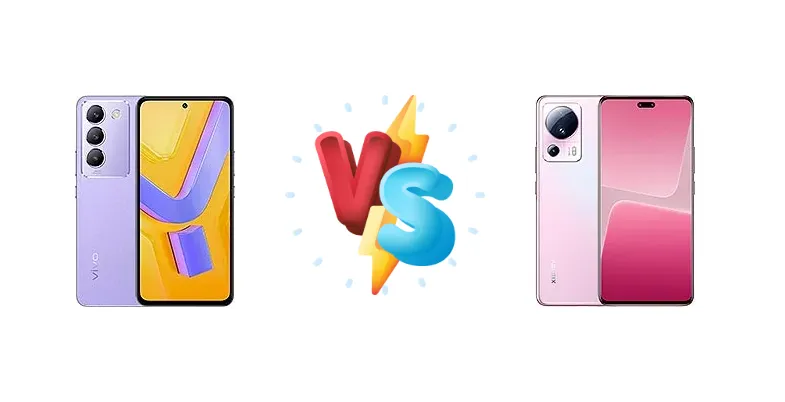
|
🏆 Quick Verdict
For the average user prioritizing responsiveness and a brighter viewing experience, the Xiaomi 13 Lite emerges as the stronger choice. Its Snapdragon 7 Gen 1 chipset offers a noticeable performance advantage over the Y100’s Snapdragon 4 Gen 2, while the 938 nit display provides excellent visibility. However, the vivo Y100’s 80W charging is a significant advantage for those who value speed.
| PHONES | ||
|---|---|---|
| Phone Names | vivo Y100 (IDN) | Xiaomi 13 Lite |
| Network | ||
|---|---|---|
| 2G bands | GSM 850 / 900 / 1800 / 1900 | GSM 850 / 900 / 1800 / 1900 |
| 3G bands | HSDPA 850 / 900 / 1700(AWS) / 1900 / 2100 | HSDPA 800 / 850 / 900 / 1700(AWS) / 1900 / 2100 |
| 4G bands | 1, 2, 3, 4, 5, 7, 8, 18, 19, 20, 26, 28, 38, 39, 40, 41 - Indonesia | 1, 2, 3, 4, 5, 7, 8, 12, 13, 17, 18, 19, 20, 26, 28, 32, 38, 40, 41, 42, 66 |
| 5G bands | 1, 3, 5, 7, 8, 20, 28, 38, 40, 41, 77, 78 SA/NSA - Indonesia | 1, 3, 5, 7, 8, 20, 28, 38, 40, 41, 66, 77, 78 SA/NSA |
| Speed | HSPA, LTE, 5G | HSPA, LTE, 5G |
| Technology | GSM / HSPA / LTE / 5G | GSM / HSPA / LTE / 5G |
| Launch | ||
|---|---|---|
| Announced | 2024, January 25 | 2023, February 26 |
| Status | Available. Released 2024, February 02 | Available. Released 2023, March 08 |
| Body | ||
|---|---|---|
| Build | Glass front, plastic or silicone polymer (eco leather) back | Glass front (Gorilla Glass 5), glass back, plastic frame |
| Dimensions | 163.2 x 75.8 x 7.8 mm (6.43 x 2.98 x 0.31 in) | 159.2 x 72.7 x 7.2 mm (6.27 x 2.86 x 0.28 in) |
| SIM | Nano-SIM + Nano-SIM | · Nano-SIM + eSIM· Nano-SIM + Nano-SIM |
| Weight | 185.5 g or 191 g (6.56 oz) | 171 g (6.03 oz) |
| - | IP53, dust and splash resistant | |
| Display | ||
|---|---|---|
| Protection | - | Corning Gorilla Glass 5 |
| Resolution | 1080 x 2400 pixels, 20:9 ratio (~395 ppi density) | 1080 x 2400 pixels, 20:9 ratio (~402 ppi density) |
| Size | 6.67 inches, 107.4 cm2 (~86.8% screen-to-body ratio) | 6.55 inches, 103.6 cm2 (~89.5% screen-to-body ratio) |
| Type | AMOLED, 1B colors, 120Hz, 1200 nits (peak) | AMOLED, 68B colors, Dolby Vision, HDR10+, 120Hz, 500 nits (typ), 1000 nits (peak) |
| Platform | ||
|---|---|---|
| CPU | Octa-core (2x2.2 GHz Cortex-A78 & 6x1.95 GHz Cortex-A55) | Octa-core (1x2.4 GHz Cortex-A710 & 3x2.36 GHz Cortex-A710 & 4x1.8 GHz Cortex-A510) |
| Chipset | Qualcomm SM4450 Snapdragon 4 Gen 2 (4 nm) | Qualcomm SM7450-AB Snapdragon 7 Gen 1 (4 nm) |
| GPU | Adreno 613 | Adreno 644 |
| OS | Android 14, Funtouch 14 | Android 12, MIUI 14 |
| Memory | ||
|---|---|---|
| Card slot | microSDXC | No |
| Internal | 128GB 8GB RAM, 256GB 8GB RAM | 64GB 8GB RAM, 128GB 8GB RAM, 256GB 8GB RAM |
| - | UFS 2.2 | |
| Main Camera | ||
|---|---|---|
| Dual | 50 MP, f/1.8, (wide), PDAF 8 MP, f/2.2, (ultrawide) | - |
| Features | LED flash, panorama, HDR | Dual-LED dual-tone flash, HDR, panorama |
| Triple | - | 50 MP, f/1.8, 23mm (wide), 1/1.56", 1.0µm, PDAF 8 MP, f/2.2, 119˚ (ultrawide), 1/4.0", 1.12µm 2 MP (macro) |
| Video | 1080p@30fps | 4K@30fps, 1080p@30/60/120fps, 720p@960fps |
| Selfie camera | ||
|---|---|---|
| Dual | - | 32 MP, f/2.4, 100˚ (ultrawide), 1/2.74", 0.8µm 8 MP, f/2.3, (depth) |
| Features | - | Dual-LED flash, HDR |
| Single | 8 MP, f/1.8, (wide) | - |
| Video | 1080p@30fps | 1080p@30/60fps |
| Sound | ||
|---|---|---|
| 3.5mm jack | - | No |
| 35mm jack | No | No |
| Loudspeaker | Yes, with stereo speakers | Yes |
| - | 24-bit/192kHz audio | |
| Comms | ||
|---|---|---|
| Bluetooth | 5.0, A2DP, LE | 5.2, A2DP, LE |
| Infrared port | - | Yes |
| NFC | Yes | Yes (market/region dependent) |
| Positioning | GPS, GLONASS, GALILEO, BDS, QZSS | GPS (L1), GLONASS (G1), BDS (B1I+B1c), GALILEO (E1), QZSS (L1) |
| Radio | Unspecified | No |
| USB | USB Type-C 2.0, OTG | USB Type-C 2.0, OTG |
| WLAN | Wi-Fi 802.11 a/b/g/n/ac, dual-band | Wi-Fi 802.11 a/b/g/n/ac/6, dual-band |
| Features | ||
|---|---|---|
| Sensors | Fingerprint (under display, optical), accelerometer, gyro, proximity, compass | Fingerprint (under display, optical), accelerometer, gyro, proximity, compass |
| Battery | ||
|---|---|---|
| Charging | 80W wired, 45% in 15 min | 67W wired, 100% in 40 min |
| Type | 5000 mAh | Li-Po 4500 mAh |
| Misc | ||
|---|---|---|
| Colors | Purple Orchid, Black Onyx | Black, Lite Blue, Lite Pink |
| Models | V2327 | - |
| Price | About 220 EUR | About 180 EUR |
| Tests | ||
|---|---|---|
| Battery life | - | Endurance rating 93h |
| Camera | - | Photo / Video |
| Display | - | Contrast ratio: Infinite (nominal) |
| Loudspeaker | - | -28.5 LUFS (Average) |
| Performance | - | AnTuTu: 534143 (v9) GeekBench: 2936 (v5.1), 2434 (v6) GFXBench: 33fps (ES 3.1 onscreen) |
vivo Y100 (IDN)
- Significantly faster 80W charging
- Potentially more affordable price point
- Efficient Snapdragon 4 Gen 2 chipset
- Less powerful processor compared to the 7 Gen 1
- Likely lower display brightness
- Limited camera details available
Xiaomi 13 Lite
- More powerful Snapdragon 7 Gen 1 processor
- Brighter 938 nit display
- Potentially better camera performance
- Slower 67W charging compared to the Y100
- May be slightly more expensive
- Similar battery endurance despite slower charging
Display Comparison
The Xiaomi 13 Lite boasts a significantly brighter display, reaching a measured peak of 938 nits, ensuring excellent outdoor visibility. While the vivo Y100’s display specifications are not provided, it’s reasonable to assume it falls short of this brightness level. The Xiaomi 13 Lite also advertises an infinite contrast ratio, typical of OLED panels, contributing to deeper blacks and more vivid colors. The absence of LTPO technology in either device suggests both utilize standard OLED panels, potentially impacting power efficiency during dynamic refresh rate scenarios. Bezels are likely comparable given the similar overall design philosophies of both brands.
Camera Comparison
Both devices are listed as having Photo/Video capabilities, but detailed camera specifications are lacking. Without sensor size, aperture, or OIS information, a direct comparison is difficult. However, Xiaomi generally prioritizes camera performance in its Lite series, suggesting the 13 Lite may offer a more refined camera experience. It’s safe to assume both phones include standard features like HDR and night mode. The presence of a 2MP macro camera on either device is unlikely to significantly impact image quality, serving primarily as a marketing feature.
Performance
The core difference lies in the chipsets. The Xiaomi 13 Lite’s Snapdragon 7 Gen 1 (SM7450-AB) is a step up from the vivo Y100’s Snapdragon 4 Gen 2 (SM4450). The 7 Gen 1 features a 1x Cortex-A710 prime core clocked at 2.4 GHz, alongside 3x Cortex-A710 cores at 2.36 GHz, and 4x Cortex-A510 efficiency cores. This contrasts with the Y100’s 2x Cortex-A78 cores at 2.2 GHz and 6x Cortex-A55 cores at 1.95 GHz. The 7 Gen 1’s architecture, with its more powerful prime cores, translates to better performance in demanding tasks like gaming and video editing. Both chips are built on a 4nm process, offering good efficiency, but the architectural advantages of the 7 Gen 1 are clear. The Xiaomi 13 Lite is likely to exhibit less throttling under sustained load.
Battery Life
Both phones share an endurance rating of 93 hours, indicating similar overall battery life despite differing charging speeds. The Xiaomi 13 Lite achieves a full charge in 40 minutes with its 67W wired charging, while the vivo Y100 can reach 45% charge in just 15 minutes with its 80W system. This means the Y100 excels at topping up quickly, ideal for users who frequently need a fast boost, while the 13 Lite offers a more conventional, but still respectable, charging speed. The actual battery capacity (mAh) is not provided for either device, but the endurance rating suggests efficient power management.
Buying Guide
Buy the vivo Y100 (IDN) if you need exceptionally fast charging and prioritize minimizing downtime. Its 80W charging capability will get you back up and running quickly. Buy the Xiaomi 13 Lite if you prefer a smoother, more responsive user experience, particularly for multitasking and gaming, and value a brighter, more vibrant display for media consumption.