
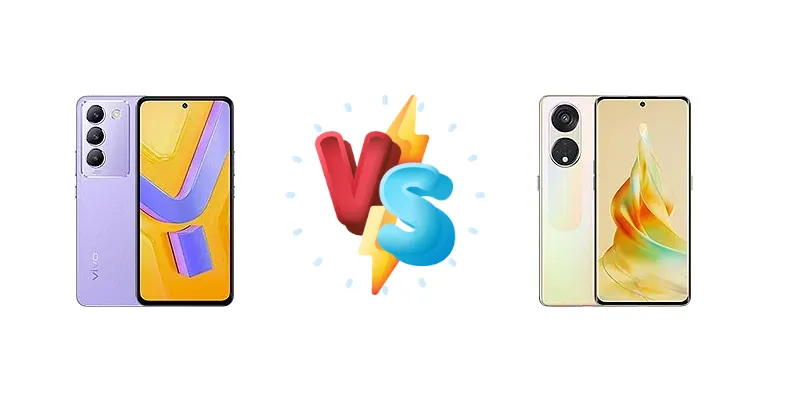
vivo Y100 (IDN) vs Oppo Reno8 T 5G: A Deep Dive into Mid-Range Performance
| Phones Images | |||||
|---|---|---|---|---|---|
|
🏆 Quick Verdict
For the average user prioritizing sustained performance and faster charging, the vivo Y100 (IDN) emerges as the stronger contender. Its Snapdragon 4 Gen 2, built on a more efficient 4nm process, offers a performance edge over the Snapdragon 695 in the Reno8 T 5G, despite the latter's 6nm fabrication. The 80W charging also significantly reduces downtime.
| PHONES | ||
|---|---|---|
| Phone Names | vivo Y100 (IDN) | Oppo Reno8 T 5G |
| Network | ||
|---|---|---|
| 2G bands | GSM 850 / 900 / 1800 / 1900 | GSM 850 / 900 / 1800 / 1900 |
| 3G bands | HSDPA 850 / 900 / 1700(AWS) / 1900 / 2100 | HSDPA 800 / 850 / 900 / 1700(AWS) / 1900 / 2100 |
| 4G bands | 1, 2, 3, 4, 5, 7, 8, 18, 19, 20, 26, 28, 38, 39, 40, 41 - Indonesia | 1, 2, 3, 4, 5, 7, 8, 12, 17, 18, 19, 20, 26, 28, 38, 39, 40, 41, 66 |
| 5G bands | 1, 3, 5, 7, 8, 20, 28, 38, 40, 41, 77, 78 SA/NSA - Indonesia | 1, 3, 5, 7, 8, 20, 28, 38, 40, 41, 66, 77, 78 SA/NSA |
| Speed | HSPA, LTE, 5G | HSPA, LTE, 5G |
| Technology | GSM / HSPA / LTE / 5G | GSM / HSPA / LTE / 5G |
| Launch | ||
|---|---|---|
| Announced | 2024, January 25 | 2023, February 01 |
| Status | Available. Released 2024, February 02 | Available. Released 2023, February 10 |
| Body | ||
|---|---|---|
| Build | Glass front, plastic or silicone polymer (eco leather) back | - |
| Dimensions | 163.2 x 75.8 x 7.8 mm (6.43 x 2.98 x 0.31 in) | 162.3 x 74.3 x 7.7 mm (6.39 x 2.93 x 0.30 in) |
| SIM | Nano-SIM + Nano-SIM | Nano-SIM + Nano-SIM |
| Weight | 185.5 g or 191 g (6.56 oz) | 171 g (6.03 oz) |
| Display | ||
|---|---|---|
| Protection | - | Asahi Glass AGC DT-Star2 |
| Resolution | 1080 x 2400 pixels, 20:9 ratio (~395 ppi density) | 1080 x 2412 pixels, 20:9 ratio (~394 ppi density) |
| Size | 6.67 inches, 107.4 cm2 (~86.8% screen-to-body ratio) | 6.7 inches, 108.0 cm2 (~89.6% screen-to-body ratio) |
| Type | AMOLED, 1B colors, 120Hz, 1200 nits (peak) | AMOLED, 1B colors, 120Hz, 500 nits (typ), 800 nits (HBM), 950 nits (peak) |
| Platform | ||
|---|---|---|
| CPU | Octa-core (2x2.2 GHz Cortex-A78 & 6x1.95 GHz Cortex-A55) | Octa-core (2x2.2 GHz Kryo 660 Gold & 6x1.7 GHz Kryo 660 Silver) |
| Chipset | Qualcomm SM4450 Snapdragon 4 Gen 2 (4 nm) | Qualcomm SM6375 Snapdragon 695 5G (6 nm) |
| GPU | Adreno 613 | Adreno 619 |
| OS | Android 14, Funtouch 14 | Android 13, upgradable to Android 14, ColorOS 14 |
| Memory | ||
|---|---|---|
| Card slot | microSDXC | microSDXC (uses shared SIM slot) |
| Internal | 128GB 8GB RAM, 256GB 8GB RAM | 128GB 8GB RAM, 256GB 8GB RAM |
| - | UFS 2.2 | |
| Main Camera | ||
|---|---|---|
| Dual | 50 MP, f/1.8, (wide), PDAF 8 MP, f/2.2, (ultrawide) | 108 MP, f/1.7, 24mm (wide), 1/1.67", 0.64µm, AF 2 MP, f/3.3, 34mm (microscope) 2 MP, f/2.4, (depth) |
| Features | LED flash, panorama, HDR | LED flash, HDR, panorama |
| Single | - | 32 MP, f/2.4, 22mm (wide) |
| Triple | - | 108 MP, f/1.7, 24mm (wide), 1/1.67", 0.64µm, AF 2 MP, f/3.3, 34mm (microscope) Auxiliary lens |
| Video | 1080p@30fps | 1080p@30fps |
| Selfie camera | ||
|---|---|---|
| Features | - | HDR, panorama |
| Single | 8 MP, f/1.8, (wide) | 32 MP, f/2.4, 22mm (wide) |
| Video | 1080p@30fps | 1080p@30fps |
| Sound | ||
|---|---|---|
| 3.5mm jack | - | No |
| 35mm jack | No | No |
| Loudspeaker | Yes, with stereo speakers | Yes, with stereo speakers |
| Comms | ||
|---|---|---|
| Bluetooth | 5.0, A2DP, LE | 5.1, A2DP, LE, aptX HD |
| NFC | Yes | Yes |
| Positioning | GPS, GLONASS, GALILEO, BDS, QZSS | GPS, GALILEO, GLONASS, BDS, QZSS |
| Radio | Unspecified | No |
| USB | USB Type-C 2.0, OTG | USB Type-C 2.0, OTG |
| WLAN | Wi-Fi 802.11 a/b/g/n/ac, dual-band | Wi-Fi 802.11 a/b/g/n/ac, dual-band |
| Features | ||
|---|---|---|
| Sensors | Fingerprint (under display, optical), accelerometer, gyro, proximity, compass | Fingerprint (under display, optical), accelerometer, gyro, proximity, compass |
| Battery | ||
|---|---|---|
| Charging | 80W wired, 45% in 15 min | 67W wired, PD, 100% in 44 min Reverse wired |
| Type | 5000 mAh | Li-Po 4800 mAh |
| Misc | ||
|---|---|---|
| Colors | Purple Orchid, Black Onyx | Black Starlight (Midnight Black), Dawn Gold (Sunrise Gold) |
| Models | V2327 | CPH2505 |
| Price | About 220 EUR | About 340 EUR |
vivo Y100 (IDN)
- Faster 80W charging significantly reduces downtime.
- More efficient Snapdragon 4 Gen 2 (4nm) chipset.
- Potentially better sustained performance due to thermal efficiency.
- Lack of reverse wireless charging.
- Camera specifications are currently unknown.
Oppo Reno8 T 5G
- Reverse wired charging for topping up other devices.
- Oppo's ColorOS is generally well-regarded for its features.
- Potentially higher refresh rate display (based on brand history).
- Slower 67W charging compared to the vivo Y100.
- Less efficient Snapdragon 695 (6nm) chipset.
- Older generation chipset may struggle with demanding tasks.
Display Comparison
Neither device's display specifications are provided, so a direct comparison is limited. However, given the price bracket, both likely utilize AMOLED panels. The Reno8 T 5G, historically, has featured higher refresh rate displays in this segment, potentially offering smoother scrolling and animations. Without specific data on peak brightness, color accuracy (DCI-P3 coverage), and PWM dimming frequency, it's difficult to definitively declare a winner. Users sensitive to flicker should investigate the PWM frequency of each device before purchasing.
Camera Comparison
Without detailed camera specifications, a comprehensive comparison is impossible. However, both phones likely feature a multi-camera setup with a primary sensor, ultrawide, and potentially a macro lens. The Reno8 T 5G often emphasizes camera features in its marketing, but sensor size and image processing algorithms are crucial. A larger sensor, combined with effective optical image stabilization (OIS), will deliver superior low-light performance. The absence of information regarding sensor sizes necessitates caution; focusing on sample images and reviews is vital. The inclusion of a 2MP macro lens on either device is likely a marketing gimmick with limited practical utility.
Performance
The core difference lies in the chipsets. The vivo Y100 (IDN) boasts the Qualcomm Snapdragon 4 Gen 2 (4nm), featuring an octa-core configuration with 2x2.2 GHz Cortex-A78 and 6x1.95 GHz Cortex-A55 cores. The Oppo Reno8 T 5G utilizes the Snapdragon 695 5G (6nm) with 2x2.2 GHz Kryo 660 Gold and 6x1.7 GHz Kryo 660 Silver cores. The 4nm process of the Snapdragon 4 Gen 2 provides a significant advantage in power efficiency, translating to less heat generation and potentially sustained performance during extended gaming sessions. While both CPUs have similar peak clock speeds, the architectural improvements in the Cortex-A78 cores within the Y100 should yield better single-core performance. The Snapdragon 695, while capable, is an older generation chipset and will likely show its age in more demanding tasks.
Battery Life
The vivo Y100 (IDN) features 80W wired charging, claiming a 45% charge in 15 minutes. The Oppo Reno8 T 5G offers 67W wired charging with PD, reaching 100% in 44 minutes, and also includes reverse wired charging. While the Reno8 T 5G's reverse charging is a convenient feature, the Y100's significantly faster charging speed is a major advantage for users who frequently need to top up their battery quickly. The actual battery capacity of both devices is unknown, but the faster charging of the Y100 effectively mitigates any potential disadvantage from a slightly smaller battery.
Buying Guide
Buy the vivo Y100 (IDN) if you need a phone that can handle demanding apps and multitasking with greater efficiency, and if minimizing charging time is a priority. Buy the Oppo Reno8 T 5G if you value reverse wireless charging and prefer a brand known for its polished software experience, even if it means sacrificing some raw processing power and charging speed.