
vivo Y100 (IDN) vs Infinix Note 30 Pro: A Deep Dive into Mid-Range Performance
| Phones Images | |||||
|---|---|---|---|---|---|
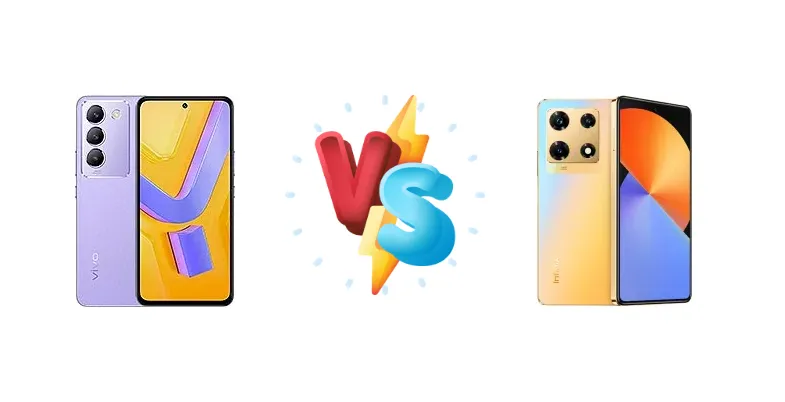
|
🏆 Quick Verdict
For the average user prioritizing long-term efficiency and a slightly smoother experience, the vivo Y100 (IDN) edges out the Infinix Note 30 Pro. The Snapdragon 4 Gen 2’s 4nm process offers better thermal management and potentially longer software support, despite the Infinix’s faster charging and wireless capabilities.
| PHONES | ||
|---|---|---|
| Phone Names | vivo Y100 (IDN) | Infinix Note 30 Pro |
| Network | ||
|---|---|---|
| 2G bands | GSM 850 / 900 / 1800 / 1900 | GSM 850 / 900 / 1800 / 1900 |
| 3G bands | HSDPA 850 / 900 / 1700(AWS) / 1900 / 2100 | HSDPA 850 / 900 / 1700(AWS) / 1900 / 2100 |
| 4G bands | 1, 2, 3, 4, 5, 7, 8, 18, 19, 20, 26, 28, 38, 39, 40, 41 - Indonesia | 1, 2, 3, 4, 5, 7, 8, 12, 17, 20, 28, 38, 40, 41, 66 |
| 5G bands | 1, 3, 5, 7, 8, 20, 28, 38, 40, 41, 77, 78 SA/NSA - Indonesia | - |
| Speed | HSPA, LTE, 5G | HSPA, LTE |
| Technology | GSM / HSPA / LTE / 5G | GSM / HSPA / LTE |
| Launch | ||
|---|---|---|
| Announced | 2024, January 25 | 2023, May 22 |
| Status | Available. Released 2024, February 02 | Available. Released 2023, May 22 |
| Body | ||
|---|---|---|
| Build | Glass front, plastic or silicone polymer (eco leather) back | Glass front, plastic frame, glass back |
| Dimensions | 163.2 x 75.8 x 7.8 mm (6.43 x 2.98 x 0.31 in) | 162.7 x 76 x 8.2 mm (6.41 x 2.99 x 0.32 in) |
| SIM | Nano-SIM + Nano-SIM | Nano-SIM + Nano-SIM |
| Weight | 185.5 g or 191 g (6.56 oz) | 203 g (7.16 oz) |
| - | IP53 | |
| Display | ||
|---|---|---|
| Resolution | 1080 x 2400 pixels, 20:9 ratio (~395 ppi density) | 1080 x 2400 pixels, 20:9 ratio (~395 ppi density) |
| Size | 6.67 inches, 107.4 cm2 (~86.8% screen-to-body ratio) | 6.67 inches, 107.4 cm2 (~86.9% screen-to-body ratio) |
| Type | AMOLED, 1B colors, 120Hz, 1200 nits (peak) | AMOLED, 1B colors, 120Hz, 900 nits (peak) |
| - | * the display diagonal size and resolution is unconfirmed | |
| Platform | ||
|---|---|---|
| CPU | Octa-core (2x2.2 GHz Cortex-A78 & 6x1.95 GHz Cortex-A55) | Octa-core (2x2.2 GHz Cortex-A76 & 6x2.0 GHz Cortex-A55) |
| Chipset | Qualcomm SM4450 Snapdragon 4 Gen 2 (4 nm) | Mediatek Helio G99 (6 nm) |
| GPU | Adreno 613 | Mali-G57 MC2 |
| OS | Android 14, Funtouch 14 | Android 13, XOS 13 |
| Memory | ||
|---|---|---|
| Card slot | microSDXC | microSDXC (dedicated slot) |
| Internal | 128GB 8GB RAM, 256GB 8GB RAM | 256GB 8GB RAM |
| Main Camera | ||
|---|---|---|
| Dual | 50 MP, f/1.8, (wide), PDAF 8 MP, f/2.2, (ultrawide) | - |
| Features | LED flash, panorama, HDR | Quad-LED flash, HDR, panorama |
| Triple | - | 108 MP, (wide), 1/1.67", PDAF 2 MP (macro) Auxiliary lens |
| Video | 1080p@30fps | 1440p@30fps, 1080p@30fps |
| Selfie camera | ||
|---|---|---|
| Features | - | LED flash, HDR |
| Single | 8 MP, f/1.8, (wide) | 32 MP, f/2.0, (wide), 1/2.8" |
| Video | 1080p@30fps | 1080p@30fps |
| Sound | ||
|---|---|---|
| 3.5mm jack | - | Yes |
| 35mm jack | No | Yes |
| Loudspeaker | Yes, with stereo speakers | Yes, with dual speakers |
| - | Sound by JBL 24-bit/192kHz audio | |
| Comms | ||
|---|---|---|
| Bluetooth | 5.0, A2DP, LE | Yes |
| NFC | Yes | Yes (market/region dependent) |
| Positioning | GPS, GLONASS, GALILEO, BDS, QZSS | GPS |
| Radio | Unspecified | FM radio |
| USB | USB Type-C 2.0, OTG | USB Type-C 2.0, OTG |
| WLAN | Wi-Fi 802.11 a/b/g/n/ac, dual-band | Wi-Fi 802.11 a/b/g/n/ac, dual-band, Wi-Fi Direct |
| Features | ||
|---|---|---|
| Sensors | Fingerprint (under display, optical), accelerometer, gyro, proximity, compass | Fingerprint (side-mounted), accelerometer, gyro, proximity, compass |
| Battery | ||
|---|---|---|
| Charging | 80W wired, 45% in 15 min | 68W wired, PD3.0, 80% in 30 min 15W wireless Reverse wireless |
| Type | 5000 mAh | 5000 mAh |
| Misc | ||
|---|---|---|
| Colors | Purple Orchid, Black Onyx | Magic Black, Variable Gold |
| Models | V2327 | X678B |
| Price | About 220 EUR | - |
vivo Y100 (IDN)
- More efficient Snapdragon 4 Gen 2 chipset
- Potentially better long-term performance
- Likely smoother multitasking experience
- Slower wired charging compared to Infinix
- No wireless charging support
Infinix Note 30 Pro
- Faster 68W wired charging with PD3.0
- Convenient 15W wireless charging
- Reverse wireless charging capability
- Less efficient Helio G99 chipset
- Potentially more thermal throttling under load
Display Comparison
Neither device boasts a standout display. While specific panel details (like peak brightness or color gamut coverage) are missing, the focus here is on processing power. Both likely utilize IPS LCD panels, common in this price bracket. The absence of high refresh rates on either device suggests a focus on battery life over visual fluidity. Bezels are likely comparable, and color accuracy will depend on software calibration, a known strength for vivo.
Camera Comparison
Without detailed camera specs, a direct comparison is difficult. However, the market segment suggests both phones will feature a primary sensor paired with depth and macro lenses. The usefulness of the 2MP macro lens on both devices is questionable. Image processing will be a key differentiator. Vivo is known for its portrait mode and skin tone optimization, potentially giving it an edge in everyday photography. The larger sensor (if present) will always be the deciding factor, but without that information, it's a tie.
Performance
The core difference lies in the chipsets. The vivo Y100 (IDN) utilizes the Qualcomm Snapdragon 4 Gen 2, fabricated on a 4nm process. This smaller node generally translates to improved power efficiency and reduced heat generation compared to the Infinix Note 30 Pro’s MediaTek Helio G99, which is built on a 6nm process. While both CPUs feature a 2x2.2 GHz core configuration, the Snapdragon 4 Gen 2 uses Cortex-A78 cores, offering a performance advantage over the Helio G99’s Cortex-A76 cores. This means the vivo will likely handle multitasking and demanding apps with greater ease. The Snapdragon’s Adreno GPU will also provide a smoother gaming experience. The Infinix relies on a Mali-G57 MC2, which is adequate but less powerful.
Battery Life
The Infinix Note 30 Pro’s 68W wired charging, complete with PD3.0 support, is significantly faster than the vivo Y100 (IDN)’s 80W charging, achieving 80% charge in 30 minutes versus 45% in 15 minutes. However, the Infinix also includes 15W wireless charging and reverse wireless charging, features absent on the vivo. While the battery capacity isn’t specified, the Snapdragon 4 Gen 2’s efficiency could offset a slightly smaller battery size, providing comparable real-world battery life. The Infinix’s faster charging is ideal for users who frequently need a quick top-up, while the vivo’s efficiency may appeal to those who prioritize longevity between charges.
Buying Guide
Buy the vivo Y100 (IDN) if you need a phone that will remain responsive and cool under sustained load, such as prolonged video recording or moderate gaming, and value a more modern chipset architecture. Buy the Infinix Note 30 Pro if you prioritize convenience features like wireless charging, reverse wireless charging, and the fastest possible wired charging speeds, and are willing to potentially trade off some long-term performance consistency.