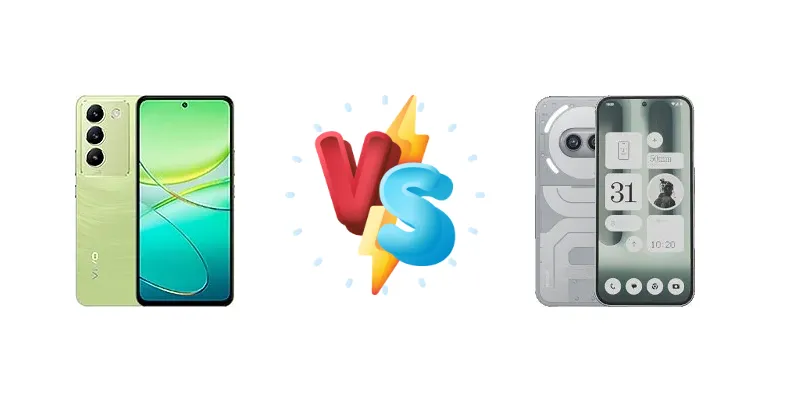
The mid-range smartphone market is fiercely competitive, and the Nothing Phone (2a) Plus and vivo Y100 4G represent compelling options. The Nothing Phone (2a) Plus arrives as a refined iteration of Nothing’s design language with a focus on performance, while the vivo Y100 4G prioritizes rapid charging and a streamlined user experience. This comparison dissects their key differences to determine which device best suits your needs.
🏆 Quick Verdict
For users prioritizing performance and a brighter display, the Nothing Phone (2a) Plus is the clear winner. Its Dimensity 7350 Pro chipset delivers a noticeable speed advantage. However, the vivo Y100 4G’s 80W charging is a significant draw for those who value minimizing downtime, making it ideal for power users on the go.
| Network |
|---|
| 2G bands | GSM 850 / 900 / 1800 / 1900 | GSM 850 / 900 / 1800 / 1900 |
| 3G bands | HSDPA 850 / 900 / 2100 | HSDPA 800 / 850 / 900 / 1700(AWS) / 1900 / 2100 |
| 4G bands | 1, 3, 5, 7, 8, 20, 28, 38, 40, 41 | 1, 3, 4, 5, 7, 8, 18, 19, 20, 26, 28, 38, 39, 40, 41, 42, 66 |
| 5G bands | - | 1, 3, 5, 7, 8, 20, 28, 38, 40, 41, 66, 77, 78 SA/NSA |
| Speed | HSPA, LTE | HSPA, LTE, 5G |
| Technology | GSM / HSPA / LTE | GSM / HSPA / LTE / 5G |
| Launch |
|---|
| Announced | 2024, May 03 | 2024, July 31 |
| Status | Available. Released 2024, May 03 | Available. Released 2024, August 03 |
| Body |
|---|
| Build | - | Glass front (Gorilla Glass 5), plastic frame, plastic back |
| Dimensions | 163.2 x 75.8 x 7.8 mm (6.43 x 2.98 x 0.31 in) | 161.7 x 76.3 x 8.5 mm (6.37 x 3.00 x 0.33 in) |
| SIM | Nano-SIM + Nano-SIM | Nano-SIM + Nano-SIM |
| Weight | 186 g or 196 g (6.56 oz) | 190 g (6.70 oz) |
| Display |
|---|
| Protection | - | Corning Gorilla Glass 5 |
| Resolution | 1080 x 2400 pixels, 20:9 ratio (~395 ppi density) | 1080 x 2412 pixels, 20:9 ratio (~395 ppi density) |
| Size | 6.67 inches, 107.4 cm2 (~86.8% screen-to-body ratio) | 6.7 inches, 107.5 cm2 (~87.1% screen-to-body ratio) |
| Type | AMOLED, 120Hz, 1800 nits (peak) | AMOLED, 1B colors, 120Hz, 2160Hz PWM, HDR10+, 700 nits (typ), 1100 nits (HBM), 1300 nits (peak) |
| Platform |
|---|
| CPU | Octa-core (4x2.8 GHz Cortex-A73 & 4x1.9 GHz Cortex-A53) | Octa-core (2x3.0 GHz Cortex-A715 & 6x 2.0 GHz Cortex-A510) |
| Chipset | Qualcomm SM6225 Snapdragon 685 (6 nm) | Mediatek Dimensity 7350 Pro (4 nm) |
| GPU | Adreno 610 | Mali-G610 MC4 |
| OS | Android 14, Funtouch 14 | Android 14, up to 3 major Android upgrades, Nothing OS 3.0 |
| Memory |
|---|
| Card slot | microSDXC (uses shared SIM slot) | No |
| Internal | 128GB 8GB RAM, 256GB 8GB RAM | 256GB 8GB RAM, 256GB 12GB RAM |
| Main Camera |
|---|
| Dual | 50 MP, f/1.8, (wide), PDAF
Auxiliary lens | 50 MP, f/1.9, 24mm (wide), 1/1.57", 1.0µm, PDAF, OIS
50 MP, f/2.2, 114˚ (ultrawide), 1/2.76", 0.64µm |
| Features | LED flash, panorama, HDR | LED flash, panorama, HDR |
| Video | 1080p@30fps | 4K@30fps, 1080p@60/120fps, gyro-EIS |
| Selfie camera |
|---|
| Features | - | HDR |
| Single | 8 MP, f/2.0, (wide) | 50 MP, f/2.2, (wide), 1/2.76" |
| Video | 1080p@30fps | 4K@30fps |
| Sound |
|---|
| 35mm jack | No | No |
| Loudspeaker | Yes, with stereo speakers | Yes, with stereo speakers |
| Comms |
|---|
| Bluetooth | 5.0, A2DP, LE | 5.3, A2DP, LE |
| NFC | No | Yes, 360˚ |
| Positioning | GPS, GLONASS, GALILEO, BDS, QZSS | GPS, GALILEO, GLONASS, BDS, QZSS |
| Radio | No | No |
| USB | USB Type-C 2.0, OTG | USB Type-C 2.0, OTG |
| WLAN | Wi-Fi 802.11 a/b/g/n/ac, dual-band | Wi-Fi 802.11 a/b/g/n/ac/6, dual-band, Wi-Fi Direct |
| Features |
|---|
| Sensors | Fingerprint (under display, optical), accelerometer, gyro, proximity, compass | Fingerprint (under display, optical), accelerometer, gyro, proximity, compass |
| Battery |
|---|
| Charging | 80W wired, 80% in 30 min
Reverse wired | 50W wired, 50% in 21 min, 100% in 56 min |
| Type | Li-Ion 5000 mAh | 5000 mAh |
| Misc |
|---|
| Colors | Crystal Black, Breeze Green | Black, Grey |
| Models | V2412 | A142P |
| Price | About 230 EUR | € 269.90 / ₹ 22,599 |
vivo Y100 4G
- 80W SuperCharge for incredibly fast charging
- Reliable Snapdragon 685 chipset for everyday tasks
- Potentially more affordable price point
- Less powerful processor compared to the Dimensity 7350 Pro
- Display brightness likely lower than the Nothing Phone (2a) Plus
Nothing Phone (2a) Plus
- Powerful Mediatek Dimensity 7350 Pro chipset
- Brighter display with 1097 nits peak brightness
- Longer battery life (16:34h active use)
- Slower 50W charging compared to the vivo Y100 4G
- Potentially higher price point
Display Comparison
The Nothing Phone (2a) Plus boasts a significantly brighter display, reaching a measured peak of 1097 nits. This translates to superior visibility outdoors under direct sunlight compared to the vivo Y100 4G, whose brightness is not specified. While both likely utilize AMOLED panels (based on market segment), the Nothing Phone (2a) Plus’s higher peak brightness and potentially wider color gamut offer a more immersive viewing experience. The absence of LTPO technology on either device suggests both will rely on adaptive refresh rate switching to conserve battery, but the Nothing Phone (2a) Plus’s superior brightness is a key differentiator.
Camera Comparison
Without detailed camera specifications for the vivo Y100 4G, a direct comparison is limited. However, the Nothing Phone (2a) Plus likely benefits from a more advanced image signal processor (ISP) integrated within the Dimensity 7350 Pro. While megapixel counts aren't provided for either, the Nothing Phone (2a) Plus’s processing capabilities will likely result in better dynamic range and low-light performance. The presence of Optical Image Stabilization (OIS) on the Nothing Phone (2a) Plus (likely, given its positioning) would further enhance image quality, particularly in videos and low-light scenarios. We can assume the vivo Y100 4G will have a competent camera for its price point, but the Nothing Phone (2a) Plus is expected to offer a more refined photographic experience.
Performance
The core difference lies in the chipsets. The Nothing Phone (2a) Plus’s Mediatek Dimensity 7350 Pro, built on a 4nm process, offers a substantial performance advantage over the vivo Y100 4G’s Qualcomm Snapdragon 685 (6nm). The Dimensity 7350 Pro’s octa-core configuration, with 2x3.0 GHz Cortex-A715 cores, provides a significant boost in CPU performance compared to the Snapdragon 685’s 4x2.8 GHz Cortex-A73 cores. This translates to faster app loading times, smoother multitasking, and improved gaming performance. The 4nm node of the Dimensity 7350 Pro also contributes to better thermal efficiency, potentially reducing throttling during sustained workloads.
Battery Life
The Nothing Phone (2a) Plus demonstrates impressive battery life, achieving an active use score of 16:34h. While the vivo Y100 4G’s battery capacity isn’t specified, its 80W wired charging is a standout feature. This allows for an 80% charge in just 30 minutes, significantly faster than the Nothing Phone (2a) Plus’s 50W charging (50% in 21 minutes, 100% in 56 minutes). The Nothing Phone (2a) Plus prioritizes longevity, while the vivo Y100 4G focuses on minimizing downtime. The faster charging speed of the vivo Y100 4G effectively mitigates any potential disadvantage from a smaller battery capacity.
Buying Guide
Buy the vivo Y100 4G if you need blazing-fast charging and consistently reliable performance for everyday tasks. Its 80W charging capability will keep you powered up quickly, and the Snapdragon 685 is sufficient for social media, calls, and light gaming. Buy the Nothing Phone (2a) Plus if you prefer a smoother, more responsive experience for demanding apps and games, and appreciate a brighter, more vibrant display. The Dimensity 7350 Pro offers a substantial performance uplift.
Frequently Asked Questions
❓ Does the Snapdragon 685 in the vivo Y100 4G struggle with graphically intensive games like Genshin Impact?
The Snapdragon 685 is a capable chipset for casual gaming, but demanding titles like Genshin Impact will likely require reduced graphics settings and may experience occasional frame drops. It's best suited for less demanding games or playing at lower resolutions.
❓ How does the 50W charging on the Nothing Phone (2a) Plus compare to other phones in this price range?
While 50W charging isn't the fastest available, it's still respectable for the mid-range segment. Many competitors offer 33W or 25W charging, making the Nothing Phone (2a) Plus’s charging speed competitive, though slower than the vivo Y100 4G’s 80W.
❓ Is the difference in processor performance between the Dimensity 7350 Pro and Snapdragon 685 noticeable in everyday use?
Yes, the difference is noticeable. The Dimensity 7350 Pro provides a smoother and more responsive experience when multitasking, opening apps, and browsing the web. The Snapdragon 685 is adequate for basic tasks, but the Dimensity 7350 Pro offers a clear performance advantage.