
Google Pixel 7a vs. vivo Y100 4G: A Detailed Comparison of Mid-Range Contenders
| Phones Images | |||||
|---|---|---|---|---|---|
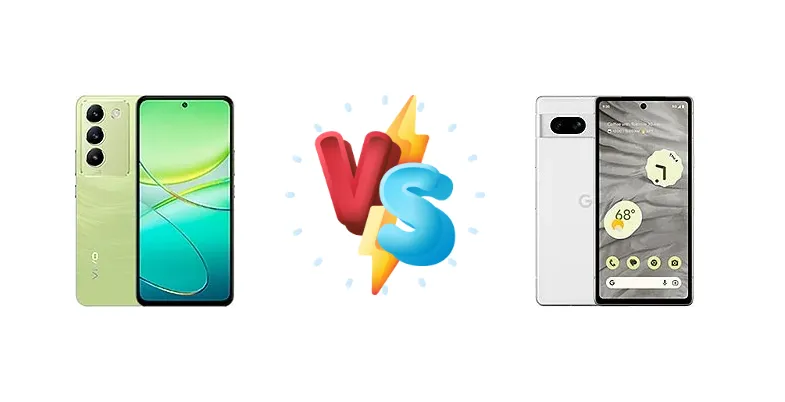
|
🏆 Quick Verdict
For the average user prioritizing camera quality and software experience, the Google Pixel 7a is the clear winner. Its Tensor G2 chipset and exceptional image processing capabilities significantly outperform the vivo Y100 4G’s Snapdragon 685. However, the vivo Y100 4G’s 80W charging is a compelling advantage for those who value speed and convenience.
| PHONES | ||
|---|---|---|
| Phone Names | vivo Y100 4G | Google Pixel 7a |
| Network | ||
|---|---|---|
| 2G bands | GSM 850 / 900 / 1800 / 1900 | GSM 850 / 900 / 1800 / 1900 |
| 3G bands | HSDPA 850 / 900 / 2100 | HSDPA 800 / 850 / 900 / 1700(AWS) / 1900 / 2100 |
| 4G bands | 1, 3, 5, 7, 8, 20, 28, 38, 40, 41 | 1, 2, 3, 4, 5, 7, 8, 12, 13, 14, 17, 20, 25, 26, 28, 29, 30, 38, 40, 41, 48, 66, 71 - GWKK3, G0DZQ |
| 5G bands | - | 1, 2, 3, 5, 7, 8, 12, 14, 20, 25, 28, 30, 38, 41, 48, 66, 71, 77, 78 SA/NSA/Sub6 - GWKK3 |
| Speed | HSPA, LTE | HSPA, LTE, 5G |
| Technology | GSM / HSPA / LTE | GSM / HSPA / LTE / 5G |
| - | 1, 2, 3, 5, 7, 8, 12, 20, 25, 28, 38, 40, 41, 66, 75, 76, 77, 78, 79 SA/NSA/Sub6 - GHL1X, G82U8 | |
| Launch | ||
|---|---|---|
| Announced | 2024, May 03 | 2023, May 10 |
| Status | Available. Released 2024, May 03 | Available. Released 2023, May 10 |
| Body | ||
|---|---|---|
| Build | - | Glass front (Gorilla Glass 3), aluminum frame, plastic back |
| Dimensions | 163.2 x 75.8 x 7.8 mm (6.43 x 2.98 x 0.31 in) | 152 x 72.9 x 9 mm (5.98 x 2.87 x 0.35 in) |
| SIM | Nano-SIM + Nano-SIM | Nano-SIM + eSIM |
| Weight | 186 g or 196 g (6.56 oz) | 193.5 g (6.84 oz) |
| - | IP67 dust/water resistant (up to 1m for 30 min) | |
| Display | ||
|---|---|---|
| Protection | - | Corning Gorilla Glass 3 |
| Resolution | 1080 x 2400 pixels, 20:9 ratio (~395 ppi density) | 1080 x 2400 pixels, 20:9 ratio (~429 ppi density) |
| Size | 6.67 inches, 107.4 cm2 (~86.8% screen-to-body ratio) | 6.1 inches, 90.7 cm2 (~81.8% screen-to-body ratio) |
| Type | AMOLED, 120Hz, 1800 nits (peak) | OLED, HDR, 90Hz |
| - | Always-on display | |
| Platform | ||
|---|---|---|
| CPU | Octa-core (4x2.8 GHz Cortex-A73 & 4x1.9 GHz Cortex-A53) | Octa-core (2x2.85 GHz Cortex-X1 & 2x2.35 GHz Cortex-A78 & 4x1.80 GHz Cortex-A55) |
| Chipset | Qualcomm SM6225 Snapdragon 685 (6 nm) | Google Tensor G2 (5 nm) |
| GPU | Adreno 610 | Mali-G710 MP7 |
| OS | Android 14, Funtouch 14 | Android 13, upgradable to Android 15, up to 5 major Android upgrades |
| Memory | ||
|---|---|---|
| Card slot | microSDXC (uses shared SIM slot) | No |
| Internal | 128GB 8GB RAM, 256GB 8GB RAM | 128GB 8GB RAM |
| - | UFS 3.1 | |
| Main Camera | ||
|---|---|---|
| Dual | 50 MP, f/1.8, (wide), PDAF Auxiliary lens | 64 MP, f/1.9, 26mm (wide), 1/1.73", 0.8µm, dual pixel PDAF, OIS 13 MP, f/2.2, 120˚ (ultrawide), 1.12µm |
| Features | LED flash, panorama, HDR | Dual-LED flash, Pixel Shift, Auto-HDR, panorama |
| Video | 1080p@30fps | 4K@30/60fps, 1080p@30/60/120/240fps, OIS |
| Selfie camera | ||
|---|---|---|
| Features | - | HDR, panorama |
| Single | 8 MP, f/2.0, (wide) | 13 MP, f/2.2, 20mm (ultrawide), 1.12µm |
| Video | 1080p@30fps | 4K@30fps, 1080p@30fps |
| Sound | ||
|---|---|---|
| 3.5mm jack | - | No |
| 35mm jack | No | No |
| Loudspeaker | Yes, with stereo speakers | Yes, with stereo speakers |
| Comms | ||
|---|---|---|
| Bluetooth | 5.0, A2DP, LE | 5.3, A2DP, LE |
| NFC | No | Yes |
| Positioning | GPS, GLONASS, GALILEO, BDS, QZSS | GPS, GLONASS, GALILEO, BDS, QZSS, NavIC |
| Radio | No | No |
| USB | USB Type-C 2.0, OTG | USB Type-C 3.2 |
| WLAN | Wi-Fi 802.11 a/b/g/n/ac, dual-band | Wi-Fi 802.11 a/b/g/n/ac/6e, tri-band |
| Features | ||
|---|---|---|
| Sensors | Fingerprint (under display, optical), accelerometer, gyro, proximity, compass | Fingerprint (under display, optical), accelerometer, gyro, proximity, compass, barometer |
| Battery | ||
|---|---|---|
| Charging | 80W wired, 80% in 30 min Reverse wired | 18W wired, PD3.0 7.5W wireless |
| Type | Li-Ion 5000 mAh | Li-Po 4385 mAh |
| Misc | ||
|---|---|---|
| Colors | Crystal Black, Breeze Green | Charcoal, Snow, Sea, Coral |
| Models | V2412 | GWKK3, GHL1X, G0DZQ, G82U8 |
| Price | About 230 EUR | € 179.90 / $ 150.00 / £ 170.00 / ₹ 25,980 |
vivo Y100 4G
- Superior camera performance and image processing
- Faster and more efficient Tensor G2 chipset
- Guaranteed software updates and Google’s AI features
- Slower 18W charging
- Potentially shorter battery life compared to vivo
Google Pixel 7a
- Blazing-fast 80W wired charging
- Reverse wired charging capability
- Potentially more affordable price point
- Less powerful Snapdragon 685 chipset
- Inferior camera performance compared to Pixel 7a
Display Comparison
The Pixel 7a boasts a peak brightness of 1070 nits, offering excellent visibility in direct sunlight, a metric the vivo Y100 4G’s display specifications don’t directly address. While the Y100 4G’s panel details are absent, the Pixel 7a’s OLED technology delivers vibrant colors and deep blacks. The absence of LTPO on either device suggests neither offers adaptive refresh rates for power saving, but the Pixel 7a’s higher peak brightness is a significant advantage for outdoor use.
Camera Comparison
The Pixel 7a’s camera system is a standout feature, leveraging Google’s computational photography expertise. While specific sensor details are missing for both, the Pixel 7a’s image processing is renowned for its dynamic range, accurate colors, and excellent low-light performance. The vivo Y100 4G likely focuses on more conventional image processing, potentially prioritizing brighter, more saturated images. The Pixel 7a’s video capabilities are also expected to be superior, benefiting from the Tensor G2’s image signal processor (ISP). We can assume the Pixel 7a will offer more advanced features like Magic Eraser and Photo Unblur.
Performance
The core difference lies in the chipsets: Google’s Tensor G2 (5nm) versus Qualcomm’s Snapdragon 685 (6nm). The Tensor G2, with its Cortex-X1 prime core clocked at 2.85 GHz, offers substantially more processing power than the Snapdragon 685’s Cortex-A73 cores peaking at 2.8 GHz. The 5nm fabrication process of the Tensor G2 also contributes to better thermal efficiency, potentially reducing throttling during sustained workloads. While the Snapdragon 685 is adequate for everyday tasks, the Tensor G2 provides a smoother experience with demanding apps and games. The Pixel 7a’s likely use of faster LPDDR5x RAM further enhances its performance advantage.
Battery Life
The Pixel 7a has an endurance rating of 76 hours, indicating respectable battery life. However, the vivo Y100 4G’s 80W wired charging is a game-changer, capable of charging from 0% to 80% in just 30 minutes. The Pixel 7a’s 18W charging, while supporting PD3.0, is significantly slower. This difference in charging speed is a major consideration for users who prioritize convenience and quick top-ups. The Y100 4G also offers reverse wired charging, a feature absent on the Pixel 7a.
Buying Guide
Buy the vivo Y100 4G if you need exceptionally fast charging and a dependable, if less powerful, daily driver. It’s ideal for users who frequently find themselves needing to top up their battery quickly and don’t heavily rely on demanding applications. Buy the Google Pixel 7a if you prioritize camera performance, a smooth software experience with guaranteed updates, and the benefits of Google’s AI-powered features, even if it means slower charging and potentially shorter battery endurance.