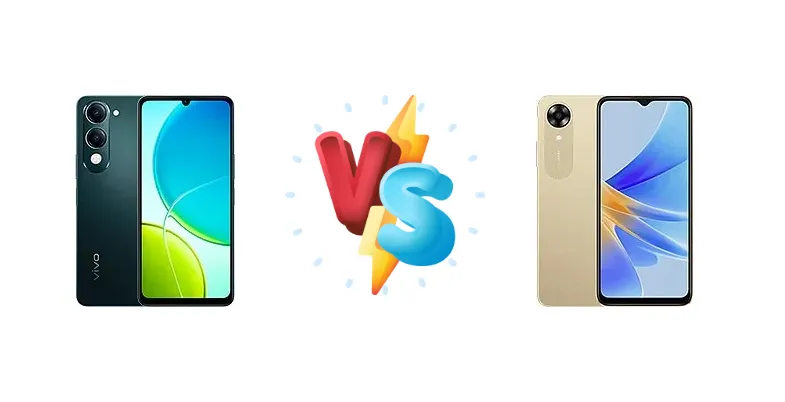
The sub-$150 smartphone market is fiercely competitive, and the vivo Y04 and Oppo A17k represent two compelling options for users prioritizing affordability. While both devices aim to deliver essential smartphone functionality, they diverge significantly in their core processing power and battery optimization strategies. This comparison dissects these differences to determine which phone offers the best value.
🏆 Quick Verdict
For the average user seeking all-day battery life and a generally smoother experience, the vivo Y04 is the better choice. Its Unisoc T7225 chipset, while not a performance king, offers a more balanced architecture than the Oppo A17k’s Helio G35, resulting in better sustained performance and a remarkable 52.40-hour endurance rating.
| Network |
|---|
| 2G bands | GSM 850 / 900 / 1800 / 1900 | GSM 850 / 900 / 1800 / 1900 |
| 3G bands | HSDPA 850 / 900 / 2100 | HSDPA 850 / 900 / 2100 |
| 4G bands | 1, 3, 5, 7, 8, 20, 28, 38, 40, 41 - International | 1, 3, 5, 8, 38, 40, 41 |
| Speed | HSPA, LTE | HSPA, LTE |
| Technology | GSM / HSPA / LTE | GSM / HSPA / LTE |
| Launch |
|---|
| Announced | 2025, February 26 | 2022, October 13 |
| Status | Available. Released 2025, March 11 | Available. Released 2022, October 18 |
| Body |
|---|
| Build | Glass front, plastic frame, plastic back | - |
| Dimensions | 167.3 x 77 x 8.2 mm (6.59 x 3.03 x 0.32 in) | 164.2 x 75.6 x 8.3 mm (6.46 x 2.98 x 0.33 in) |
| SIM | Nano-SIM + Nano-SIM | Nano-SIM + Nano-SIM |
| Weight | 199 g (7.02 oz) | 189 g (6.67 oz) |
| | - | IPX4 water resistance |
| Display |
|---|
| Protection | Mohs level 5 | Panda Glass |
| Resolution | 720 x 1600 pixels, 20:9 ratio (~260 ppi density) | 720 x 1612 pixels, 20:9 ratio (~269 ppi density) |
| Size | 6.74 inches, 109.7 cm2 (~85.1% screen-to-body ratio) | 6.56 inches, 103.4 cm2 (~83.3% screen-to-body ratio) |
| Type | IPS LCD, 90Hz, 570 nits (HBM) | IPS LCD, 480 nits (typ), 600 nits (HBM) |
| Platform |
|---|
| CPU | Octa-core (2x2.0 GHz Cortex-A75 & 6x1.8 GHz Cortex-A55) | Octa-core (4x2.3 GHz Cortex-A53 & 4x1.8 GHz Cortex-A53) |
| Chipset | Unisoc T7225 (12 nm) | Mediatek MT6765 Helio G35 (12 nm) |
| GPU | Mali-G52 MP1 | PowerVR GE8320 |
| OS | Android 14, Funtouch 14 | Android 12, ColorOS 12.1 |
| Memory |
|---|
| Card slot | microSDXC (dedicated slot) | microSDXC |
| Internal | 64GB 4GB RAM, 128GB 4GB RAM, 128GB 6GB RAM, 256GB 4GB RAM | 64GB 3GB RAM |
| | - | eMMC 5.1 |
| Main Camera |
|---|
| Features | LED flash, panorama | LED flash, panorama |
| Single | 13 MP, f/2.2, (wide), PDAF
Auxiliary lens | 8 MP, f/2.0, (wide), AF |
| Video | 1080p@30fps | 1080p@30fps |
| Selfie camera |
|---|
| Single | 5 MP, f/2.2, (wide) | 5 MP, f/2.2, (wide) |
| Video | Yes | 1080p@30fps |
| Sound |
|---|
| 3.5mm jack | - | Yes |
| 35mm jack | Yes | Yes |
| Loudspeaker | Yes, with stereo speakers | Yes |
| Comms |
|---|
| Bluetooth | 5.2, A2DP, LE | 5.3, A2DP, LE, aptX HD |
| NFC | No | No |
| Positioning | GPS, GALILEO, GLONASS, BDS, QZSS | GPS, GLONASS, BDS, GALILEO |
| Radio | FM radio | Unspecified |
| USB | USB Type-C 2.0, OTG | microUSB 2.0, OTG |
| WLAN | Wi-Fi 802.11 a/b/g/n/ac, dual-band | Wi-Fi 802.11 a/b/g/n/ac, dual-band |
| Features |
|---|
| Sensors | Fingerprint (side-mounted), accelerometer, proximity, compass | Fingerprint (side-mounted), accelerometer, proximity, compass |
| Battery |
|---|
| Charging | 15W wired | - |
| Type | Li-Ion 5500 mAh | Li-Po 5000 mAh |
| Misc |
|---|
| Colors | Titanium Gold (Titanium Silver), Dark Green (Majestic Green), Violet | Navy Blue, Gold |
| Models | V2430 | CPH2471 |
| Price | About 110 EUR | About 130 EUR |
| SAR | 0.97 W/kg (head) 0.93 W/kg (body) | - |
| EU LABEL |
|---|
| Battery | 52:40h endurance, 1000 cycles | - |
| Energy | Class A | - |
| Free fall | Class A (300 falls) | - |
| Repairability | Class B | - |
vivo Y04
- Exceptional battery life (52.40h endurance)
- More efficient CPU architecture (Unisoc T7225)
- Longer battery lifespan (1000 charge cycles)
- Potentially lower peak CPU performance
- Camera specs are unknown
Oppo A17k
- Higher peak CPU clock speed (2.3 GHz)
- Potentially lower initial price
- Familiar MediaTek chipset
- Less efficient CPU architecture (Helio G35)
- Shorter battery life expected
- Older Cortex-A53 cores
Display Comparison
Neither device boasts a standout display. Given the price point, we can assume both utilize LCD panels, likely with 720p+ resolution. Details regarding brightness and color accuracy are unavailable, but both will likely suffice for basic viewing. The focus here is on efficiency, not visual fidelity.
Camera Comparison
Both phones likely feature basic camera setups, and detailed sensor information is lacking. It's safe to assume both include a primary camera and potentially a depth or macro sensor. Without specific megapixel counts or aperture details, a direct comparison is difficult. However, given the target market, image processing will likely be similar, focusing on basic scene optimization rather than advanced computational photography. The quality will be adequate for social media sharing in good lighting conditions.
Performance
The core difference lies in the chipsets. The vivo Y04’s Unisoc T7225 employs a big.LITTLE architecture with 2x 2.0 GHz Cortex-A75 cores and 6x 1.8 GHz Cortex-A55 cores. This configuration prioritizes efficiency and responsiveness for common tasks. Conversely, the Oppo A17k’s MediaTek Helio G35 uses 4x 2.3 GHz Cortex-A53 cores and 4x 1.8 GHz Cortex-A53 cores. While the G35 boasts a higher peak clock speed, the older A53 architecture is less efficient and offers lower IPC (Instructions Per Clock) than the A75 cores in the Y04. This translates to potentially faster burst performance on the A17k, but the Y04 will likely maintain smoother operation during prolonged use. The Y04's architecture is better suited for multitasking and sustained workloads.
Battery Life
The vivo Y04’s 52.40-hour endurance rating is a significant advantage. This suggests excellent power management and optimization, likely stemming from the more efficient Unisoc T7225 chipset. The Oppo A17k’s battery capacity is unknown, but given the less efficient chipset, it will almost certainly fall short of the Y04’s longevity. The Y04 also supports 1000 charge cycles, indicating a longer lifespan before significant battery degradation. While both offer 15W wired charging, the Y04’s larger endurance buffer means you’ll need to charge it less frequently.
Buying Guide
Buy the vivo Y04 if you need exceptional battery life and a more modern CPU architecture for handling everyday tasks and light multitasking. This phone is ideal for users who prioritize longevity and reliability over raw processing power. Buy the Oppo A17k if you prefer a slightly higher clock speed on some cores, potentially benefiting very basic, single-threaded applications, but be prepared for shorter battery life and potentially more noticeable slowdowns under sustained load.
Frequently Asked Questions
❓ Will the Unisoc T7225 in the vivo Y04 struggle with popular apps like WhatsApp and Facebook?
No, the Unisoc T7225 is more than capable of handling everyday applications like WhatsApp, Facebook, and web browsing. Its Cortex-A75 cores provide a noticeable performance boost over the older Cortex-A53 cores found in the Oppo A17k, ensuring a smoother and more responsive experience even with multiple apps open.
❓ How much faster is the charging on either phone, and will 15W charging take a long time to fully charge the battery?
Both phones utilize 15W wired charging. While not the fastest charging available, it's adequate for this price segment. The vivo Y04’s superior battery endurance means you’ll charge it less frequently, mitigating the slower charging speed. A full charge will likely take around 2-3 hours for both devices.
❓ Is the difference in CPU architecture (A75 vs A53) noticeable in real-world use?
Yes, the difference is noticeable, particularly during multitasking and sustained use. The A75 cores in the Y04 are more efficient and offer higher IPC, resulting in smoother app switching and less lag when running multiple applications simultaneously. The A53 cores in the A17k will likely struggle more under similar workloads.