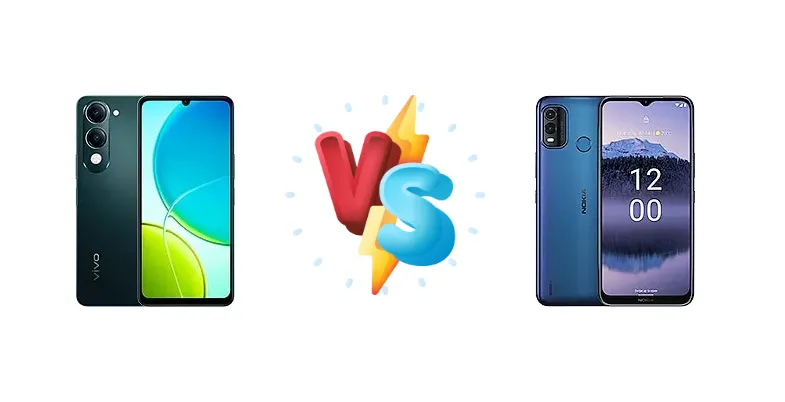
The sub-$150 smartphone market is fiercely competitive. Both the vivo Y04 and Nokia G11 Plus aim to deliver essential smartphone functionality at an accessible price point. However, they take different approaches, with the Y04 prioritizing processing power and endurance, while the G11 Plus focuses on a more streamlined experience. This comparison dissects their key specifications to determine which device best suits your needs.
🏆 Quick Verdict
For most users, the vivo Y04 emerges as the stronger choice. Its Unisoc T7225 chipset, featuring faster Cortex-A75 cores, provides a noticeable performance edge over the Nokia G11 Plus’s T606. Coupled with a significantly longer battery endurance rating of 52:40h, the Y04 offers a more responsive and reliable experience.
| Network |
|---|
| 2G bands | GSM 850 / 900 / 1800 / 1900 | GSM 850 / 900 / 1800 / 1900 |
| 3G bands | HSDPA 850 / 900 / 2100 | HSDPA 850 / 900 / 2100 - International |
| 4G bands | 1, 3, 5, 7, 8, 20, 28, 38, 40, 41 - International | 1, 3, 5, 7, 8, 20, 28, 38, 40, 41 - International |
| Speed | HSPA, LTE | HSPA 42.2/5.76 Mbps, LTE Cat4 150/50 Mbps |
| Technology | GSM / HSPA / LTE | GSM / HSPA / LTE |
| | - | 1, 3, 5, 8, 40, 41 - India |
| Launch |
|---|
| Announced | 2025, February 26 | 2022, June 29 |
| Status | Available. Released 2025, March 11 | Available. Released 2022, July 20 |
| Body |
|---|
| Build | Glass front, plastic frame, plastic back | Glass front, plastic frame, plastic back |
| Dimensions | 167.3 x 77 x 8.2 mm (6.59 x 3.03 x 0.32 in) | 164.8 x 75.9 x 8.6 mm (6.49 x 2.99 x 0.34 in) |
| SIM | Nano-SIM + Nano-SIM | · Nano-SIM· Nano-SIM + Nano-SIM |
| Weight | 199 g (7.02 oz) | 192 g (6.77 oz) |
| | - | Splash protection |
| Display |
|---|
| Protection | Mohs level 5 | - |
| Resolution | 720 x 1600 pixels, 20:9 ratio (~260 ppi density) | 720 x 1600 pixels, 20:9 ratio (~269 ppi density) |
| Size | 6.74 inches, 109.7 cm2 (~85.1% screen-to-body ratio) | 6.52 inches, 102.6 cm2 (~82.1% screen-to-body ratio) |
| Type | IPS LCD, 90Hz, 570 nits (HBM) | IPS LCD, 90Hz, 400 nits (typ) |
| Platform |
|---|
| CPU | Octa-core (2x2.0 GHz Cortex-A75 & 6x1.8 GHz Cortex-A55) | Octa-core (2x1.6 GHz Cortex-A75 & 6x1.6 GHz Cortex-A55) |
| Chipset | Unisoc T7225 (12 nm) | Unisoc T606 (12 nm) |
| GPU | Mali-G52 MP1 | Mali-G57 MP1 |
| OS | Android 14, Funtouch 14 | Android 12, upgradable to Android 13 |
| Memory |
|---|
| Card slot | microSDXC (dedicated slot) | microSDXC (dedicated slot) |
| Internal | 64GB 4GB RAM, 128GB 4GB RAM, 128GB 6GB RAM, 256GB 4GB RAM | 32GB 3GB RAM, 64GB 3GB RAM, 64GB 4GB RAM, 128GB 3GB RAM |
| | - | eMMC 5.1 |
| Main Camera |
|---|
| Dual | - | 50 MP, f/1.8, (wide), 1/2.67", PDAF
Auxiliary lens |
| Features | LED flash, panorama | LED flash |
| Single | 13 MP, f/2.2, (wide), PDAF
Auxiliary lens | 8 MP, f/2.0, (wide), 1/4.0" |
| Video | 1080p@30fps | 1080p@30fps |
| Selfie camera |
|---|
| Single | 5 MP, f/2.2, (wide) | 8 MP, f/2.0, (wide), 1/4.0" |
| Video | Yes | 1080p@30fps |
| Sound |
|---|
| 3.5mm jack | - | Yes |
| 35mm jack | Yes | Yes |
| Loudspeaker | Yes, with stereo speakers | Yes |
| Comms |
|---|
| Bluetooth | 5.2, A2DP, LE | 5.0, A2DP, LE |
| NFC | No | No |
| Positioning | GPS, GALILEO, GLONASS, BDS, QZSS | GPS |
| Radio | FM radio | FM radio |
| USB | USB Type-C 2.0, OTG | USB Type-C 2.0, OTG |
| WLAN | Wi-Fi 802.11 a/b/g/n/ac, dual-band | Wi-Fi 802.11 a/b/g/n/ac, dual-band, Wi-Fi Direct |
| Features |
|---|
| Sensors | Fingerprint (side-mounted), accelerometer, proximity, compass | Fingerprint (rear-mounted), accelerometer, proximity |
| Battery |
|---|
| Charging | 15W wired | 10W wired |
| Type | Li-Ion 5500 mAh | Li-Ion 5000 mAh |
| Misc |
|---|
| Colors | Titanium Gold (Titanium Silver), Dark Green (Majestic Green), Violet | Lake Blue, Charcoal Grey |
| Models | V2430 | - |
| Price | About 110 EUR | About 130 EUR |
| SAR | 0.97 W/kg (head) 0.93 W/kg (body) | - |
| EU LABEL |
|---|
| Battery | 52:40h endurance, 1000 cycles | - |
| Energy | Class A | - |
| Free fall | Class A (300 falls) | - |
| Repairability | Class B | - |
vivo Y04
- Faster processor for smoother performance
- Significantly longer battery life (52:40h endurance)
- Faster 15W wired charging
- May run a more heavily customized version of Android
- Camera performance likely similar to the G11 Plus
Nokia G11 Plus
- Clean Android experience (likely)
- Potentially more software updates from Nokia
- Simple and straightforward user interface
- Slower processor for less responsive performance
- Shorter battery life
- Slower 10W wired charging
Display Comparison
Neither device boasts a standout display. Both likely utilize LCD panels, common in this price bracket. The focus here isn't on visual fidelity, but on functionality. Without specific display specs, it's difficult to differentiate, but the Y04's slightly higher processing power *could* translate to smoother scrolling and animations, even with a similar panel.
Camera Comparison
Both phones likely feature modest camera setups geared towards casual photography. Without detailed sensor information, it’s difficult to make a definitive judgment. However, the inclusion of a 2MP macro lens on both devices is largely a marketing tactic; image quality from such sensors is typically underwhelming. The primary sensor’s quality and image processing algorithms will be the deciding factors, and without further data, we can only assume they are similarly matched in this segment.
Performance
The core difference lies in the chipsets. The vivo Y04’s Unisoc T7225 features two Cortex-A75 cores clocked at 2.0 GHz, compared to the Nokia G11 Plus’s T606 with 1.6 GHz Cortex-A75 cores. This 0.4 GHz difference, combined with the higher clock speed of the efficiency cores (1.8 GHz vs 1.6 GHz), translates to a tangible performance advantage for the Y04 in CPU-intensive tasks. While both are 12nm chips, the architectural improvements in the T7225 provide a more responsive user experience. The G11 Plus will handle basic tasks, but the Y04 will feel snappier when switching between apps or loading more demanding content.
Battery Life
The vivo Y04 significantly outperforms the Nokia G11 Plus in battery endurance, boasting a tested 52:40h runtime. While the G11 Plus’s battery capacity isn’t specified, the Y04’s endurance suggests a well-optimized combination of hardware and software. Furthermore, the Y04 supports 15W wired charging, compared to the G11 Plus’s slower 10W charging. This means the Y04 will replenish its battery faster, minimizing downtime. The 15W charging, while not fast by modern standards, is a clear advantage over the G11 Plus’s 10W offering.
Buying Guide
Buy the vivo Y04 if you frequently multitask, play casual games, or need a phone that can reliably last through a full day of heavy use. The faster processor and superior battery endurance make it ideal for power users on a budget. Buy the Nokia G11 Plus if you prioritize simplicity and a clean Android experience, and your smartphone usage is primarily limited to basic tasks like calls, texts, and light browsing. The G11 Plus offers a functional experience, but sacrifices performance for a potentially smoother, less demanding software experience.
Frequently Asked Questions
❓ Will the Unisoc T7225 in the vivo Y04 handle popular games like PUBG Mobile?
While the T7225 isn't a gaming powerhouse, it should be capable of running PUBG Mobile at lower settings. Expect playable frame rates with reduced graphics quality. The Nokia G11 Plus’s T606 will likely struggle more with demanding titles.
❓ How long will it take to fully charge the vivo Y04 with the 15W charger?
While a precise time isn't available, a full charge from 0% with the 15W charger is estimated to take around 2.5 to 3 hours. This is faster than the Nokia G11 Plus’s 10W charging, which will likely take over 3.5 hours.
❓ Does the Nokia G11 Plus receive regular Android updates?
Nokia is known for providing relatively timely Android updates, even on its budget devices. However, the G11 Plus is likely limited to a maximum of two major Android version updates and three years of security patches.
❓ Is the battery health of the vivo Y04 likely to degrade quickly?
vivo claims the Y04’s battery is rated for 1000 full charge cycles. This suggests a reasonable level of battery longevity, meaning it should retain a significant portion of its capacity even after extended use.