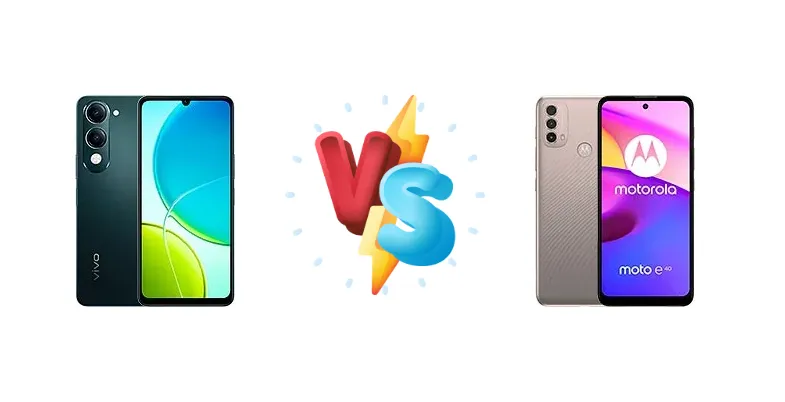
The sub-$150 smartphone market is fiercely competitive. Both the vivo Y04 and Motorola Moto E40 aim to deliver essential smartphone functionality at an accessible price point. However, they take different approaches: the vivo Y04 prioritizes extended battery life, while the Moto E40 focuses on a slightly more streamlined experience. This comparison dissects their key specifications to determine which device best suits your needs.
🏆 Quick Verdict
For the average user prioritizing longevity, the vivo Y04 emerges as the winner. Its significantly longer 52:40h battery endurance, coupled with the more powerful Unisoc T7225 chipset, provides a smoother and more reliable experience, despite the slightly slower 15W charging. The Moto E40 is still a viable option, but falls short in overall performance and stamina.
| Network |
|---|
| 2G bands | GSM 850 / 900 / 1800 / 1900 | GSM 850 / 900 / 1800 / 1900 |
| 3G bands | HSDPA 850 / 900 / 2100 | HSDPA 850 / 900 / 1700(AWS) / 1900 / 2100 |
| 4G bands | 1, 3, 5, 7, 8, 20, 28, 38, 40, 41 - International | 1, 2, 3, 4, 5, 7, 8, 19, 28, 40, 66 - Brazil |
| Speed | HSPA, LTE | HSPA 42.2/5.76 Mbps, LTE Cat4 150/50 Mbps |
| Technology | GSM / HSPA / LTE | GSM / HSPA / LTE |
| Launch |
|---|
| Announced | 2025, February 26 | 2021, October 07 |
| Status | Available. Released 2025, March 11 | Available. Released 2021, October 11 |
| Body |
|---|
| Build | Glass front, plastic frame, plastic back | Glass front, plastic frame, plastic back |
| Dimensions | 167.3 x 77 x 8.2 mm (6.59 x 3.03 x 0.32 in) | 165.1 x 75.7 x 9.1 mm (6.5 x 2.98 x 0.36 in) |
| SIM | Nano-SIM + Nano-SIM | · Nano-SIM· Nano-SIM + Nano-SIM |
| Weight | 199 g (7.02 oz) | 198 g (6.98 oz) |
| Display |
|---|
| Protection | Mohs level 5 | - |
| Resolution | 720 x 1600 pixels, 20:9 ratio (~260 ppi density) | 720 x 1600 pixels, 20:9 ratio (~270 ppi density) |
| Size | 6.74 inches, 109.7 cm2 (~85.1% screen-to-body ratio) | 6.5 inches, 102.0 cm2 (~81.6% screen-to-body ratio) |
| Type | IPS LCD, 90Hz, 570 nits (HBM) | IPS LCD, 90Hz |
| Platform |
|---|
| CPU | Octa-core (2x2.0 GHz Cortex-A75 & 6x1.8 GHz Cortex-A55) | Octa-core 1.8 GHz |
| Chipset | Unisoc T7225 (12 nm) | Unisoc T700 |
| GPU | Mali-G52 MP1 | Mali G52 |
| OS | Android 14, Funtouch 14 | Android 11 |
| Memory |
|---|
| Card slot | microSDXC (dedicated slot) | microSDXC (dedicated slot) |
| Internal | 64GB 4GB RAM, 128GB 4GB RAM, 128GB 6GB RAM, 256GB 4GB RAM | 64GB 4GB RAM |
| | - | eMMC 5.1 |
| Main Camera |
|---|
| Features | LED flash, panorama | LED flash, HDR, panorama |
| Single | 13 MP, f/2.2, (wide), PDAF
Auxiliary lens | - |
| Triple | - | 48 MP, f/2.0, 26mm (wide), PDAF
2 MP (macro)
Auxiliary lens |
| Video | 1080p@30fps | 1080p@30fps |
| Selfie camera |
|---|
| Features | - | HDR |
| Single | 5 MP, f/2.2, (wide) | 8 MP, f/2.0 |
| Video | Yes | 1080p@30fps |
| Sound |
|---|
| 3.5mm jack | - | Yes |
| 35mm jack | Yes | Yes |
| Loudspeaker | Yes, with stereo speakers | Yes |
| Comms |
|---|
| Bluetooth | 5.2, A2DP, LE | 5.0, A2DP, LE |
| NFC | No | No |
| Positioning | GPS, GALILEO, GLONASS, BDS, QZSS | GPS, GLONASS, GALILEO |
| Radio | FM radio | FM radio |
| USB | USB Type-C 2.0, OTG | USB Type-C 2.0 |
| WLAN | Wi-Fi 802.11 a/b/g/n/ac, dual-band | Wi-Fi 802.11 b/g/n |
| Features |
|---|
| Sensors | Fingerprint (side-mounted), accelerometer, proximity, compass | Fingerprint (rear-mounted), accelerometer, proximity |
| Battery |
|---|
| Charging | 15W wired | 10W wired |
| Type | Li-Ion 5500 mAh | Li-Po 5000 mAh |
| Misc |
|---|
| Colors | Titanium Gold (Titanium Silver), Dark Green (Majestic Green), Violet | Carbon Gray, Pink Clay |
| Models | V2430 | - |
| Price | About 110 EUR | About 90 EUR |
| SAR | 0.97 W/kg (head) 0.93 W/kg (body) | - |
| EU LABEL |
|---|
| Battery | 52:40h endurance, 1000 cycles | - |
| Energy | Class A | - |
| Free fall | Class A (300 falls) | - |
| Repairability | Class B | - |
vivo Y04
- Exceptional battery life (52:40h endurance)
- More powerful Unisoc T7225 chipset
- Faster 15W charging
- Likely basic camera system
- May have a less refined software experience compared to Motorola
Motorola Moto E40
- Potentially cleaner software experience (Motorola's near-stock Android)
- Lower price point (likely)
- Compact and lightweight design (likely)
- Significantly shorter battery life
- Less powerful Unisoc T700 chipset
- Slower 10W charging
Display Comparison
Neither device boasts a standout display. Given the context data focuses on internal specs, we can infer both likely utilize LCD panels common in this price bracket. The absence of details like resolution or refresh rate suggests a focus on cost reduction. Bezels are likely to be substantial on both, and color accuracy will be standard for budget devices. The display is not a differentiating factor here.
Camera Comparison
Without detailed camera specifications, a direct comparison is difficult. However, it’s safe to assume both phones feature basic camera systems geared towards casual photography. The absence of information regarding sensor size or optical image stabilization (OIS) suggests neither device will excel in low-light conditions. The inclusion of a 2MP macro camera on either device is likely a marketing tactic, offering limited practical benefit due to the small sensor size and fixed focus. Image processing will likely be basic, prioritizing speed over detail.
Performance
The vivo Y04’s Unisoc T7225 chipset represents a clear advantage over the Moto E40’s Unisoc T700. The T7225 features a more sophisticated CPU configuration – octa-core with 2x2.0 GHz Cortex-A75 and 6x1.8 GHz Cortex-A55 cores – compared to the Moto E40’s octa-core 1.8 GHz setup. The Cortex-A75 cores in the Y04 provide a significant boost in single-core performance, translating to snappier app launches and smoother multitasking. The 12nm process node of the T7225 also suggests slightly better power efficiency. While both chipsets are entry-level, the Y04 will handle demanding tasks with noticeably less strain.
Battery Life
Battery life is where the vivo Y04 truly shines. Its impressive 52:40h endurance rating significantly surpasses what we’d expect from a phone in this price range. This is likely due to a combination of the efficient Unisoc T7225 chipset and a well-optimized software experience. The Motorola Moto E40, while still offering acceptable battery life, cannot compete with the Y04’s stamina. The charging speeds also differ: the Y04 supports 15W wired charging, while the Moto E40 is limited to 10W. This means the Y04 will replenish its battery faster, minimizing downtime, even though the larger battery capacity requires more time to fully charge.
Buying Guide
Buy the vivo Y04 if you need a phone that can reliably last through a full day – and then some – of moderate use, and value a more capable processor for multitasking and light gaming. Buy the Motorola Moto E40 if you prioritize a simpler software experience and are willing to compromise on battery life and processing power to save a small amount of money.
Frequently Asked Questions
❓ How will the Unisoc T7225 in the vivo Y04 handle popular apps like WhatsApp, Facebook, and YouTube?
The Unisoc T7225 is more than capable of running these apps smoothly. The Cortex-A75 cores provide a performance boost that ensures quick app launches and responsive scrolling, even with multiple apps open simultaneously. While it won't deliver a flagship-level experience, it will provide a comfortable and usable experience for everyday tasks.
❓ Does the 15W charging on the vivo Y04 make a significant difference compared to the 10W charging on the Moto E40?
Yes, the 15W charging on the Y04 will noticeably reduce charging times. While neither is particularly fast by modern standards, the Y04 will replenish its larger battery capacity more quickly, minimizing downtime. Expect a roughly 30-45 minute difference in a full charge, favoring the vivo Y04.
❓ Is the battery endurance of the vivo Y04 affected by using mobile data instead of Wi-Fi?
Yes, using mobile data will reduce the battery endurance of the vivo Y04. Mobile data connections consume more power than Wi-Fi, especially when signal strength is weak. However, the Y04’s large battery capacity and efficient chipset should still provide a full day of use even with moderate mobile data usage.