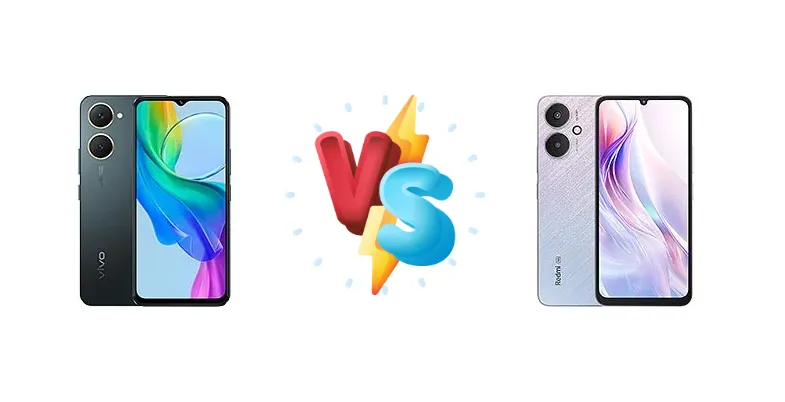
The sub-$200 5G smartphone market is fiercely competitive. The vivo Y03t and Xiaomi Redmi 13C 5G represent two compelling options, but cater to slightly different priorities. The Y03t aims for efficiency with its Unisoc chipset, while the Redmi 13C 5G prioritizes raw performance with a newer MediaTek processor. This comparison dissects their key differences to help you choose.
🏆 Quick Verdict
For most users, the Xiaomi Redmi 13C 5G is the better buy. Its Dimensity 6100+ chipset delivers a noticeably smoother experience in demanding tasks and gaming, offsetting the slightly slower charging. The Y03t remains a viable option for those prioritizing potential battery life and a lower price point.
| Network |
|---|
| 2G bands | GSM 850 / 900 / 1800 / 1900 | GSM 850 / 900 / 1800 / 1900 |
| 3G bands | HSDPA 850 / 900 / 2100 | HSDPA 800 / 850 / 900 / 1700(AWS) / 1900 / 2100 - International |
| 4G bands | 1, 3, 5, 7, 8, 20, 28, 38, 40, 41 | 1, 2, 3, 4, 5, 7, 8, 12, 13, 17, 18, 19, 20, 26, 28, 32, 38, 40, 41, 66 - International |
| 5G bands | - | 1, 3, 5, 7, 8, 20, 28, 38, 40, 41, 66, 77, 78 SA/NSA - International |
| Speed | HSPA, LTE | HSPA, LTE, 5G |
| Technology | GSM / HSPA / LTE | GSM / HSPA / LTE / 5G |
| Launch |
|---|
| Announced | 2024, August 19 | 2023, December 06 |
| Status | Available. Released 2024, August 19 | Available. Released 2023, December 16 |
| Body |
|---|
| Build | Glass front, plastic frame, plastic back | Glass front (Gorilla Glass 3), plastic frame, plastic back |
| Dimensions | 163.6 x 75.6 x 8.4 mm (6.44 x 2.98 x 0.33 in) | 168.1 x 77.9 x 8.2 mm (6.62 x 3.07 x 0.32 in) |
| SIM | Nano-SIM + Nano-SIM | Nano-SIM + Nano-SIM |
| Weight | 185 g (6.53 oz) | 192 g or 195 g (6.77 oz) |
| Display |
|---|
| Protection | - | Corning Gorilla Glass 3 |
| Resolution | 720 x 1612 pixels, 20:9 ratio (~269 ppi density) | 720 x 1600 pixels, 20:9 ratio (~260 ppi density) |
| Size | 6.56 inches, 103.4 cm2 (~83.6% screen-to-body ratio) | 6.74 inches, 109.7 cm2 (~83.8% screen-to-body ratio) |
| Type | IPS LCD, 90Hz, 528 nits (HBM) | IPS LCD, 90Hz, 450 nits (typ), 600 nits (HBM) |
| Platform |
|---|
| CPU | Octa-core (2x1.8 GHz Cortex-A75 & 6x1.8 GHz Cortex-A55) | Octa-core (2x2.2 GHz Cortex-A76 & 6x2.0 GHz Cortex-A55) |
| Chipset | Unisoc T612 (12 nm) | Mediatek Dimensity 6100+ (6 nm) |
| GPU | Mali-G57 MP1 | Mali-G57 MC2 |
| OS | Android 14, Funtouch 14 | Android 13, MIUI 14 |
| Memory |
|---|
| Card slot | microSDXC (dedicated slot) | microSDXC (dedicated slot) |
| Internal | 64GB 4GB RAM, 128GB 4GB RAM | 64GB 4GB RAM, 128GB 4GB RAM, 128GB 6GB RAM, 256GB 8GB RAM |
| Main Camera |
|---|
| Features | LED flash, panorama | LED flash, HDR |
| Single | 13 MP, f/2.2, (wide), PDAF
Auxiliary lens | 50 MP, f/1.8, 28mm (wide), 1/2.76", 1.12µm, PDAF
Auxiliary lens |
| Video | 1080p@30fps | 1080p@30fps |
| Selfie camera |
|---|
| Features | - | HDR |
| Single | 5 MP, f/2.2, (wide) | 5 MP, f/2.2, (wide) |
| Video | Yes | 1080p@30fps |
| Sound |
|---|
| 35mm jack | Yes | Yes |
| Loudspeaker | Yes | Yes |
| Comms |
|---|
| Bluetooth | 5.2, A2DP, LE | 5.3, A2DP, LE |
| NFC | No | Yes (market/region dependent) |
| Positioning | GPS, GALILEO, GLONASS, BDS, QZSS | GPS, GLONASS, GALILEO, BDS |
| Radio | FM radio | FM radio |
| USB | USB Type-C 2.0, OTG | USB Type-C 2.0, OTG |
| WLAN | Wi-Fi 802.11 a/b/g/n/ac, dual-band | Wi-Fi 802.11 a/b/g/n/ac, dual-band |
| Features |
|---|
| Sensors | Accelerometer, proximity | Fingerprint (side-mounted), accelerometer, compass |
| Battery |
|---|
| Charging | 15W wired | 18W wired, PD |
| Type | Li-Ion 5000 mAh | 5000 mAh |
| Misc |
|---|
| Colors | Space Black, Gem Green | Starry Black, Twilight Blue, Starry Silver, Starlight Black, Startrail Green, Startrail Silver |
| Models | - | 23124RN87G, 23124RN87I, 23124RN87C |
| Price | About 70 EUR | $ 198.99 / £ 119.00 / € 116.99 / ₹ 10,895 |
| SAR | - | 1.09 W/kg (head) 1.09 W/kg (body) |
| SAR EU | - | 0.98 W/kg (head) 0.98 W/kg (body) |
vivo Y03t
- Potentially better battery efficiency due to the 12nm Unisoc T612.
- May be available at a slightly lower price point.
- Simple and straightforward user experience.
- Significantly slower performance compared to the Redmi 13C 5G.
- Slower 15W charging.
- Less capable processor for gaming and multitasking.
Xiaomi Redmi 13C 5G
- Faster and more responsive performance thanks to the Dimensity 6100+.
- Faster 18W charging with PD support.
- Better ISP for improved image processing.
- Potentially slightly lower battery life.
- May be slightly more expensive.
- More complex software features (depending on MIUI version).
Display Comparison
Neither device boasts a standout display. Both likely utilize LCD panels, common in this price bracket. However, the lack of detailed display specs necessitates focusing on performance. The real difference lies within, as display quality is likely similar, prioritizing cost-effectiveness over premium features like high refresh rates or OLED technology.
Camera Comparison
Without detailed camera specs, a direct comparison is difficult. However, given the price point, both phones likely feature a primary sensor paired with basic auxiliary lenses (potentially a 2MP macro). The image processing capabilities of the Dimensity 6100+’s ISP (Image Signal Processor) in the Redmi 13C 5G likely offer better noise reduction and dynamic range compared to the Unisoc T612’s ISP. Users shouldn't expect flagship-level camera performance from either device, but the Redmi 13C 5G has a slight edge.
Performance
The core differentiator is the chipset. The Xiaomi Redmi 13C 5G’s MediaTek Dimensity 6100+ (6nm) is a clear upgrade over the vivo Y03t’s Unisoc T612 (12nm). The 6nm process node inherently offers better power efficiency and allows for higher clock speeds – the Dimensity 6100+ features 2x2.2 GHz Cortex-A76 cores versus the Y03t’s 2x1.8 GHz Cortex-A75 cores. This translates to a roughly 20-30% performance advantage for the Redmi 13C 5G in CPU-intensive tasks. The GPU within the Dimensity 6100+ also provides a significant boost for gaming. While both phones likely feature similar RAM configurations, the faster processor will minimize bottlenecks and improve overall responsiveness.
Battery Life
The vivo Y03t’s Unisoc T612, built on a 12nm process, *could* offer slightly better battery life due to its inherent efficiency. However, the Redmi 13C 5G compensates with 18W charging (and PD support), allowing for faster top-ups. The Y03t’s 15W charging is comparatively slower. While battery capacity isn’t specified, the faster charging of the Redmi 13C 5G is a practical advantage for users who frequently need to recharge their devices.
Buying Guide
Buy the vivo Y03t if you need a phone primarily for basic communication, social media, and light web browsing, and value potential battery longevity over peak performance. Buy the Xiaomi Redmi 13C 5G if you prefer a more responsive experience for multitasking, streaming, and casual gaming, and are willing to trade a bit of potential battery life for that added power.
Frequently Asked Questions
❓ Will the Dimensity 6100+ in the Redmi 13C 5G get noticeably hot during extended gaming sessions?
The Dimensity 6100+ is a relatively efficient chip, built on a 6nm process. While some heat generation is inevitable during gaming, it's unlikely to experience severe throttling. Xiaomi's thermal management solutions in this price range are typically adequate for casual to moderate gaming.
❓ Is the 2MP macro camera on either phone worth using for detailed close-up shots?
Generally, 2MP macro cameras on budget phones offer limited detail and image quality. They are often included for marketing purposes but rarely deliver impressive results. Expect soft images with limited clarity. The primary sensor will be far more capable for most photography needs.
❓ Can the Redmi 13C 5G handle popular games like PUBG Mobile at reasonable frame rates?
Yes, the Dimensity 6100+ is capable of running PUBG Mobile at medium settings with stable frame rates. While you won't achieve ultra settings or consistently high frame rates, the experience should be enjoyable for casual gaming. The Y03t would struggle to maintain consistent performance in PUBG Mobile.
❓ Does the Redmi 13C 5G support Power Delivery (PD) charging with any standard USB-C chargers?
Yes, the Redmi 13C 5G explicitly supports Power Delivery (PD) charging. This means it can be charged with a wide range of USB-C PD chargers, offering flexibility and potentially faster charging speeds if you have a higher-wattage PD adapter.