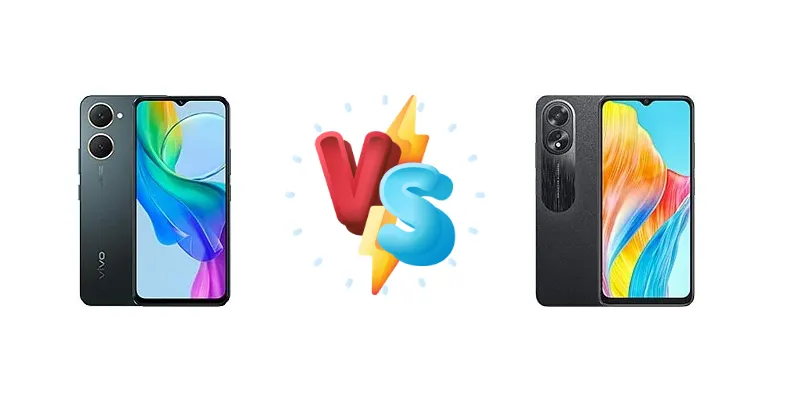
The vivo Y03t and Oppo A18 represent the fiercely competitive sub-$150 smartphone market. Both aim to deliver essential features at an accessible price, but they take different approaches to achieving this. The Y03t leverages the Unisoc T612, while the A18 opts for the MediaTek Helio G85. This comparison dissects their key differences to help you choose the right device.
🏆 Quick Verdict
For most users, the Oppo A18 emerges as the slightly better choice. Its Helio G85 chipset, with a 2.0 GHz clock speed compared to the Y03t’s 1.8 GHz, provides a noticeable performance edge in everyday tasks and light gaming. While both offer similar battery life, the A18’s slightly better processing power makes it more future-proof.
| Network |
|---|
| 2G bands | GSM 850 / 900 / 1800 / 1900 | GSM 850 / 900 / 1800 / 1900 |
| 3G bands | HSDPA 850 / 900 / 2100 | HSDPA 850 / 900 / 2100 |
| 4G bands | 1, 3, 5, 7, 8, 20, 28, 38, 40, 41 | 1, 3, 5, 7, 8, 20, 28, 38, 40, 41 |
| Speed | HSPA, LTE | HSPA, LTE |
| Technology | GSM / HSPA / LTE | GSM / HSPA / LTE |
| Launch |
|---|
| Announced | 2024, August 19 | 2023, September 27 |
| Status | Available. Released 2024, August 19 | Available. Released 2023, October 05 |
| Body |
|---|
| Build | Glass front, plastic frame, plastic back | - |
| Dimensions | 163.6 x 75.6 x 8.4 mm (6.44 x 2.98 x 0.33 in) | 163.7 x 75 x 8.2 mm (6.44 x 2.95 x 0.32 in) |
| SIM | Nano-SIM + Nano-SIM | Nano-SIM + Nano-SIM |
| Weight | 185 g (6.53 oz) | 188 g (6.63 oz) |
| Display |
|---|
| Resolution | 720 x 1612 pixels, 20:9 ratio (~269 ppi density) | 720 x 1612 pixels, 20:9 ratio (~269 ppi density) |
| Size | 6.56 inches, 103.4 cm2 (~83.6% screen-to-body ratio) | 6.56 inches, 103.4 cm2 (~84.2% screen-to-body ratio) |
| Type | IPS LCD, 90Hz, 528 nits (HBM) | IPS LCD, 90Hz, 720 nits (peak) |
| Platform |
|---|
| CPU | Octa-core (2x1.8 GHz Cortex-A75 & 6x1.8 GHz Cortex-A55) | Octa-core (2x2.0 GHz Cortex-A75 & 6x1.8 GHz Cortex-A55) |
| Chipset | Unisoc T612 (12 nm) | Mediatek MT6769 Helio G85 (12 nm) |
| GPU | Mali-G57 MP1 | Mali-G52 MC2 |
| OS | Android 14, Funtouch 14 | Android 13, upgradable to Android 15, ColorOS 15 |
| Memory |
|---|
| Card slot | microSDXC (dedicated slot) | microSDXC |
| Internal | 64GB 4GB RAM, 128GB 4GB RAM | 64GB 4GB RAM, 128GB 4GB RAM |
| Main Camera |
|---|
| Dual | - | 8 MP, f/2.0, (wide), AF
Auxiliary lens |
| Features | LED flash, panorama | LED flash, panorama |
| Single | 13 MP, f/2.2, (wide), PDAF
Auxiliary lens | - |
| Video | 1080p@30fps | 1080p@30fps |
| Selfie camera |
|---|
| Features | - | Panorama |
| Single | 5 MP, f/2.2, (wide) | 5 MP, f/2.2, (wide) |
| Video | Yes | 1080p@30fps |
| Sound |
|---|
| 35mm jack | Yes | Yes |
| Loudspeaker | Yes | Yes |
| Comms |
|---|
| Bluetooth | 5.2, A2DP, LE | 5.3, A2DP, LE, aptX HD |
| NFC | No | No |
| Positioning | GPS, GALILEO, GLONASS, BDS, QZSS | GPS, GALILEO, GLONASS, BDS, QZSS |
| Radio | FM radio | No |
| USB | USB Type-C 2.0, OTG | USB Type-C 2.0, OTG |
| WLAN | Wi-Fi 802.11 a/b/g/n/ac, dual-band | Wi-Fi 802.11 a/b/g/n/ac, dual-band |
| Features |
|---|
| Sensors | Accelerometer, proximity | Fingerprint (side-mounted), accelerometer, proximity, compass |
| Battery |
|---|
| Charging | 15W wired | - |
| Type | Li-Ion 5000 mAh | Li-Po 5000 mAh |
| Misc |
|---|
| Colors | Space Black, Gem Green | Glowing Black, Glowing Blue |
| Models | - | CPH2591 |
| Price | About 70 EUR | ₹ 10,290 |
vivo Y03t
- Potentially more stable software experience (vivo’s Funtouch OS is generally well-optimized)
- Competitive pricing
- Reliable for basic smartphone tasks
- Unisoc T612 chipset is less powerful than the Helio G85
- May struggle with demanding games and multitasking
Oppo A18
- More powerful MediaTek Helio G85 chipset
- Slightly better gaming performance
- Potentially improved image processing
- Oppo’s ColorOS can be resource-intensive
- May experience slightly faster battery drain under heavy load
Display Comparison
Neither vivo nor Oppo provide detailed display specifications beyond resolution. Given the price point, both likely utilize LCD panels. The real difference lies in processing power impacting UI smoothness. While both will likely offer similar color accuracy, the A18’s more powerful GPU may translate to slightly better graphics rendering, though this will be minimal. Expect standard 60Hz refresh rates on both.
Camera Comparison
Detailed camera specs are unavailable, but given the market segment, both phones likely feature a primary sensor paired with basic depth or macro lenses. The image processing capabilities of MediaTek chips are generally more refined than Unisoc’s, suggesting the Oppo A18 may produce slightly more detailed and vibrant photos, particularly in challenging lighting conditions. However, without knowing sensor sizes and apertures, it’s difficult to make a definitive judgment. Expect both to struggle in low-light scenarios.
Performance
The core distinction here is the chipset. The Oppo A18’s MediaTek Helio G85 (12nm) boasts a slightly higher CPU clock speed (2.0 GHz vs 1.8 GHz on the vivo Y03t’s Unisoc T612). Both utilize the same Cortex-A75 and A55 core configuration, but the higher clock speed on the A18’s A75 cores will result in faster single-core performance. This translates to quicker app launches and smoother multitasking. While both are 12nm chips, the Helio G85 is generally considered more efficient for gaming, offering a small advantage in sustained performance. The Y03t’s Unisoc T612 is still capable, but will show more strain under heavier loads.
Battery Life
Both devices likely house batteries in the 5000mAh range, a common capacity for this price bracket. The vivo Y03t features 15W wired charging. The Oppo A18’s charging speed is also likely 15W, based on brand trends. Therefore, 0-100% charge times will be comparable, around 2.5-3 hours. Battery life will largely depend on usage, but the Helio G85’s slightly better efficiency could translate to marginally longer screen-on time for the A18.
Buying Guide
Buy the vivo Y03t if you prioritize a consistently stable experience for basic tasks like calling, texting, and social media, and are less concerned with demanding applications. Buy the Oppo A18 if you occasionally play mobile games, multitask frequently, or want a phone that feels a bit more responsive overall. The A18 is the better option for users who anticipate needing a little extra power.
Frequently Asked Questions
❓ Will the Oppo A18 be able to run popular games like PUBG Mobile or Call of Duty?
The Helio G85 in the Oppo A18 is capable of running PUBG Mobile and Call of Duty, but you’ll likely need to play at medium or low graphics settings to maintain a stable frame rate. Don’t expect a flagship gaming experience, but it’s sufficient for casual gaming sessions. The vivo Y03t will struggle more with these titles.
❓ How does the software experience differ between the vivo Y03t and Oppo A18?
The vivo Y03t runs Funtouch OS, while the Oppo A18 uses ColorOS, both based on Android. Funtouch OS is generally considered lighter and more streamlined, potentially offering a smoother experience on the less powerful Unisoc T612. ColorOS is feature-rich but can be more resource-intensive, which the Helio G85 in the A18 can handle better.
❓ Is the camera quality significantly different between these two phones?
While detailed camera specs are lacking, the Oppo A18 likely has an edge due to MediaTek’s generally superior image processing algorithms. Expect slightly more detailed and vibrant photos, especially in good lighting conditions. However, both phones will struggle in low-light scenarios.