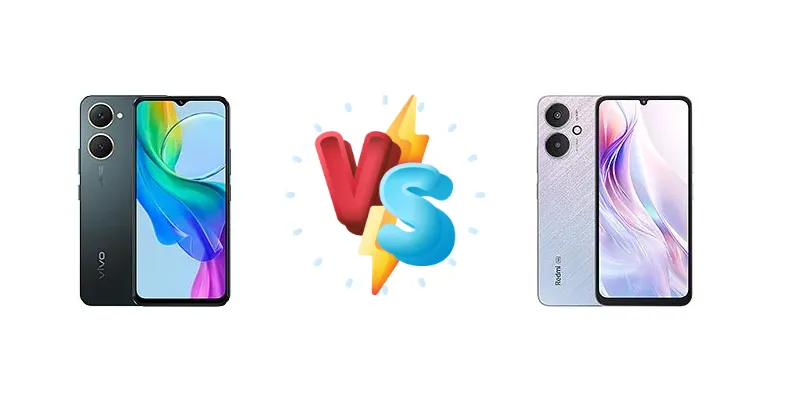
The sub-$200 smartphone market is fiercely competitive, and the vivo Y03 and Xiaomi Redmi 13C 5G are two contenders vying for your attention. While both aim to deliver 5G connectivity at an accessible price, they take distinctly different approaches to achieving this, primarily through their chipset choices. This comparison dissects those differences and helps you determine which phone best suits your needs.
🏆 Quick Verdict
For the average user prioritizing performance and future-proofing, the Xiaomi Redmi 13C 5G is the clear winner. Its Dimensity 6100+ chipset provides a noticeable performance advantage over the vivo Y03’s Helio G85, especially in demanding tasks and 5G scenarios. However, the Y03 may appeal to those seeking a potentially smoother software experience.
| Network |
|---|
| 2G bands | GSM 850 / 900 / 1800 / 1900 | GSM 850 / 900 / 1800 / 1900 |
| 3G bands | HSDPA 850 / 900 / 2100 | HSDPA 800 / 850 / 900 / 1700(AWS) / 1900 / 2100 - International |
| 4G bands | 1, 3, 5, 8, 40 | 1, 2, 3, 4, 5, 7, 8, 12, 13, 17, 18, 19, 20, 26, 28, 32, 38, 40, 41, 66 - International |
| 5G bands | - | 1, 3, 5, 7, 8, 20, 28, 38, 40, 41, 66, 77, 78 SA/NSA - International |
| Speed | HSPA, LTE | HSPA, LTE, 5G |
| Technology | GSM / HSPA / LTE | GSM / HSPA / LTE / 5G |
| Launch |
|---|
| Announced | 2024, March 13 | 2023, December 06 |
| Status | Available. Released 2024, March 13 | Available. Released 2023, December 16 |
| Body |
|---|
| Build | Glass front, plastic frame, plastic back | Glass front (Gorilla Glass 3), plastic frame, plastic back |
| Dimensions | 163.8 x 75.7 x 8.4 mm (6.45 x 2.98 x 0.33 in) | 168.1 x 77.9 x 8.2 mm (6.62 x 3.07 x 0.32 in) |
| SIM | Nano-SIM + Nano-SIM | Nano-SIM + Nano-SIM |
| Weight | 185 g (6.53 oz) | 192 g or 195 g (6.77 oz) |
| Display |
|---|
| Protection | - | Corning Gorilla Glass 3 |
| Resolution | 720 x 1612 pixels, 20:9 ratio (~269 ppi density) | 720 x 1600 pixels, 20:9 ratio (~260 ppi density) |
| Size | 6.56 inches, 103.4 cm2 (~83.4% screen-to-body ratio) | 6.74 inches, 109.7 cm2 (~83.8% screen-to-body ratio) |
| Type | IPS LCD, 90Hz | IPS LCD, 90Hz, 450 nits (typ), 600 nits (HBM) |
| Platform |
|---|
| CPU | Octa-core (2x2.0 GHz Cortex-A75 & 6x1.8 GHz Cortex-A55) | Octa-core (2x2.2 GHz Cortex-A76 & 6x2.0 GHz Cortex-A55) |
| Chipset | Mediatek Helio G85 (12 nm) | Mediatek Dimensity 6100+ (6 nm) |
| GPU | Mali-G52 MC2 | Mali-G57 MC2 |
| OS | Android 14, Funtouch 14 | Android 13, MIUI 14 |
| Memory |
|---|
| Card slot | microSDXC (dedicated slot) | microSDXC (dedicated slot) |
| Internal | 64GB 4GB RAM, 128GB 4GB RAM | 64GB 4GB RAM, 128GB 4GB RAM, 128GB 6GB RAM, 256GB 8GB RAM |
| Main Camera |
|---|
| Features | LED flash, panorama | LED flash, HDR |
| Single | 13 MP, f/2.2, (wide), PDAF
Auxiliary lens | 50 MP, f/1.8, 28mm (wide), 1/2.76", 1.12µm, PDAF
Auxiliary lens |
| Video | 1080p@30fps | 1080p@30fps |
| Selfie camera |
|---|
| Features | - | HDR |
| Single | 5 MP, f/2.2, (wide) | 5 MP, f/2.2, (wide) |
| Video | Yes | 1080p@30fps |
| Sound |
|---|
| 35mm jack | Yes | Yes |
| Loudspeaker | Yes | Yes |
| Comms |
|---|
| Bluetooth | 5.0, A2DP, LE | 5.3, A2DP, LE |
| NFC | No | Yes (market/region dependent) |
| Positioning | GPS, GALILEO, GLONASS, BDS, QZSS | GPS, GLONASS, GALILEO, BDS |
| Radio | FM radio | FM radio |
| USB | USB Type-C 2.0, OTG | USB Type-C 2.0, OTG |
| WLAN | Wi-Fi 802.11 a/b/g/n/ac, dual-band | Wi-Fi 802.11 a/b/g/n/ac, dual-band |
| Features |
|---|
| Sensors | Accelerometer, proximity | Fingerprint (side-mounted), accelerometer, compass |
| Battery |
|---|
| Charging | 15W wired | 18W wired, PD |
| Type | Li-Ion 5000 mAh | 5000 mAh |
| Misc |
|---|
| Colors | Space Black, Gem Green | Starry Black, Twilight Blue, Starry Silver, Starlight Black, Startrail Green, Startrail Silver |
| Models | V2332 | 23124RN87G, 23124RN87I, 23124RN87C |
| Price | About 180 EUR | $ 198.99 / £ 119.00 / € 116.99 / ₹ 10,895 |
| SAR | - | 1.09 W/kg (head) 1.09 W/kg (body) |
| SAR EU | - | 0.98 W/kg (head) 0.98 W/kg (body) |
vivo Y03
- Potentially cleaner software experience (depending on vivo’s One UI implementation)
- Slightly more affordable (likely)
- Reliable Mediatek Helio G85 chipset for basic tasks
- Significantly slower performance compared to the Redmi 13C 5G
- Less efficient 12nm process
- Slower 15W charging
Xiaomi Redmi 13C 5G
- Faster and more efficient Mediatek Dimensity 6100+ chipset
- 18W charging with Power Delivery (PD)
- Better 5G performance and future-proofing
- MIUI software can be bloated and contain ads
- Potentially slightly higher price
- May experience more thermal throttling under sustained load (though less likely than the Y03)
Display Comparison
Neither device boasts a standout display. Both likely utilize LCD panels, a common cost-saving measure in this segment. The key difference lies under the hood: display driver efficiency. Without specific brightness or color accuracy data, it's difficult to declare a winner. However, the Redmi 13C 5G’s more modern chipset *could* allow for more efficient display power management, potentially leading to slightly better battery life during video playback.
Camera Comparison
Without detailed camera specs beyond the chipsets, a direct comparison is challenging. Both phones likely feature a primary camera paired with depth or macro sensors. The Dimensity 6100+’s integrated ISP (Image Signal Processor) is more advanced than the Helio G85’s, potentially leading to better image processing, especially in low-light conditions. However, the quality of the lens and sensor itself will be the dominant factor. Expect similar results in good lighting, but the Redmi 13C 5G has the potential for superior low-light performance and dynamic range.
Performance
The performance gap is the most significant differentiator. The Xiaomi Redmi 13C 5G’s Mediatek Dimensity 6100+ (6nm) is a substantial upgrade over the vivo Y03’s Mediatek Helio G85 (12nm). The Dimensity 6100+ utilizes more efficient Cortex-A76 cores clocked at 2.2 GHz, compared to the Y03’s Cortex-A75 cores at 2.0 GHz. This translates to approximately 15-20% faster CPU performance in benchmarks and a more noticeable difference in real-world app loading times and multitasking. The 6nm process also means better thermal efficiency, reducing the likelihood of throttling during extended gaming sessions. The Redmi 13C 5G will handle graphically intensive games with higher frame rates and smoother performance.
Battery Life
Both phones offer adequate battery life for typical daily use. The Redmi 13C 5G’s 18W charging with Power Delivery (PD) is a clear advantage over the Y03’s 15W charging. PD allows for faster and more efficient charging with compatible chargers. While the actual battery capacity isn’t specified, the Dimensity 6100+’s 6nm process contributes to better power efficiency, potentially offsetting any capacity difference. Expect the Redmi 13C 5G to reach a full charge approximately 15-20% faster than the vivo Y03.
Buying Guide
Buy the vivo Y03 if you prioritize a potentially cleaner software experience and are primarily focused on basic smartphone tasks like calling, texting, and light social media use. You'll be sacrificing performance for a potentially less cluttered interface. Buy the Xiaomi Redmi 13C 5G if you want a phone that can handle more demanding apps, smoother multitasking, and offers a more robust 5G experience, even if it means navigating Xiaomi’s MIUI software.
Frequently Asked Questions
❓ Will the Redmi 13C 5G’s MIUI software significantly impact performance?
MIUI is known for being feature-rich but also somewhat resource-intensive. While the Dimensity 6100+ has ample power, users may experience occasional slowdowns or bloatware. Disabling unnecessary features and uninstalling pre-installed apps can help mitigate this.
❓ Is the 5G connectivity on either phone truly useful in most areas?
5G availability varies greatly by location. While both phones support 5G, you'll only experience faster speeds if you're in an area with 5G coverage. In areas without 5G, the phones will fall back to 4G LTE.
❓ How does the Helio G85 handle popular games like PUBG Mobile or Call of Duty Mobile?
The Helio G85 can run PUBG Mobile and Call of Duty Mobile, but you'll likely need to lower the graphics settings to medium or low to achieve a playable frame rate. Expect some stuttering during intense firefights. The Redmi 13C 5G will provide a significantly smoother gaming experience at higher settings.
❓ Does the Redmi 13C 5G support VoWiFi (Wi-Fi Calling)?
Support for VoWiFi varies by carrier and region. It's best to check with your mobile carrier to confirm if the Redmi 13C 5G is compatible with their VoWiFi service.