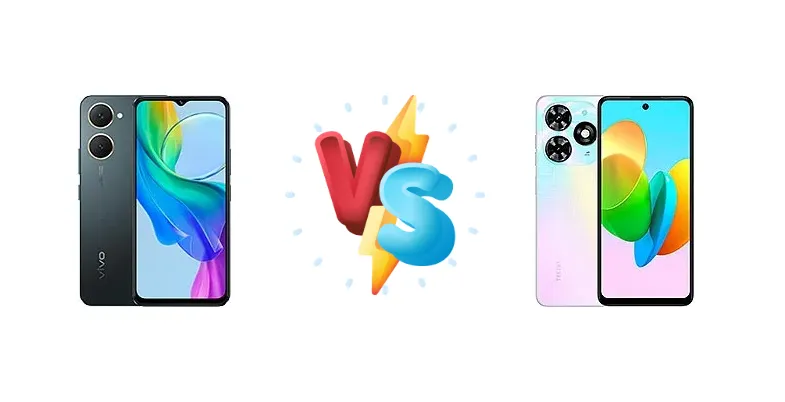
The sub-$150 smartphone market is fiercely competitive. Both the vivo Y03 and Tecno Spark 20C aim to deliver essential smartphone functionality at an incredibly accessible price point. However, they take different approaches to achieving this, with the Y03 leveraging a more modern, albeit power-efficient, chipset architecture while the Spark 20C opts for a higher clock speed on a less advanced core design. This comparison will dissect these differences to determine which device offers the best overall value.
🏆 Quick Verdict
For the average user prioritizing consistent performance in everyday tasks, the vivo Y03 emerges as the better choice. Its Mediatek Helio G85, built on a 12nm process with Cortex-A75 cores, provides a noticeable advantage in responsiveness and multitasking compared to the Tecno Spark 20C’s Cortex-A53 based chipset, despite the latter’s higher clock speed.
| Network |
|---|
| 2G bands | GSM 850 / 900 / 1800 / 1900 | GSM 850 / 900 / 1800 / 1900 |
| 3G bands | HSDPA 850 / 900 / 2100 | HSDPA 900 / 2100 |
| 4G bands | 1, 3, 5, 8, 40 | LTE |
| Speed | HSPA, LTE | HSPA, LTE |
| Technology | GSM / HSPA / LTE | GSM / HSPA / LTE |
| Launch |
|---|
| Announced | 2024, March 13 | 2023, November 27 |
| Status | Available. Released 2024, March 13 | Available. Released 2023, December |
| Body |
|---|
| Build | Glass front, plastic frame, plastic back | Glass front, plastic back, plastic frame |
| Dimensions | 163.8 x 75.7 x 8.4 mm (6.45 x 2.98 x 0.33 in) | 163.7 x 75.6 x 8.6 mm (6.44 x 2.98 x 0.34 in) |
| SIM | Nano-SIM + Nano-SIM | Nano-SIM + Nano-SIM |
| Weight | 185 g (6.53 oz) | - |
| Display |
|---|
| Resolution | 720 x 1612 pixels, 20:9 ratio (~269 ppi density) | 720 x 1612 pixels, 20:9 ratio (~267 ppi density) |
| Size | 6.56 inches, 103.4 cm2 (~83.4% screen-to-body ratio) | 6.6 inches, 104.6 cm2 (~84.6% screen-to-body ratio) |
| Type | IPS LCD, 90Hz | IPS LCD, 90Hz |
| Platform |
|---|
| CPU | Octa-core (2x2.0 GHz Cortex-A75 & 6x1.8 GHz Cortex-A55) | Octa-core 2.2 GHz Cortex-A53 |
| Chipset | Mediatek Helio G85 (12 nm) | Mediatek |
| GPU | Mali-G52 MC2 | - |
| OS | Android 14, Funtouch 14 | Android 13 |
| Memory |
|---|
| Card slot | microSDXC (dedicated slot) | microSDXC |
| Internal | 64GB 4GB RAM, 128GB 4GB RAM | 128GB 4GB RAM, 128GB 8GB RAM, 256GB 4GB RAM |
| Main Camera |
|---|
| Features | LED flash, panorama | Dual-LED flash, HDR |
| Single | 13 MP, f/2.2, (wide), PDAF
Auxiliary lens | 50 MP, (wide), 1/2.8", PDAF
Auxiliary lens |
| Video | 1080p@30fps | 1080p@30fps |
| Selfie camera |
|---|
| Features | - | Dual-LED flash |
| Single | 5 MP, f/2.2, (wide) | 8 MP |
| Video | Yes | Yes |
| Sound |
|---|
| 35mm jack | Yes | Yes |
| Loudspeaker | Yes | Yes, with stereo speakers |
| Comms |
|---|
| Bluetooth | 5.0, A2DP, LE | Yes |
| NFC | No | No |
| Positioning | GPS, GALILEO, GLONASS, BDS, QZSS | GPS |
| Radio | FM radio | FM radio |
| USB | USB Type-C 2.0, OTG | USB Type-C, OTG |
| WLAN | Wi-Fi 802.11 a/b/g/n/ac, dual-band | Yes |
| Features |
|---|
| Sensors | Accelerometer, proximity | Fingerprint (side-mounted), accelerometer, compass |
| Battery |
|---|
| Charging | 15W wired | 18W wired |
| Type | Li-Ion 5000 mAh | 5000 mAh |
| Misc |
|---|
| Colors | Space Black, Gem Green | Mystery White, Alpenglow Gold, Magic Skin, Gravity Black |
| Models | V2332 | BG7n, BG7 |
| Price | About 180 EUR | About 140 EUR |
vivo Y03
- More powerful CPU cores (Cortex-A75)
- Potentially better power efficiency
- Smoother multitasking experience
- Slower charging speed (15W)
- Limited display information
Tecno Spark 20C
- Faster charging speed (18W)
- Higher CPU clock speed
- Potentially lower price point
- Less efficient CPU architecture (Cortex-A53)
- Likely more throttling under load
Display Comparison
Neither device boasts a standout display. Given the provided data, a detailed display comparison is limited. Both likely utilize LCD panels common in this price bracket. The absence of information regarding resolution, brightness, or refresh rate suggests a focus on cost reduction. Expect similar viewing experiences, with color accuracy and peak brightness being areas where both phones will likely fall short of premium offerings.
Camera Comparison
Without detailed camera specifications, a comprehensive comparison is impossible. However, it’s safe to assume both phones feature basic camera setups geared towards social media sharing. The absence of information regarding sensor size or aperture suggests neither device will excel in low-light photography. Any marketing around megapixel count should be viewed with skepticism, as image quality is more dependent on sensor size and image processing than sheer pixel numbers. Expect similar results in good lighting conditions, with the Y03 potentially benefiting from the Helio G85’s slightly more capable ISP (Image Signal Processor).
Performance
The core difference lies in the chipset architecture. The vivo Y03’s Mediatek Helio G85 features a combination of 2x 2.0 GHz Cortex-A75 and 6x 1.8 GHz Cortex-A55 cores. The Cortex-A75 is a significantly more powerful core than the Cortex-A53 found in the Tecno Spark 20C, which utilizes an octa-core configuration clocked at 2.2 GHz. While the Spark 20C’s higher clock speed *appears* advantageous, the A75’s superior instruction per clock (IPC) and architectural improvements translate to better real-world performance, especially in multi-threaded tasks and gaming. The 12nm process of the Helio G85 also contributes to better power efficiency compared to the likely larger node process of the Tecno’s chipset. This means the Y03 is less likely to throttle under sustained load.
Battery Life
The Tecno Spark 20C’s 18W wired charging offers a slight advantage over the vivo Y03’s 15W charging. This translates to a potentially faster 0-100% charge time, though the actual difference will depend on battery capacity (which is not provided). However, the Helio G85’s superior power efficiency in the Y03 could offset this charging advantage, resulting in comparable real-world battery life despite potentially having a smaller battery capacity. The efficiency of the chipset will have a greater impact on daily usage than the marginal charging speed difference.
Buying Guide
Buy the vivo Y03 if you need a phone that feels responsive during daily use, handles multitasking without significant slowdowns, and benefits from a slightly more efficient processor. Buy the Tecno Spark 20C if you prioritize the fastest possible clock speed on a budget, potentially benefiting from slightly quicker app launch times in some scenarios, and prefer a marginally faster charging solution, understanding that sustained performance may be less consistent.
Frequently Asked Questions
❓ Will the Tecno Spark 20C’s higher clock speed make a noticeable difference in everyday tasks like browsing and social media?
While the 2.2 GHz clock speed of the Spark 20C sounds impressive, the older Cortex-A53 cores are less efficient than the Cortex-A75 cores in the vivo Y03. This means the Y03 will likely feel more responsive and smoother during everyday tasks, even with a lower clock speed, due to its superior architecture.
❓ Is the 18W charging on the Tecno Spark 20C significantly faster than the 15W charging on the vivo Y03?
The difference in charging speed is likely to be noticeable, but not dramatic. Expect the Tecno Spark 20C to charge slightly faster, potentially shaving off 15-30 minutes for a full charge. However, the Helio G85 in the Y03 is more power efficient, which could lead to comparable overall battery life despite the slower charging.
❓ Can the vivo Y03 handle basic mobile games like PUBG Mobile or Call of Duty Mobile?
The Helio G85 is capable of running PUBG Mobile and Call of Duty Mobile at medium settings with reasonable frame rates. However, don't expect a high-end gaming experience. The Tecno Spark 20C may struggle more with these titles due to its less powerful chipset, potentially experiencing more frame drops and stuttering.