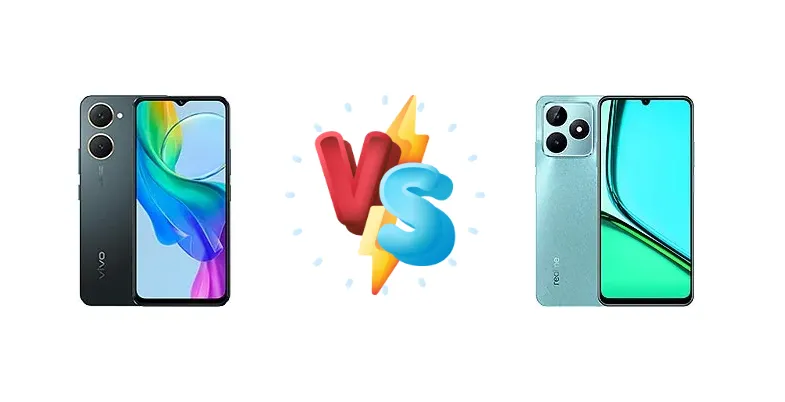
The sub-$150 smartphone market is fiercely competitive. Both the vivo Y03 and Realme C51s aim to deliver essential smartphone functionality at an accessible price. However, they take different approaches: the vivo Y03 prioritizes a proven chipset, while the Realme C51s focuses on faster charging and a more modern aesthetic. This comparison dissects the key differences to help you choose the right device.
🏆 Quick Verdict
For most users, the Realme C51s is the better choice. Its 33W charging significantly reduces downtime, reaching 50% in just 28 minutes, a substantial advantage over the vivo Y03’s slower 15W charging. While the Helio G85 in the Y03 offers slightly better raw CPU performance, the convenience of faster charging outweighs this difference for everyday use.
| Network |
|---|
| 2G bands | GSM 850 / 900 / 1800 / 1900 | GSM 850 / 900 / 1800 / 1900 |
| 3G bands | HSDPA 850 / 900 / 2100 | HSDPA 900 / 2100 |
| 4G bands | 1, 3, 5, 8, 40 | 1, 3, 5, 8, 38, 40 |
| Speed | HSPA, LTE | HSPA, LTE |
| Technology | GSM / HSPA / LTE | GSM / HSPA / LTE |
| Launch |
|---|
| Announced | 2024, March 13 | 2024, March 15 |
| Status | Available. Released 2024, March 13 | Available. Released 2024, March 15 |
| Body |
|---|
| Build | Glass front, plastic frame, plastic back | Glass front, plastic frame, plastic back |
| Dimensions | 163.8 x 75.7 x 8.4 mm (6.45 x 2.98 x 0.33 in) | 167.2 x 76.7 x 7.5 mm (6.58 x 3.02 x 0.30 in) |
| SIM | Nano-SIM + Nano-SIM | Nano-SIM + Nano-SIM |
| Weight | 185 g (6.53 oz) | 182 g (6.42 oz) |
| Display |
|---|
| Resolution | 720 x 1612 pixels, 20:9 ratio (~269 ppi density) | 720 x 1600 pixels, 20:9 ratio (~260 ppi density) |
| Size | 6.56 inches, 103.4 cm2 (~83.4% screen-to-body ratio) | 6.74 inches, 109.7 cm2 (~85.5% screen-to-body ratio) |
| Type | IPS LCD, 90Hz | IPS LCD, 90Hz, 560 nits (peak) |
| Platform |
|---|
| CPU | Octa-core (2x2.0 GHz Cortex-A75 & 6x1.8 GHz Cortex-A55) | Octa-core (2x1.8 GHz Cortex-A75 & 6x1.8 GHz Cortex-A55) |
| Chipset | Mediatek Helio G85 (12 nm) | Unisoc Tiger T612 (12 nm) |
| GPU | Mali-G52 MC2 | Mali-G57 |
| OS | Android 14, Funtouch 14 | Android 13, Realme UI |
| Memory |
|---|
| Card slot | microSDXC (dedicated slot) | microSDXC (dedicated slot) |
| Internal | 64GB 4GB RAM, 128GB 4GB RAM | 128GB 6GB RAM |
| Main Camera |
|---|
| Features | LED flash, panorama | LED flash, HDR, panorama |
| Single | 13 MP, f/2.2, (wide), PDAF
Auxiliary lens | 50 MP, f/1.8, 27mm (wide), 1/2.76", 0.64µm, PDAF
Auxiliary lens |
| Video | 1080p@30fps | 1080p@30fps |
| Selfie camera |
|---|
| Features | - | HDR |
| Single | 5 MP, f/2.2, (wide) | 5 MP, f/2.2, 28mm (wide), 1/5.0", 1.12µm |
| Video | Yes | 720p@30fps |
| Sound |
|---|
| 35mm jack | Yes | Yes |
| Loudspeaker | Yes | Yes |
| Comms |
|---|
| Bluetooth | 5.0, A2DP, LE | 5.0, A2DP, LE |
| NFC | No | Yes, 360˚ (market/region dependent) |
| Positioning | GPS, GALILEO, GLONASS, BDS, QZSS | GPS, GLONASS, GALILEO |
| Radio | FM radio | Unspecified |
| USB | USB Type-C 2.0, OTG | USB Type-C |
| WLAN | Wi-Fi 802.11 a/b/g/n/ac, dual-band | Wi-Fi 802.11 a/b/g/n/ac, dual-band |
| Features |
|---|
| Sensors | Accelerometer, proximity | Fingerprint (side-mounted), accelerometer, gyro, proximity, compass |
| Battery |
|---|
| Charging | 15W wired | 33W wired, 0-50% in 28 min |
| Type | Li-Ion 5000 mAh | 5000 mAh |
| Misc |
|---|
| Colors | Space Black, Gem Green | Shiny Green, Mighty Black |
| Models | V2332 | RMX3765 |
| Price | About 180 EUR | About 100 EUR |
vivo Y03
- Slightly faster CPU performance due to higher clocked cores.
- Established Mediatek Helio G85 chipset.
- Potentially better image processing (based on brand reputation).
- Significantly slower 15W charging.
- May lack the latest software optimizations found in newer chipsets.
Realme C51s
- 33W fast charging (0-50% in 28 minutes).
- More modern Unisoc Tiger T612 chipset.
- Likely more efficient power management.
- Slightly lower CPU clock speed.
- Unisoc chipset may have less software support compared to Mediatek.
Display Comparison
Neither device boasts a standout display. Both utilize 12nm chipsets, suggesting similar power constraints impacting display capabilities. While specific display specs (resolution, panel type) are missing, the focus here is on performance. The absence of high refresh rates on either device indicates a prioritization of battery life over visual fluidity. Bezels are likely comparable given the price point, and color accuracy will likely be standard for this segment.
Camera Comparison
Without detailed camera specs, a direct comparison is difficult. Both phones likely feature a primary camera paired with auxiliary sensors (often 2MP macro/depth lenses). The image processing algorithms will be key differentiators, and brand reputation suggests vivo may have a slight edge in image quality. However, the lack of OIS on either device means low-light performance will be limited. Focusing on the primary sensor’s megapixel count and aperture (if available) would be crucial for a more informed assessment.
Performance
The core difference lies in the chipsets. The vivo Y03’s Mediatek Helio G85 features a slightly higher clocked Cortex-A75 core (2.0 GHz vs 1.8 GHz in the Realme C51s’ Unisoc Tiger T612). This translates to a marginal advantage in single-core CPU performance, potentially noticeable in app launch speeds or light gaming. However, both chips share the same Cortex-A55 efficiency cores, and both are built on a 12nm process, meaning thermal performance will be similar under sustained load. The Unisoc T612 benefits from being a newer architecture, potentially offering improved efficiency in certain tasks, but the Helio G85 has a more established track record. RAM configurations are likely similar, further minimizing the performance gap.
Battery Life
The Realme C51s’ 33W charging is the clear winner here. While battery capacity isn’t specified, the ability to reach 50% charge in 28 minutes is a significant advantage over the vivo Y03’s 15W charging. This drastically reduces downtime and makes the C51s more convenient for users on the go. The 12nm process node of both chipsets suggests similar power efficiency, meaning the battery life difference will likely be minimal despite the charging disparity.
Buying Guide
Buy the vivo Y03 if you prioritize sustained CPU performance for tasks like light gaming or multitasking and are comfortable with slower charging speeds. This phone suits users who value a slightly more established chipset. Buy the Realme C51s if you value convenience and quick top-ups. The 33W charging is a game-changer for users who frequently find themselves needing a quick boost, and the Unisoc T612 is perfectly adequate for typical smartphone usage.
Frequently Asked Questions
❓ Will the Unisoc Tiger T612 in the Realme C51s struggle with demanding games like PUBG Mobile?
The Unisoc Tiger T612 is capable of running PUBG Mobile, but you’ll likely need to lower graphics settings to achieve a smooth frame rate. It’s not a gaming-focused chipset like the Helio G85, but it’s sufficient for casual gaming and everyday tasks. Expect medium settings for a playable experience.
❓ How much faster is the 33W charging on the Realme C51s compared to the 15W charging on the vivo Y03 in real-world use?
The Realme C51s can reach 50% charge in approximately 28 minutes, while the vivo Y03 will take considerably longer – likely over an hour to reach the same level. This means you can quickly top up the C51s during a short break, whereas the Y03 requires a more substantial charging period.
❓ Does the Realme C51s support reverse charging, allowing me to charge other devices?
Based on typical specifications for phones in this price range, it's unlikely the Realme C51s supports reverse charging. This feature is usually reserved for higher-end models.
❓ Is the difference in CPU clock speed between the Helio G85 and Tiger T612 noticeable for everyday tasks like browsing and social media?
The difference in CPU clock speed is unlikely to be noticeable for typical everyday tasks. Both chipsets are capable of handling browsing, social media, and messaging without issue. The faster charging of the Realme C51s will have a more significant impact on your daily experience.