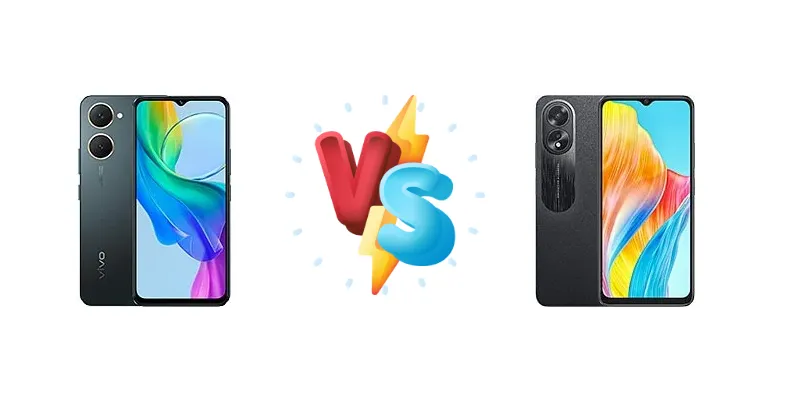
The vivo Y03 and Oppo A18 represent a fascinating trend in the budget smartphone market: near-identical hardware sold under different brands. Both devices target the ultra-affordable segment, relying on the Mediatek Helio G85 chipset. This comparison aims to dissect the nuances – beyond branding – to determine which phone offers the best value for your money.
🏆 Quick Verdict
For the average user, the choice between the vivo Y03 and Oppo A18 is largely down to brand preference and current pricing. They offer virtually the same performance and features. However, if the Oppo A18 is available at a slightly lower price, it edges out the Y03 due to potential cost savings.
| Network |
|---|
| 2G bands | GSM 850 / 900 / 1800 / 1900 | GSM 850 / 900 / 1800 / 1900 |
| 3G bands | HSDPA 850 / 900 / 2100 | HSDPA 850 / 900 / 2100 |
| 4G bands | 1, 3, 5, 8, 40 | 1, 3, 5, 7, 8, 20, 28, 38, 40, 41 |
| Speed | HSPA, LTE | HSPA, LTE |
| Technology | GSM / HSPA / LTE | GSM / HSPA / LTE |
| Launch |
|---|
| Announced | 2024, March 13 | 2023, September 27 |
| Status | Available. Released 2024, March 13 | Available. Released 2023, October 05 |
| Body |
|---|
| Build | Glass front, plastic frame, plastic back | - |
| Dimensions | 163.8 x 75.7 x 8.4 mm (6.45 x 2.98 x 0.33 in) | 163.7 x 75 x 8.2 mm (6.44 x 2.95 x 0.32 in) |
| SIM | Nano-SIM + Nano-SIM | Nano-SIM + Nano-SIM |
| Weight | 185 g (6.53 oz) | 188 g (6.63 oz) |
| Display |
|---|
| Resolution | 720 x 1612 pixels, 20:9 ratio (~269 ppi density) | 720 x 1612 pixels, 20:9 ratio (~269 ppi density) |
| Size | 6.56 inches, 103.4 cm2 (~83.4% screen-to-body ratio) | 6.56 inches, 103.4 cm2 (~84.2% screen-to-body ratio) |
| Type | IPS LCD, 90Hz | IPS LCD, 90Hz, 720 nits (peak) |
| Platform |
|---|
| CPU | Octa-core (2x2.0 GHz Cortex-A75 & 6x1.8 GHz Cortex-A55) | Octa-core (2x2.0 GHz Cortex-A75 & 6x1.8 GHz Cortex-A55) |
| Chipset | Mediatek Helio G85 (12 nm) | Mediatek MT6769 Helio G85 (12 nm) |
| GPU | Mali-G52 MC2 | Mali-G52 MC2 |
| OS | Android 14, Funtouch 14 | Android 13, upgradable to Android 15, ColorOS 15 |
| Memory |
|---|
| Card slot | microSDXC (dedicated slot) | microSDXC |
| Internal | 64GB 4GB RAM, 128GB 4GB RAM | 64GB 4GB RAM, 128GB 4GB RAM |
| Main Camera |
|---|
| Dual | - | 8 MP, f/2.0, (wide), AF
Auxiliary lens |
| Features | LED flash, panorama | LED flash, panorama |
| Single | 13 MP, f/2.2, (wide), PDAF
Auxiliary lens | - |
| Video | 1080p@30fps | 1080p@30fps |
| Selfie camera |
|---|
| Features | - | Panorama |
| Single | 5 MP, f/2.2, (wide) | 5 MP, f/2.2, (wide) |
| Video | Yes | 1080p@30fps |
| Sound |
|---|
| 35mm jack | Yes | Yes |
| Loudspeaker | Yes | Yes |
| Comms |
|---|
| Bluetooth | 5.0, A2DP, LE | 5.3, A2DP, LE, aptX HD |
| NFC | No | No |
| Positioning | GPS, GALILEO, GLONASS, BDS, QZSS | GPS, GALILEO, GLONASS, BDS, QZSS |
| Radio | FM radio | No |
| USB | USB Type-C 2.0, OTG | USB Type-C 2.0, OTG |
| WLAN | Wi-Fi 802.11 a/b/g/n/ac, dual-band | Wi-Fi 802.11 a/b/g/n/ac, dual-band |
| Features |
|---|
| Sensors | Accelerometer, proximity | Fingerprint (side-mounted), accelerometer, proximity, compass |
| Battery |
|---|
| Charging | 15W wired | - |
| Type | Li-Ion 5000 mAh | Li-Po 5000 mAh |
| Misc |
|---|
| Colors | Space Black, Gem Green | Glowing Black, Glowing Blue |
| Models | V2332 | CPH2591 |
| Price | About 180 EUR | ₹ 10,290 |
vivo Y03
- Potentially cleaner software experience (vivo's Funtouch OS)
- Reliable performance for basic tasks
- Long battery life with 5000mAh battery
- Limited camera capabilities
- Slow 15W charging
- Potential for throttling under heavy load
Oppo A18
- Established ColorOS features and optimizations
- Reliable performance for basic tasks
- Long battery life with 5000mAh battery
- Limited camera capabilities
- Slow 15W charging
- Potential for throttling under heavy load
Display Comparison
Both the vivo Y03 and Oppo A18 are expected to feature similar LCD panels, given their price point. While specific details like peak brightness and color gamut coverage are unavailable, the shared Helio G85 chipset suggests comparable display capabilities. Expect a 6.5-inch display, typical for this segment. The absence of high refresh rates or advanced panel technologies like LTPO is standard, focusing on maximizing battery life rather than visual fidelity. Bezels are likely to be noticeable, but functional for the price.
Camera Comparison
Camera specifications are likely to be similar, with both phones featuring a primary camera and potentially a depth sensor. Details on sensor size and aperture are missing, but given the price, expect a modest main sensor. Image processing will likely differ between vivo and Oppo, potentially leading to variations in color science and dynamic range. The inclusion of a 2MP macro camera on either device is largely a marketing tactic, offering limited practical benefit due to its low resolution. Focusing on the primary sensor's performance in good lighting conditions is more realistic.
Performance
The core of both devices is the Mediatek Helio G85 (12 nm) chipset, featuring an octa-core CPU configuration with 2x2.0 GHz Cortex-A75 and 6x1.8 GHz Cortex-A55 cores. This means performance will be nearly indistinguishable between the two. The Helio G85 is capable of handling everyday tasks like social media, web browsing, and light gaming. However, demanding titles will require reduced graphics settings. RAM configurations are likely similar, impacting multitasking capabilities. Thermal management will be a key factor; the 12nm process isn't the most efficient, so sustained heavy loads could lead to throttling, though this is common in this price bracket.
Battery Life
Both devices are expected to house a similar capacity battery, likely around 5000mAh, providing all-day battery life for moderate usage. However, the charging speed is limited to 15W wired on the vivo Y03. The Oppo A18 also features 15W charging. This means a full charge will take approximately 2-3 hours. While not fast charging, it's adequate for overnight charging or topping up throughout the day. Battery life will be heavily influenced by usage patterns, with gaming and video streaming consuming power more rapidly.
Buying Guide
Buy the vivo Y03 if you prioritize a potentially cleaner software experience, as vivo historically offers a different UI approach than Oppo's ColorOS. Buy the Oppo A18 if you prefer the established features and optimizations of ColorOS, or if it's available at a significantly lower price point, maximizing your value for money. Both are excellent choices for first-time smartphone users or those needing a reliable secondary device.
Frequently Asked Questions
❓ Will the Helio G85 handle popular games like PUBG Mobile or Call of Duty Mobile?
The Helio G85 can run PUBG Mobile and Call of Duty Mobile, but you'll need to lower the graphics settings to medium or low and potentially reduce the frame rate to achieve a smooth gaming experience. Expect some frame drops during intense action sequences.
❓ How does the software experience differ between vivo's Funtouch OS and Oppo's ColorOS?
ColorOS is generally considered more feature-rich and customizable, while Funtouch OS often prioritizes simplicity and a cleaner interface. Both have improved significantly over the years, but ColorOS typically offers more advanced features like gesture navigation and system-wide dark mode.
❓ Is the 15W charging speed sufficient for daily use?
While 15W charging isn't fast, it's adequate for overnight charging. A full charge will take around 2-3 hours. It's best to plug in the phone overnight to ensure it's fully charged for the next day.
❓ What is the real-world battery life I can expect from these phones?
With moderate usage – including social media, web browsing, and occasional calls – you can expect around 8-10 hours of screen-on time from either the vivo Y03 or Oppo A18. Heavy gaming or video streaming will significantly reduce battery life.