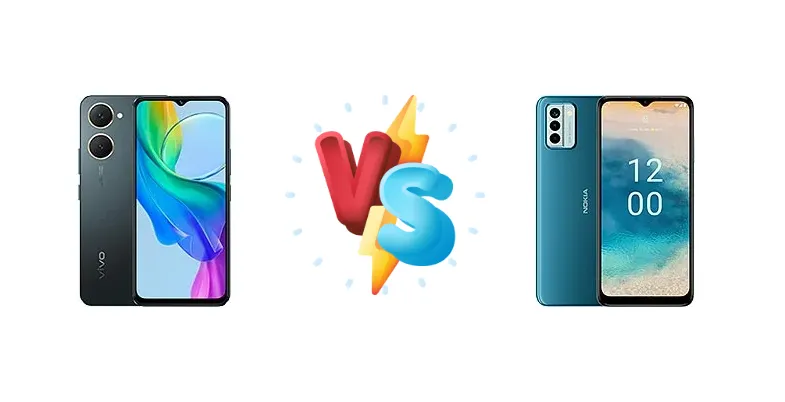
The sub-$150 smartphone market is fiercely competitive. Both the vivo Y03 and Nokia G22 aim to deliver essential smartphone functionality at an accessible price point. However, they take different approaches to achieving this, with the Y03 prioritizing a slightly more powerful processor while the G22 focuses on repairability and faster charging. This comparison dissects their key differences to help you choose the right device.
🏆 Quick Verdict
For most users, the vivo Y03 offers a slight edge due to its more capable Mediatek Helio G85 chipset, providing a smoother experience for demanding apps and light gaming. However, the Nokia G22’s 20W charging and focus on user repairability make it a compelling alternative for those prioritizing longevity and ease of maintenance.
| Network |
|---|
| 2G bands | GSM 850 / 900 / 1800 / 1900 | GSM 850 / 900 / 1800 / 1900 |
| 3G bands | HSDPA 850 / 900 / 2100 | HSDPA 850 / 900 / 2100 |
| 4G bands | 1, 3, 5, 8, 40 | 1, 3, 5, 7, 8, 20, 28, 38, 39, 40, 41 |
| Speed | HSPA, LTE | HSPA, LTE |
| Technology | GSM / HSPA / LTE | GSM / HSPA / LTE |
| Launch |
|---|
| Announced | 2024, March 13 | 2023, February 25 |
| Status | Available. Released 2024, March 13 | Available. Released 2023, February 25 |
| Body |
|---|
| Build | Glass front, plastic frame, plastic back | Glass front (Gorilla Glass 3), plastic frame, plastic back |
| Dimensions | 163.8 x 75.7 x 8.4 mm (6.45 x 2.98 x 0.33 in) | 165 x 76.2 x 8.5 mm (6.50 x 3.00 x 0.33 in) |
| SIM | Nano-SIM + Nano-SIM | Nano-SIM + Nano-SIM |
| Weight | 185 g (6.53 oz) | 196.2 g (6.91 oz) |
| | - | Dust and splash resistant
QuickFix user-reparable design |
| Display |
|---|
| Protection | - | Corning Gorilla Glass 3 |
| Resolution | 720 x 1612 pixels, 20:9 ratio (~269 ppi density) | 720 x 1600 pixels, 20:9 ratio (~270 ppi density) |
| Size | 6.56 inches, 103.4 cm2 (~83.4% screen-to-body ratio) | 6.5 inches, 102.0 cm2 (~81.1% screen-to-body ratio) |
| Type | IPS LCD, 90Hz | IPS LCD, 90Hz, 500 nits (typ) |
| Platform |
|---|
| CPU | Octa-core (2x2.0 GHz Cortex-A75 & 6x1.8 GHz Cortex-A55) | Octa-core (2x1.6 GHz Cortex-A75 & 6x1.6 GHz Cortex-A55) |
| Chipset | Mediatek Helio G85 (12 nm) | Unisoc T606 (12 nm) |
| GPU | Mali-G52 MC2 | Mali-G57 MP1 |
| OS | Android 14, Funtouch 14 | Android 12 |
| Memory |
|---|
| Card slot | microSDXC (dedicated slot) | microSDXC (uses shared SIM slot) |
| Internal | 64GB 4GB RAM, 128GB 4GB RAM | 64GB 4GB RAM, 128GB 4GB RAM, 256GB 6GB RAM |
| | - | UFS 2.2 |
| Main Camera |
|---|
| Features | LED flash, panorama | LED flash, HDR, panorama |
| Single | 13 MP, f/2.2, (wide), PDAF
Auxiliary lens | - |
| Triple | - | 50 MP, f/1.8, (wide), 1/2.76", 0.64µm, PDAF
2 MP (macro)
Auxiliary lens |
| Video | 1080p@30fps | 1080p@30fps |
| Selfie camera |
|---|
| Single | 5 MP, f/2.2, (wide) | 8 MP, f/2.0, (wide) |
| Video | Yes | 1080p@30fps |
| Sound |
|---|
| 3.5mm jack | - | Yes |
| 35mm jack | Yes | Yes |
| Loudspeaker | Yes | Yes |
| Comms |
|---|
| Bluetooth | 5.0, A2DP, LE | 5.0, A2DP, LE |
| NFC | No | Yes (market/region dependent) |
| Positioning | GPS, GALILEO, GLONASS, BDS, QZSS | GPS, GLONASS, GALILEO |
| Radio | FM radio | FM radio, RDS |
| USB | USB Type-C 2.0, OTG | USB Type-C 2.0, OTG |
| WLAN | Wi-Fi 802.11 a/b/g/n/ac, dual-band | Wi-Fi 802.11 a/b/g/n/ac, dual-band |
| Features |
|---|
| Sensors | Accelerometer, proximity | Fingerprint (side-mounted), accelerometer, proximity |
| Battery |
|---|
| Charging | 15W wired | 20W wired, PD3.0 |
| Type | Li-Ion 5000 mAh | Li-Po 5050 mAh |
| Misc |
|---|
| Colors | Space Black, Gem Green | Lagoon Blue, Meteor Gray, So Peach |
| Models | V2332 | - |
| Price | About 180 EUR | About 120 EUR |
vivo Y03
- More powerful Helio G85 processor
- Slightly better performance for apps and gaming
- Potentially smoother multitasking experience
- Slower 15W charging
- Likely less focus on repairability
Nokia G22
- Faster 20W charging with PD3.0 support
- Emphasis on user repairability
- Potentially longer software support due to Nokia's commitment
- Less powerful Unisoc T606 processor
- May exhibit more lag with demanding apps
Display Comparison
Neither device boasts a standout display. Both likely utilize LCD panels, common in this price bracket. Without specific display specs, it's reasonable to assume similar color accuracy and viewing angles. The focus here is on functionality, not visual fidelity. Bezels are likely to be substantial on both, maximizing screen real estate within the budget constraints.
Camera Comparison
Without detailed camera specifications, a direct comparison is difficult. However, it’s safe to assume both phones feature basic camera setups geared towards social media sharing rather than professional photography. The main sensor quality will be the determining factor, and without knowing the sensor sizes or apertures, it’s impossible to declare a clear winner. The inclusion of a 2MP macro camera on either device is largely a marketing tactic, offering limited practical benefit due to the low resolution and lack of optical image stabilization (OIS).
Performance
The core difference lies in the chipsets. The vivo Y03’s Mediatek Helio G85, built on a 12nm process, features a CPU configuration of 2x2.0 GHz Cortex-A75 and 6x1.8 GHz Cortex-A55 cores. This is a slight advantage over the Nokia G22’s Unisoc T606 (also 12nm) with its 2x1.6 GHz Cortex-A75 and 6x1.6 GHz Cortex-A55 cores. The higher clock speeds on the A75 cores in the Helio G85 translate to snappier app launches and better multitasking performance. While both are octa-core CPUs, the G85’s architecture provides a noticeable, albeit not massive, performance boost. The Unisoc T606 is still capable for basic tasks, but will likely exhibit more lag under heavier loads.
Battery Life
The Nokia G22 gains a significant advantage with its 20W wired charging, supporting PD3.0. This will result in considerably faster charging times compared to the vivo Y03’s 15W charging. While battery capacity isn’t specified, the faster charging speed of the G22 is a tangible benefit for users who frequently need to top up their phone. A full charge on the G22 will likely take around 90-120 minutes, while the Y03 could take upwards of 2 hours.
Buying Guide
Buy the vivo Y03 if you need a phone that can handle everyday tasks and occasional gaming with a bit more responsiveness. It’s ideal for users who prioritize performance within a tight budget. Buy the Nokia G22 if you value long-term usability and the ability to easily repair the device yourself, potentially saving money on costly repairs and extending its lifespan. It’s a great choice for environmentally conscious users.
Frequently Asked Questions
❓ Will the Unisoc T606 in the Nokia G22 struggle with popular apps like TikTok or Instagram?
The Unisoc T606 is capable of running these apps, but you may experience occasional lag or slowdowns, especially when multitasking. The Helio G85 in the vivo Y03 will provide a smoother experience for these types of applications.
❓ How much easier is the Nokia G22 to repair compared to other smartphones?
Nokia designed the G22 with user repairability in mind. Replacement parts (screen, battery, charging port) are readily available and can be installed with basic tools and online guides, potentially saving you money on professional repairs. This is a significant advantage over the vivo Y03, which is likely more difficult to repair.
❓ Does the vivo Y03 support fast charging protocols other than the standard 15W?
It's unlikely. The vivo Y03 is specified with 15W wired charging, and it's uncommon for phones in this price range to support more advanced fast charging standards. Using a higher wattage charger won't necessarily charge the phone faster, as the phone itself limits the charging rate.
❓ Is the Nokia G22 a good choice for gaming?
The Nokia G22 is not ideal for demanding mobile games. The Unisoc T606 processor will struggle with graphically intensive titles. It can handle casual games, but don't expect a smooth experience with games like PUBG or Genshin Impact.