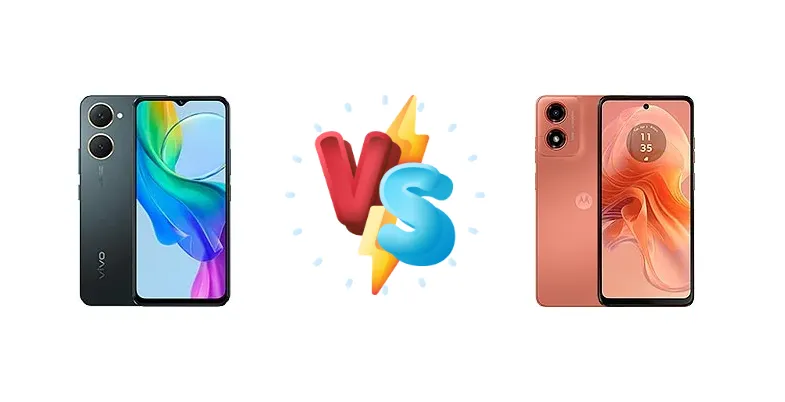
The sub-$150 smartphone market is fiercely competitive. Both the vivo Y03 and Motorola Moto G04s aim to deliver essential smartphone functionality at an accessible price. This comparison focuses on the core differences – specifically the Mediatek Helio G85 powering the vivo Y03 and the Unisoc T606 in the Moto G04s – to determine which device offers the best value for budget-conscious consumers.
🏆 Quick Verdict
For most users, the vivo Y03 emerges as the slightly better choice. While both phones share a 15W charging rate, the Helio G85 chipset offers a demonstrable performance advantage over the Unisoc T606, particularly in sustained workloads and gaming, making it a more future-proof option.
| Network |
|---|
| 2G bands | GSM 850 / 900 / 1800 / 1900 | GSM 850 / 900 / 1800 / 1900 |
| 3G bands | HSDPA 850 / 900 / 2100 | HSDPA 850 / 900 / 2100 |
| 4G bands | 1, 3, 5, 8, 40 | 1, 3, 5, 7, 8, 20, 28, 38, 40, 41 |
| Speed | HSPA, LTE | HSPA, LTE |
| Technology | GSM / HSPA / LTE | GSM / HSPA / LTE |
| Launch |
|---|
| Announced | 2024, March 13 | 2024, April 09 |
| Status | Available. Released 2024, March 13 | Available. Released 2024, April 29 |
| Body |
|---|
| Build | Glass front, plastic frame, plastic back | Glass front (Gorilla Glass 3), plastic frame, plastic back |
| Dimensions | 163.8 x 75.7 x 8.4 mm (6.45 x 2.98 x 0.33 in) | 163.5 x 74.5 x 8 mm (6.44 x 2.93 x 0.31 in) |
| SIM | Nano-SIM + Nano-SIM | Nano-SIM + Nano-SIM |
| Weight | 185 g (6.53 oz) | 178.8 g (6.31 oz) |
| Display |
|---|
| Protection | - | Corning Gorilla Glass 3 |
| Resolution | 720 x 1612 pixels, 20:9 ratio (~269 ppi density) | 720 x 1612 pixels, 20:9 ratio (~269 ppi density) |
| Size | 6.56 inches, 103.4 cm2 (~83.4% screen-to-body ratio) | 6.56 inches, 103.4 cm2 (~84.9% screen-to-body ratio) |
| Type | IPS LCD, 90Hz | IPS LCD, 90Hz |
| Platform |
|---|
| CPU | Octa-core (2x2.0 GHz Cortex-A75 & 6x1.8 GHz Cortex-A55) | Octa-core (2x1.6 GHz Cortex-A75 & 6x1.6 GHz Cortex-A55) |
| Chipset | Mediatek Helio G85 (12 nm) | Unisoc T606 (12 nm) |
| GPU | Mali-G52 MC2 | Mali-G57 MP1 |
| OS | Android 14, Funtouch 14 | Android 14, no major Android upgrades planned |
| Memory |
|---|
| Card slot | microSDXC (dedicated slot) | microSDXC (dedicated slot) |
| Internal | 64GB 4GB RAM, 128GB 4GB RAM | 64GB 4GB RAM, 128GB 4GB RAM, 128GB 8GB RAM, 256GB 4GB RAM |
| Main Camera |
|---|
| Features | LED flash, panorama | LED flash, HDR |
| Single | 13 MP, f/2.2, (wide), PDAF
Auxiliary lens | 50 MP, f/1.8, (wide), 0.64µm, PDAF |
| Video | 1080p@30fps | 1080p@30fps |
| Selfie camera |
|---|
| Features | - | HDR |
| Single | 5 MP, f/2.2, (wide) | 5 MP, f/2.2, (wide) |
| Video | Yes | 1080p@30fps |
| Sound |
|---|
| 35mm jack | Yes | Yes |
| Loudspeaker | Yes | Yes |
| Comms |
|---|
| Bluetooth | 5.0, A2DP, LE | 5.0, A2DP, LE |
| NFC | No | Yes (market/region dependent) |
| Positioning | GPS, GALILEO, GLONASS, BDS, QZSS | GPS, GALILEO, GLONASS |
| Radio | FM radio | No |
| USB | USB Type-C 2.0, OTG | USB Type-C 2.0 |
| WLAN | Wi-Fi 802.11 a/b/g/n/ac, dual-band | Wi-Fi 802.11 a/b/g/n/ac, dual-band |
| Features |
|---|
| Sensors | Accelerometer, proximity | Fingerprint (side-mounted), accelerometer, proximity |
| Battery |
|---|
| Charging | 15W wired | 15W wired |
| Type | Li-Ion 5000 mAh | 5000 mAh |
| Misc |
|---|
| Colors | Space Black, Gem Green | Concord Black, Sea Green, Satin Blue, Sunrise Orange |
| Models | V2332 | XT2421-8 |
| Price | About 180 EUR | £ 90.86 / € 78.23 |
vivo Y03
- More powerful Helio G85 chipset
- Potentially better gaming performance
- Slightly more efficient CPU architecture
- Software experience may be more heavily customized
- Unknown display specifications
Motorola Moto G04s
- Near-stock Android experience (potentially)
- Clean and simple user interface
- Competitive price point
- Less powerful Unisoc T606 chipset
- Slower CPU clock speeds
- Potentially lower gaming performance
Display Comparison
Neither vivo nor Motorola provide detailed display specifications beyond the basic panel type. Given the price point, both likely utilize LCD panels. The absence of high refresh rates or advanced features like LTPO is expected. The real-world difference in display quality will likely come down to color calibration and peak brightness, which are currently unknown. Bezels are expected to be substantial on both devices, reflecting their budget positioning.
Camera Comparison
Without detailed sensor information, a direct camera comparison is difficult. However, it’s safe to assume both phones feature a primary camera and potentially a depth or macro sensor. Given the market segment, image processing will likely prioritize computational photography to enhance image quality. The aperture of the main sensor will be a key factor; a wider aperture (lower f-number) will allow more light in, resulting in better low-light performance. The absence of Optical Image Stabilization (OIS) is expected on both devices. Focusing on the chipset's ISP capabilities, the Helio G85 generally offers more robust image signal processing features, potentially leading to slightly better image quality from the vivo Y03.
Performance
The core difference lies in the chipsets. The vivo Y03’s Mediatek Helio G85, built on a 12nm process, features a CPU configuration of 2x2.0 GHz Cortex-A75 cores and 6x1.8 GHz Cortex-A55 cores. The Motorola Moto G04s utilizes the Unisoc T606, also on a 12nm process, but with a slightly slower CPU configuration of 2x1.6 GHz Cortex-A75 cores and 6x1.6 GHz Cortex-A55 cores. This difference in clock speed, particularly on the performance cores, translates to a noticeable advantage for the Helio G85 in CPU-intensive tasks. While both chipsets are adequate for basic Android operation, the G85 will handle multitasking and more demanding apps with greater ease. The GPU within the Helio G85 also offers a performance edge, making it the better choice for casual gaming.
Battery Life
Both the vivo Y03 and Motorola Moto G04s feature 15W wired charging. This suggests similar charging times from 0-100%, likely exceeding 2 hours. Battery capacity is not specified, but given the phone's size and target market, it's reasonable to expect capacities around 5000mAh. The efficiency of the chipset and software optimization will play a crucial role in real-world battery life. While a larger battery capacity would be ideal, the Helio G85’s slightly more efficient architecture could translate to marginally better battery endurance in the vivo Y03, despite potentially similar battery sizes.
Buying Guide
Buy the vivo Y03 if you prioritize consistent performance for everyday tasks and occasional gaming. Its Helio G85 chipset provides a smoother experience when multitasking or running demanding applications. Buy the Motorola Moto G04s if you value a potentially cleaner software experience (Motorola's near-stock Android) and are primarily focused on basic communication and light usage, where the performance difference will be less noticeable.
Frequently Asked Questions
❓ Will the Unisoc T606 in the Moto G04s struggle with popular apps like Facebook or Instagram?
While the Unisoc T606 can handle basic social media apps, users may experience occasional lag or slowdowns when multitasking or using more demanding features within these apps. The Helio G85 in the vivo Y03 offers a smoother experience for these types of workloads.
❓ Is the 15W charging speed on either phone sufficient for daily use?
15W charging is relatively slow by modern standards. Expect a full charge to take over two hours. Neither phone prioritizes fast charging, focusing instead on affordability. Consider a faster charger if charging speed is a critical factor for you.
❓ Can I play games like PUBG Mobile or Call of Duty Mobile on the vivo Y03 or Moto G04s?
Both phones can *run* these games, but expect to play at low to medium settings to maintain a playable frame rate. The vivo Y03, with its Helio G85, will offer a more stable and enjoyable gaming experience compared to the Moto G04s.
❓ Which phone is likely to receive more software updates?
Motorola generally provides a more predictable update schedule, even for budget devices. However, vivo has been improving its software support in recent years. It's difficult to say definitively which phone will receive more updates, but Motorola has a slight edge in this area.