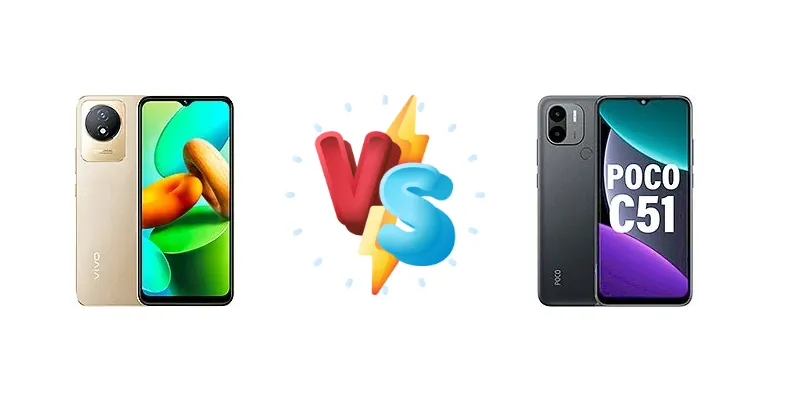
The sub-$150 smartphone market is fiercely competitive, and the vivo Y02t and Xiaomi Poco C51 are two contenders vying for your attention. Both devices aim to deliver essential smartphone functionality at an incredibly low price point, but they achieve this with different chipsets and subtle variations in features. This comparison will dissect their strengths and weaknesses to determine which phone offers the best value for budget-conscious users.
🏆 Quick Verdict
For most users, the Xiaomi Poco C51 emerges as the slightly better choice. While both phones share a 10W charging rate, the Poco C51’s Mediatek Helio G36 chipset offers a modest performance advantage over the vivo Y02t’s Helio P35, translating to a smoother experience with everyday tasks and slightly better gaming capabilities.
| Network |
|---|
| 2G bands | GSM 850 / 900 / 1800 / 1900 | GSM 850 / 900 / 1800 / 1900 |
| 3G bands | HSDPA 850 / 900 / 2100 | HSDPA 850 / 900 / 2100 |
| 4G bands | 1, 3, 5, 7, 8, 20, 28, 38, 40, 41 | 1, 3, 5, 8, 40, 41 |
| Speed | HSPA, LTE | HSPA, LTE |
| Technology | GSM / HSPA / LTE | GSM / HSPA / LTE |
| Launch |
|---|
| Announced | 2023, July 12 | 2023, April 07 |
| Status | Available. Released 2023, July 22 | Available. Released 2023, April 13 |
| Body |
|---|
| Build | Glass front, plastic back, plastic frame | - |
| Dimensions | 164 x 75.6 x 8.5 mm (6.46 x 2.98 x 0.33 in) | 164.9 x 76.8 x 9.1 mm (6.49 x 3.02 x 0.36 in) |
| SIM | Nano-SIM + Nano-SIM | Nano-SIM + Nano-SIM |
| Weight | 186 g (6.56 oz) | 192 g (6.77 oz) |
| Display |
|---|
| Resolution | 720 x 1600 pixels, 20:9 ratio (~270 ppi density) | 720 x 1600 pixels, 20:9 ratio (~269 ppi density) |
| Size | 6.51 inches, 102.3 cm2 (~82.5% screen-to-body ratio) | 6.52 inches, 102.6 cm2 (~81.0% screen-to-body ratio) |
| Type | IPS LCD | IPS LCD, 400 nits (typ) |
| Platform |
|---|
| CPU | Octa-core (4x2.35 GHz Cortex-A53 & 4x1.8 GHz Cortex-A53) | Octa-core (4x2.2 GHz Cortex-A53 & 4x1.7 GHz Cortex-A53) |
| Chipset | Mediatek MT6765 Helio P35 (12 nm) | Mediatek Helio G36 (12 nm) |
| GPU | PowerVR GE8320 | PowerVR GE8320 |
| OS | Android 13, Funtouch 13 | Android 13 (Go edition), MIUI |
| Memory |
|---|
| Card slot | microSDXC (dedicated slot) | microSDXC (dedicated slot) |
| Internal | 64GB 4GB RAM, 128GB 4GB RAM | 64GB 4GB RAM, 128GB 6GB RAM |
| | - | eMMC 5.1 |
| Main Camera |
|---|
| Dual | - | 8 MP, f/2.0, (wide)
0.08 MP (depth) |
| Features | LED flash | Dual-LED flash, HDR |
| Single | 8 MP, f/2.0 | 8 MP, f/2.0, (wide)
Auxiliary lens |
| Video | 1080p@30fps | 1080p@30fps |
| Selfie camera |
|---|
| Single | 5 MP, f/2.2 | 5 MP, f/2.2 |
| Video | Yes | 1080p@30fps |
| Sound |
|---|
| 3.5mm jack | - | Yes |
| 35mm jack | Yes | Yes |
| Loudspeaker | Yes | Yes |
| Comms |
|---|
| Bluetooth | 5.0, A2DP, LE | 5.0, A2DP, LE |
| NFC | No | No |
| Positioning | GPS, GLONASS, GALILEO, BDS, QZSS | GPS, GLONASS, BDS |
| Radio | FM radio | FM radio, recording |
| USB | microUSB 2.0, OTG | microUSB 2.0, OTG |
| WLAN | Wi-Fi 802.11 a/b/g/n/ac, dual-band | Wi-Fi 802.11 b/g/n |
| Features |
|---|
| Sensors | Accelerometer, gyro, proximity, compass (market/region dependent) | Fingerprint (rear-mounted), accelerometer |
| Battery |
|---|
| Charging | 10W wired
5W reverse wired | 10W wired |
| Type | 5000 mAh | Li-Po 5000 mAh |
| Misc |
|---|
| Colors | Orchid Blue, Cosmic Grey, Sunset Gold | Power Black, Royal Blue |
| Models | V2254, V2252 | MZB0E6DIN, MZB0DXKIN, 2302EPCC4I, 2305EPCC4G, 2302EPCC4H |
| Price | - | About 100 EUR |
| SAR | - | 0.97 W/kg (head) 0.87 W/kg (body) |
vivo Y02t
- Potentially more refined software experience (vivo's Funtouch OS)
- Slightly higher CPU clock speed (Helio P35)
- Established brand reputation for reliability
- Less powerful chipset (Helio P35)
- Likely lower performance in demanding tasks
- May have more bloatware than stock Android
Xiaomi Poco C51
- More powerful chipset (Helio G36)
- Better performance for the price
- MIUI offers extensive customization options
- MIUI can be resource-intensive
- Potential for pre-installed bloatware
- Xiaomi's software update track record can be inconsistent
Display Comparison
Neither the vivo Y02t nor the Poco C51 boast impressive displays. Both likely utilize standard LCD panels, and detailed specifications like peak brightness and color gamut coverage are unavailable. The focus here is purely on functionality, not visual fidelity. Bezels are expected to be substantial on both devices, reflecting their budget nature. Color accuracy will likely be standard for this price range, meaning it won't be suitable for color-critical work.
Camera Comparison
Camera performance on both devices will be limited. Details regarding sensor size and image processing are scarce, but it’s safe to assume both phones rely on basic image sensors. The presence of a 2MP macro camera on both is largely a marketing tactic, as the image quality will be significantly lower than the main sensor. Expect acceptable results in well-lit conditions, but struggle in low light. The focus should be on capturing memories, not professional-quality photographs.
Performance
The core difference between these two phones lies in their chipsets. The Poco C51 features the Mediatek Helio G36, with a CPU clocked up to 2.2 GHz, while the vivo Y02t uses the Helio P35, peaking at 2.35 GHz. While the P35 has a slightly higher clock speed, the G36 benefits from a newer architecture and improved efficiency. This translates to a more responsive user experience on the Poco C51, particularly when multitasking or running demanding applications. Both phones utilize the same Cortex-A53 cores, but the G36’s overall architecture provides a noticeable edge. Neither phone is a gaming powerhouse, but the G36 will handle less demanding titles with greater ease.
Battery Life
Both the vivo Y02t and Poco C51 are equipped with 10W wired charging, meaning charging times will be relatively slow. While battery capacity isn't specified, both are likely to house a 5000mAh battery, typical for this price segment. The slightly more efficient Helio G36 in the Poco C51 may contribute to marginally better battery life, but real-world usage will depend heavily on individual usage patterns. Expect a full charge to take well over two hours.
Buying Guide
Buy the vivo Y02t if you prioritize a brand with a strong track record for software stability and a slightly more refined user experience, even if it means sacrificing a small amount of processing power. Buy the Xiaomi Poco C51 if you want the best possible performance for the price, and are comfortable with Xiaomi’s MIUI software, which offers more customization options but can sometimes include pre-installed bloatware.
Frequently Asked Questions
❓ Will the Poco C51 struggle with popular social media apps like TikTok and Instagram?
While the Poco C51 won't offer a flagship-level experience, the Helio G36 chipset is capable of handling most social media apps smoothly. Expect acceptable performance for browsing feeds, watching videos, and posting content. However, intensive tasks like video editing within these apps may experience some lag.
❓ Is the 10W charging on either phone fast enough for overnight charging?
Yes, 10W charging is sufficient for overnight charging. While it won't provide a quick top-up, leaving either phone plugged in overnight will ensure a full charge by morning. Expect a full charge to take approximately 3-4 hours.
❓ Can either of these phones handle basic mobile games like Candy Crush or Subway Surfers?
Absolutely. Both the vivo Y02t and Poco C51 can comfortably handle casual mobile games like Candy Crush and Subway Surfers. The Poco C51’s Helio G36 will provide a slightly smoother experience, but both phones are capable of running these titles without significant issues.
❓ How much storage do these phones typically come with, and is it expandable?
These phones typically come with 32GB or 64GB of internal storage. Both the vivo Y02t and Poco C51 feature a dedicated microSD card slot, allowing you to expand the storage capacity up to 1TB, providing ample space for photos, videos, and apps.