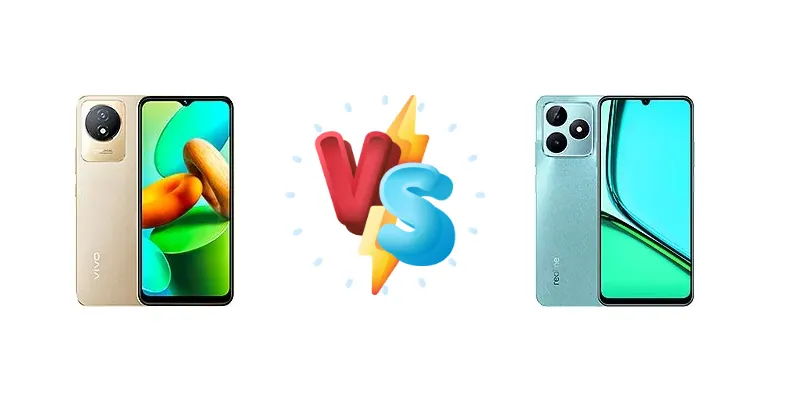
The sub-$150 smartphone market is fiercely competitive. Both the vivo Y02t and Realme C51s aim to deliver essential smartphone functionality at an accessible price. However, they take different approaches: the Y02t prioritizes a more established, if older, chipset, while the C51s opts for a newer Unisoc processor and significantly faster charging. This comparison will dissect the key differences to determine which device offers the best value.
🏆 Quick Verdict
For the average user prioritizing quick top-ups and a more responsive experience, the Realme C51s is the better choice. Its 33W charging dramatically reduces downtime compared to the vivo Y02t’s 10W charging. While the Helio P35 in the Y02t is power efficient, the Tiger T612 offers a noticeable performance uplift for everyday tasks.
| Network |
|---|
| 2G bands | GSM 850 / 900 / 1800 / 1900 | GSM 850 / 900 / 1800 / 1900 |
| 3G bands | HSDPA 850 / 900 / 2100 | HSDPA 900 / 2100 |
| 4G bands | 1, 3, 5, 7, 8, 20, 28, 38, 40, 41 | 1, 3, 5, 8, 38, 40 |
| Speed | HSPA, LTE | HSPA, LTE |
| Technology | GSM / HSPA / LTE | GSM / HSPA / LTE |
| Launch |
|---|
| Announced | 2023, July 12 | 2024, March 15 |
| Status | Available. Released 2023, July 22 | Available. Released 2024, March 15 |
| Body |
|---|
| Build | Glass front, plastic back, plastic frame | Glass front, plastic frame, plastic back |
| Dimensions | 164 x 75.6 x 8.5 mm (6.46 x 2.98 x 0.33 in) | 167.2 x 76.7 x 7.5 mm (6.58 x 3.02 x 0.30 in) |
| SIM | Nano-SIM + Nano-SIM | Nano-SIM + Nano-SIM |
| Weight | 186 g (6.56 oz) | 182 g (6.42 oz) |
| Display |
|---|
| Resolution | 720 x 1600 pixels, 20:9 ratio (~270 ppi density) | 720 x 1600 pixels, 20:9 ratio (~260 ppi density) |
| Size | 6.51 inches, 102.3 cm2 (~82.5% screen-to-body ratio) | 6.74 inches, 109.7 cm2 (~85.5% screen-to-body ratio) |
| Type | IPS LCD | IPS LCD, 90Hz, 560 nits (peak) |
| Platform |
|---|
| CPU | Octa-core (4x2.35 GHz Cortex-A53 & 4x1.8 GHz Cortex-A53) | Octa-core (2x1.8 GHz Cortex-A75 & 6x1.8 GHz Cortex-A55) |
| Chipset | Mediatek MT6765 Helio P35 (12 nm) | Unisoc Tiger T612 (12 nm) |
| GPU | PowerVR GE8320 | Mali-G57 |
| OS | Android 13, Funtouch 13 | Android 13, Realme UI |
| Memory |
|---|
| Card slot | microSDXC (dedicated slot) | microSDXC (dedicated slot) |
| Internal | 64GB 4GB RAM, 128GB 4GB RAM | 128GB 6GB RAM |
| Main Camera |
|---|
| Features | LED flash | LED flash, HDR, panorama |
| Single | 8 MP, f/2.0 | 50 MP, f/1.8, 27mm (wide), 1/2.76", 0.64µm, PDAF
Auxiliary lens |
| Video | 1080p@30fps | 1080p@30fps |
| Selfie camera |
|---|
| Features | - | HDR |
| Single | 5 MP, f/2.2 | 5 MP, f/2.2, 28mm (wide), 1/5.0", 1.12µm |
| Video | Yes | 720p@30fps |
| Sound |
|---|
| 35mm jack | Yes | Yes |
| Loudspeaker | Yes | Yes |
| Comms |
|---|
| Bluetooth | 5.0, A2DP, LE | 5.0, A2DP, LE |
| NFC | No | Yes, 360˚ (market/region dependent) |
| Positioning | GPS, GLONASS, GALILEO, BDS, QZSS | GPS, GLONASS, GALILEO |
| Radio | FM radio | Unspecified |
| USB | microUSB 2.0, OTG | USB Type-C |
| WLAN | Wi-Fi 802.11 a/b/g/n/ac, dual-band | Wi-Fi 802.11 a/b/g/n/ac, dual-band |
| Features |
|---|
| Sensors | Accelerometer, gyro, proximity, compass (market/region dependent) | Fingerprint (side-mounted), accelerometer, gyro, proximity, compass |
| Battery |
|---|
| Charging | 10W wired
5W reverse wired | 33W wired, 0-50% in 28 min |
| Type | 5000 mAh | 5000 mAh |
| Misc |
|---|
| Colors | Orchid Blue, Cosmic Grey, Sunset Gold | Shiny Green, Mighty Black |
| Models | V2254, V2252 | RMX3765 |
| Price | - | About 100 EUR |
vivo Y02t
- Potentially longer battery life due to the Helio P35's efficiency.
- Established MediaTek chipset with known performance characteristics.
- Likely a more affordable price point.
- Significantly slower 10W charging.
- Older CPU architecture resulting in slower app loading and multitasking.
- Less responsive user experience compared to the C51s.
Realme C51s
- 33W fast charging for quick top-ups.
- More modern Unisoc Tiger T612 chipset with better CPU performance.
- More responsive user experience for everyday tasks.
- Potentially slightly shorter battery life compared to the Y02t.
- Unisoc chipset may have less software optimization compared to MediaTek.
- May be slightly more expensive than the Y02t.
Display Comparison
Neither device boasts a standout display. Both likely utilize LCD panels, typical for this price bracket. Specifics like resolution and peak brightness are not provided, but we can assume they are similar – around 720p+ and modest brightness levels. The focus here isn’t on visual fidelity, but on basic usability. Bezels are likely to be noticeable on both, and color accuracy will be standard for budget phones.
Camera Comparison
Camera performance is likely to be similar, with both phones probably featuring a primary sensor around 13MP. Without specific aperture or sensor size details, it’s difficult to make a definitive judgment. However, the image processing capabilities of Unisoc chipsets have improved, potentially giving the C51s a slight edge in image quality. The inclusion of a 2MP macro camera on both devices is largely a marketing tactic, offering limited practical benefit due to the low resolution and lack of optical image stabilization (OIS).
Performance
The core difference lies in the chipsets. The Realme C51s’ Unisoc Tiger T612 features a more modern CPU architecture with 2x Cortex-A75 cores alongside 6x Cortex-A55 cores, compared to the vivo Y02t’s MediaTek Helio P35 which uses 4x Cortex-A53 cores at a higher clock speed (2.35GHz) paired with another 4x Cortex-A53 cores. While the P35’s higher clock speed *sounds* better, the A75 cores in the T612 offer significantly better single-core performance, translating to snappier app launches and smoother multitasking. The T612’s architecture is more efficient for handling modern app demands. The Y02t will likely be adequate for basic tasks, but the C51s will feel more responsive.
Battery Life
Both phones likely feature around a 5000mAh battery, a standard capacity for this segment. However, the Realme C51s’ 33W charging is a game-changer. The ability to charge from 0-50% in just 28 minutes significantly reduces downtime compared to the vivo Y02t’s slow 10W charging. While the Y02t might offer slightly longer overall battery life due to the more efficient Helio P35, the convenience of the C51s’ fast charging is a major advantage for most users.
Buying Guide
Buy the vivo Y02t if you absolutely need maximum battery life and are willing to sacrifice charging speed and overall performance. It’s ideal for users who primarily make calls, send texts, and occasionally browse social media. Buy the Realme C51s if you value a more fluid user experience, faster app loading times, and the convenience of rapid charging, even if it means slightly less battery longevity.
Frequently Asked Questions
❓ Will the Realme C51s struggle with demanding games like PUBG Mobile?
While the Unisoc Tiger T612 isn't a gaming powerhouse, it should be capable of running PUBG Mobile at medium settings with reasonable frame rates. Expect some frame drops during intense action. The Helio P35 in the Y02t will likely struggle more with demanding titles.
❓ How much faster is the 33W charging on the Realme C51s compared to the vivo Y02t's 10W charging in real-world use?
The difference is substantial. The C51s can reach 50% charge in approximately 28 minutes, while the Y02t will take well over 2 hours to reach the same level. This means you can quickly top up the C51s during a short break, whereas the Y02t requires overnight charging for a full refill.
❓ Is the Unisoc Tiger T612 chipset reliable and well-supported?
Unisoc has been steadily improving its chipsets, and the Tiger T612 is a capable processor. While it doesn't have the same brand recognition as MediaTek, it offers good performance for the price. Software support and updates may vary depending on Realme's commitment.
❓ Does either phone support microSD card expansion for additional storage?
While not explicitly stated in the provided specs, both the vivo Y02t and Realme C51s are highly likely to support microSD card expansion, a common feature in budget smartphones. Check the product listing for the maximum supported capacity.