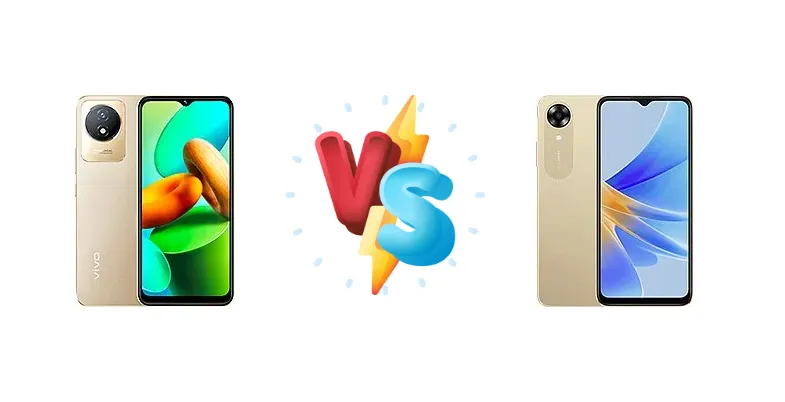
The vivo Y02t and Oppo A17k represent the fiercely competitive sub-$150 smartphone market. Both devices target first-time smartphone buyers and those seeking a reliable secondary device. The core difference lies in their chipsets – the Mediatek Helio P35 in the Y02t and the Helio G35 in the A17k – and understanding their implications is key to making the right choice.
🏆 Quick Verdict
For the average user prioritizing basic functionality and slightly better gaming potential, the Oppo A17k edges out the vivo Y02t. The Helio G35 offers a marginal performance boost, making it more responsive for everyday tasks and light gaming, despite both phones sharing similar overall specifications.
| Network |
|---|
| 2G bands | GSM 850 / 900 / 1800 / 1900 | GSM 850 / 900 / 1800 / 1900 |
| 3G bands | HSDPA 850 / 900 / 2100 | HSDPA 850 / 900 / 2100 |
| 4G bands | 1, 3, 5, 7, 8, 20, 28, 38, 40, 41 | 1, 3, 5, 8, 38, 40, 41 |
| Speed | HSPA, LTE | HSPA, LTE |
| Technology | GSM / HSPA / LTE | GSM / HSPA / LTE |
| Launch |
|---|
| Announced | 2023, July 12 | 2022, October 13 |
| Status | Available. Released 2023, July 22 | Available. Released 2022, October 18 |
| Body |
|---|
| Build | Glass front, plastic back, plastic frame | - |
| Dimensions | 164 x 75.6 x 8.5 mm (6.46 x 2.98 x 0.33 in) | 164.2 x 75.6 x 8.3 mm (6.46 x 2.98 x 0.33 in) |
| SIM | Nano-SIM + Nano-SIM | Nano-SIM + Nano-SIM |
| Weight | 186 g (6.56 oz) | 189 g (6.67 oz) |
| | - | IPX4 water resistance |
| Display |
|---|
| Protection | - | Panda Glass |
| Resolution | 720 x 1600 pixels, 20:9 ratio (~270 ppi density) | 720 x 1612 pixels, 20:9 ratio (~269 ppi density) |
| Size | 6.51 inches, 102.3 cm2 (~82.5% screen-to-body ratio) | 6.56 inches, 103.4 cm2 (~83.3% screen-to-body ratio) |
| Type | IPS LCD | IPS LCD, 480 nits (typ), 600 nits (HBM) |
| Platform |
|---|
| CPU | Octa-core (4x2.35 GHz Cortex-A53 & 4x1.8 GHz Cortex-A53) | Octa-core (4x2.3 GHz Cortex-A53 & 4x1.8 GHz Cortex-A53) |
| Chipset | Mediatek MT6765 Helio P35 (12 nm) | Mediatek MT6765 Helio G35 (12 nm) |
| GPU | PowerVR GE8320 | PowerVR GE8320 |
| OS | Android 13, Funtouch 13 | Android 12, ColorOS 12.1 |
| Memory |
|---|
| Card slot | microSDXC (dedicated slot) | microSDXC |
| Internal | 64GB 4GB RAM, 128GB 4GB RAM | 64GB 3GB RAM |
| | - | eMMC 5.1 |
| Main Camera |
|---|
| Features | LED flash | LED flash, panorama |
| Single | 8 MP, f/2.0 | 8 MP, f/2.0, (wide), AF |
| Video | 1080p@30fps | 1080p@30fps |
| Selfie camera |
|---|
| Single | 5 MP, f/2.2 | 5 MP, f/2.2, (wide) |
| Video | Yes | 1080p@30fps |
| Sound |
|---|
| 3.5mm jack | - | Yes |
| 35mm jack | Yes | Yes |
| Loudspeaker | Yes | Yes |
| Comms |
|---|
| Bluetooth | 5.0, A2DP, LE | 5.3, A2DP, LE, aptX HD |
| NFC | No | No |
| Positioning | GPS, GLONASS, GALILEO, BDS, QZSS | GPS, GLONASS, BDS, GALILEO |
| Radio | FM radio | Unspecified |
| USB | microUSB 2.0, OTG | microUSB 2.0, OTG |
| WLAN | Wi-Fi 802.11 a/b/g/n/ac, dual-band | Wi-Fi 802.11 a/b/g/n/ac, dual-band |
| Features |
|---|
| Sensors | Accelerometer, gyro, proximity, compass (market/region dependent) | Fingerprint (side-mounted), accelerometer, proximity, compass |
| Battery |
|---|
| Charging | 10W wired
5W reverse wired | - |
| Type | 5000 mAh | Li-Po 5000 mAh |
| Misc |
|---|
| Colors | Orchid Blue, Cosmic Grey, Sunset Gold | Navy Blue, Gold |
| Models | V2254, V2252 | CPH2471 |
| Price | - | About 130 EUR |
vivo Y02t
- Slightly higher CPU clock speed on the Helio P35 (potentially better single-core performance)
- 5W reverse wired charging for emergency device top-ups
- Established brand recognition within the vivo ecosystem
- Helio P35 chipset is less optimized for gaming than the G35
- Likely similar camera performance to the Oppo A17k
Oppo A17k
- Helio G35 chipset offers a marginal gaming performance advantage
- Potentially smoother multitasking experience
- Competitive pricing within the budget segment
- Lacks reverse wired charging functionality
- Oppo's software experience can be divisive for some users
Display Comparison
Neither device boasts a standout display. Both likely utilize standard IPS LCD panels, given their price point. Detailed specifications regarding brightness (nits) and color gamut coverage are unavailable, but we can assume both offer adequate, but not exceptional, viewing experiences indoors. Bezels are likely to be noticeable on both, contributing to a less immersive experience compared to higher-end devices. Color accuracy will likely be standard for this segment, prioritizing power efficiency over precise color reproduction.
Camera Comparison
Camera performance will be comparable, and likely underwhelming. Both devices likely feature a primary camera alongside basic depth or macro sensors (details are missing). The image processing capabilities of both phones will be geared towards maximizing detail in good lighting conditions, but will struggle in low-light scenarios. The aperture of the main sensor is a critical factor missing from the data; a wider aperture (lower f-number) would allow more light to reach the sensor, improving low-light performance. Without this information, it’s difficult to definitively say which phone has the better camera system. The 2MP macro sensors found on many phones in this price range offer limited practical benefit.
Performance
The core difference lies in the chipsets. The Oppo A17k’s Mediatek Helio G35 (12nm) features a slightly higher CPU clock speed (4x2.3 GHz Cortex-A53) compared to the vivo Y02t’s Helio P35 (12nm) (4x2.35 GHz Cortex-A53). While the difference appears minimal, the 'G' series from Mediatek typically indicates a focus on gaming, often with minor GPU optimizations. Both chips share the same 4x1.8 GHz Cortex-A53 cores for efficiency. This translates to a marginally smoother experience on the A17k during light gaming and app switching. However, both phones will struggle with graphically intensive titles. RAM configurations are likely similar, further minimizing the performance gap.
Battery Life
Both phones feature 10W wired charging, indicating similar charging speeds. The actual battery capacity is not specified, but given the target market, we can estimate capacities around 5000mAh. The vivo Y02t adds 5W reverse wired charging, a niche feature allowing it to charge other devices, albeit slowly. In real-world usage, both phones should comfortably last a full day with moderate use, focusing on tasks like calling, messaging, and social media. Expect approximately 2-3 hours of screen-on time. The 10W charging will require several hours to fully charge from 0-100%.
Buying Guide
Buy the vivo Y02t if you prioritize a slightly more established brand reputation within the vivo ecosystem and are primarily focused on essential smartphone functions like calling, messaging, and basic social media. Buy the Oppo A17k if you anticipate slightly more demanding usage, including occasional gaming or multitasking, and value the incremental performance gains offered by the Helio G35 chipset.
Frequently Asked Questions
❓ Will the Oppo A17k handle games like PUBG Mobile or Call of Duty Mobile?
While the Helio G35 is slightly better for gaming than the Helio P35, both phones will struggle with PUBG Mobile and Call of Duty Mobile. You'll likely need to play at the lowest graphics settings and frame rates to achieve a playable experience, and even then, expect occasional stuttering and lag. These phones are better suited for less demanding games.
❓ How long will the battery last on the vivo Y02t with typical usage?
With typical usage – including calls, messaging, social media, and some web browsing – the vivo Y02t should comfortably last a full day on a single charge. Expect around 2-3 hours of screen-on time. However, heavy gaming or prolonged video streaming will significantly reduce battery life.
❓ Is the 5W reverse charging on the vivo Y02t useful?
The 5W reverse charging is a niche feature. It's useful in emergency situations to provide a small top-up charge to another device, like a wireless earbud case. However, it's a very slow charging method and shouldn't be relied upon for regular charging of other devices.
❓ Which phone is better for someone who primarily uses WhatsApp and makes calls?
For users primarily focused on WhatsApp and calls, the difference between the two phones is minimal. Both will perform these tasks flawlessly. The Oppo A17k's slightly better chipset might offer a marginally smoother experience when switching between apps, but it's unlikely to be noticeable for basic usage.