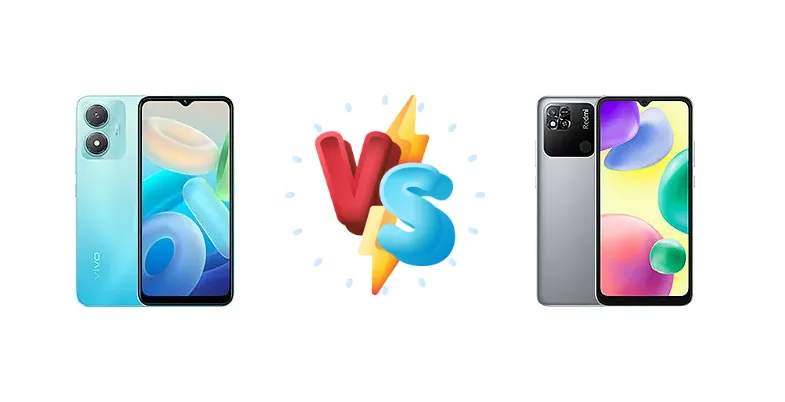
Looking for an affordable smartphone that doesn't completely break the bank? The vivo Y02s and Xiaomi Redmi 10A are both contenders in the budget phone arena. But which one offers the best bang for your buck? Let's dive into a detailed comparison to help you decide.
🏆 Quick Verdict
The vivo Y02s edges out the Redmi 10A thanks to its slightly more powerful chipset and potentially better display. However, the Redmi 10A might offer a more polished software experience and potentially better availability depending on your region. Both are solid choices for basic users.
| Network |
|---|
| 2G bands | GSM 850 / 900 / 1800 / 1900 | GSM 850 / 900 / 1800 / 1900 |
| 3G bands | HSDPA 850 / 900 / 2100 | HSDPA 850 / 900 / 2100 |
| 4G bands | 1, 3, 5, 7, 8, 20, 28, 38, 40, 41 | 1, 3, 5, 8, 40, 41 - International |
| Speed | HSPA, LTE | HSPA, LTE |
| Technology | GSM / HSPA / LTE | GSM / HSPA / CDMA2000 / LTE |
| | - | 1, 3, 5, 8, 34, 38, 39, 40, 41 - China |
| Launch |
|---|
| Announced | 2022, August 01 | 2022, March 29 |
| Status | Available. Released 2022, August 22 | Available. Released 2022, March 31 |
| Body |
|---|
| Build | Glass front, plastic back, plastic frame | - |
| Dimensions | 164 x 76 x 8.2 mm (6.46 x 2.99 x 0.32 in) | 164.9 x 77.1 x 9 mm (6.49 x 3.04 x 0.35 in) |
| SIM | Nano-SIM + Nano-SIM | Nano-SIM + Nano-SIM |
| Weight | 182 g (6.42 oz) | 194 g (6.84 oz) |
| Display |
|---|
| Resolution | 720 x 1600 pixels, 20:9 ratio (~270 ppi density) | 720 x 1600 pixels, 20:9 ratio (~269 ppi density) |
| Size | 6.51 inches, 102.3 cm2 (~82.1% screen-to-body ratio) | 6.53 inches, 102.9 cm2 (~81.0% screen-to-body ratio) |
| Type | IPS LCD | IPS LCD, 400 nits (typ) |
| Platform |
|---|
| CPU | Octa-core (4x2.35 GHz Cortex-A53 & 4x1.8 GHz Cortex-A53) | Octa-core (4x2.0 GHz Cortex-A53 & 4x1.5 GHz Cortex-A53) |
| Chipset | Mediatek MT6765 Helio P35 (12 nm) | Mediatek MT6762G Helio G25 (12 nm) |
| GPU | PowerVR GE8320 | PowerVR GE8320 |
| OS | Android 12, Funtouch 12 | Android 11, MIUI 12.5 |
| Memory |
|---|
| Card slot | microSDXC (dedicated slot) | microSDXC |
| Internal | 32GB 2GB RAM, 32GB 3GB RAM, 64GB 3GB RAM | 32GB 2GB RAM, 32GB 3GB RAM, 64GB 3GB RAM, 64GB 4GB RAM, 128GB 4GB RAM, 128GB 6GB RAM |
| | eMMC 5.1 | - |
| Main Camera |
|---|
| Features | LED flash | LED flash |
| Single | 8 MP, f/2.0, AF | 13 MP, f/2.2, (wide), 1.0µm, AF |
| Video | 1080p@30fps | 1080p@30fps |
| Selfie camera |
|---|
| Features | - | HDR |
| Single | 5 MP, f/2.2 | 5 MP |
| Video | - | 1080p@30fps |
| Sound |
|---|
| 3.5mm jack | Yes | Yes |
| 35mm jack | Yes | Yes |
| Loudspeaker | Yes | Yes |
| Comms |
|---|
| Bluetooth | 5.0, A2DP, LE | 5.0, A2DP, LE |
| NFC | No | No |
| Positioning | GPS, GLONASS, BDS, GALILEO | GPS, GLONASS, BDS |
| Radio | FM radio | No |
| USB | USB Type-C 2.0; OTG | microUSB 2.0 |
| WLAN | Wi-Fi 802.11 a/b/g/n/ac, dual-band | Wi-Fi 802.11 a/b/g/n, Wi-Fi Direct |
| Features |
|---|
| Sensors | Accelerometer, proximity, compass | Fingerprint (rear-mounted), accelerometer, proximity |
| Battery |
|---|
| Charging | 10W wired | 10W wired |
| Type | 5000 mAh | Li-Ion 5000 mAh |
| Misc |
|---|
| Colors | Vibrant Blue, Fluorite Black | Charcoal Black, Sea Blue, Slate Grey |
| Models | V2203 | 220233L2C, 220233L2G, 220233L2I |
| Price | About 100 EUR | € 60.00 / $ 66.55 |
| SAR | - | 0.90 W/kg (head) 0.65 W/kg (body) |
| SAR EU | - | 0.40 W/kg (head) 0.99 W/kg (body) |
vivo Y02s
- Slightly more powerful chipset
- Potentially better display quality
- Decent battery life
- Stylish design (subjective)
- 10W charging is slow
- Limited software updates potentially
- Camera performance may be inconsistent
Xiaomi Redmi 10A
- Clean MIUI software experience
- Good availability
- Reliable performance for basic tasks
- Decent battery life
- Less powerful chipset than Y02s
- Display quality may be slightly inferior
- 10W charging is slow
Display Comparison
Both phones feature a 6.51-inch HD+ display, offering decent viewing angles for everyday use. While specific panel types aren't always detailed, the vivo Y02s *may* have slightly better color accuracy and brightness due to its chipset's capabilities, but this is largely speculative without detailed testing.
Camera Comparison
The Redmi 10A typically features a 13MP main camera, while the Y02s often has a similar resolution. Image quality will largely depend on software processing. The Redmi 10A's MIUI software often provides more refined image processing, potentially resulting in slightly better photos in certain conditions. Both phones likely offer basic selfie cameras.
Performance
The vivo Y02s boasts the Helio P35 chipset, which has a slightly higher clock speed on its performance cores compared to the Redmi 10A's Helio G25. This translates to marginally better performance in everyday tasks and light gaming. However, neither phone is a powerhouse.
Battery Life
Both phones have a 5000mAh battery, promising all-day battery life for moderate users. Charging speeds are identical at 10W, meaning charging will take a considerable amount of time.
Buying Guide
The vivo Y02s is ideal for users prioritizing a slightly smoother performance and a potentially better screen. The Xiaomi Redmi 10A is a good fit for those seeking a reliable, widely available phone with a clean MIUI experience and potentially better software support.
Frequently Asked Questions
❓ Which phone is better for gaming?
Neither phone is ideal for demanding games. The vivo Y02s has a slightly more powerful chipset, but both will struggle with high graphics settings. Stick to lighter games.
❓ How long does the battery last on each phone?
Both phones offer all-day battery life with moderate usage. Expect around 8-10 hours of screen-on time.
❓ Which phone has better software support?
Xiaomi generally provides better software updates and longer support for its devices, so the Redmi 10A likely has an edge in this area.