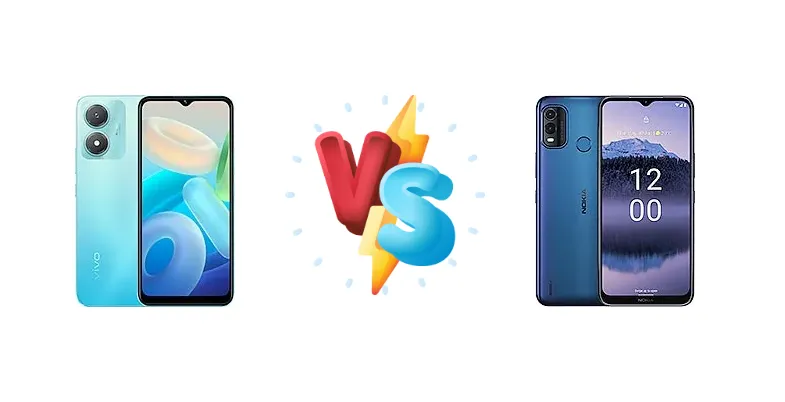
The sub-$150 smartphone market is fiercely competitive. Both the vivo Y02s and Nokia G11 Plus aim to deliver essential smartphone functionality at an accessible price point. However, they achieve this with different chipsets – the Mediatek Helio P35 in the vivo and the Unisoc T606 in the Nokia – leading to distinct performance characteristics. This comparison will dissect these differences to help you choose the right device.
🏆 Quick Verdict
For the average user prioritizing responsiveness in everyday tasks, the Nokia G11 Plus emerges as the better choice. Its Unisoc T606 chipset, featuring Cortex-A75 cores, offers a noticeable performance advantage over the Helio P35’s all-A53 configuration, despite both being fabricated on a 12nm process. While both offer similar battery and charging capabilities, the Nokia’s slightly more efficient processor translates to better real-world usability.
| Network |
|---|
| 2G bands | GSM 850 / 900 / 1800 / 1900 | GSM 850 / 900 / 1800 / 1900 |
| 3G bands | HSDPA 850 / 900 / 2100 | HSDPA 850 / 900 / 2100 - International |
| 4G bands | 1, 3, 5, 7, 8, 20, 28, 38, 40, 41 | 1, 3, 5, 7, 8, 20, 28, 38, 40, 41 - International |
| Speed | HSPA, LTE | HSPA 42.2/5.76 Mbps, LTE Cat4 150/50 Mbps |
| Technology | GSM / HSPA / LTE | GSM / HSPA / LTE |
| | - | 1, 3, 5, 8, 40, 41 - India |
| Launch |
|---|
| Announced | 2022, August 01 | 2022, June 29 |
| Status | Available. Released 2022, August 22 | Available. Released 2022, July 20 |
| Body |
|---|
| Build | Glass front, plastic back, plastic frame | Glass front, plastic frame, plastic back |
| Dimensions | 164 x 76 x 8.2 mm (6.46 x 2.99 x 0.32 in) | 164.8 x 75.9 x 8.6 mm (6.49 x 2.99 x 0.34 in) |
| SIM | Nano-SIM + Nano-SIM | · Nano-SIM· Nano-SIM + Nano-SIM |
| Weight | 182 g (6.42 oz) | 192 g (6.77 oz) |
| | - | Splash protection |
| Display |
|---|
| Resolution | 720 x 1600 pixels, 20:9 ratio (~270 ppi density) | 720 x 1600 pixels, 20:9 ratio (~269 ppi density) |
| Size | 6.51 inches, 102.3 cm2 (~82.1% screen-to-body ratio) | 6.52 inches, 102.6 cm2 (~82.1% screen-to-body ratio) |
| Type | IPS LCD | IPS LCD, 90Hz, 400 nits (typ) |
| Platform |
|---|
| CPU | Octa-core (4x2.35 GHz Cortex-A53 & 4x1.8 GHz Cortex-A53) | Octa-core (2x1.6 GHz Cortex-A75 & 6x1.6 GHz Cortex-A55) |
| Chipset | Mediatek MT6765 Helio P35 (12 nm) | Unisoc T606 (12 nm) |
| GPU | PowerVR GE8320 | Mali-G57 MP1 |
| OS | Android 12, Funtouch 12 | Android 12, upgradable to Android 13 |
| Memory |
|---|
| Card slot | microSDXC (dedicated slot) | microSDXC (dedicated slot) |
| Internal | 32GB 2GB RAM, 32GB 3GB RAM, 64GB 3GB RAM | 32GB 3GB RAM, 64GB 3GB RAM, 64GB 4GB RAM, 128GB 3GB RAM |
| | eMMC 5.1 | eMMC 5.1 |
| Main Camera |
|---|
| Dual | - | 50 MP, f/1.8, (wide), 1/2.67", PDAF
Auxiliary lens |
| Features | LED flash | LED flash |
| Single | 8 MP, f/2.0, AF | 8 MP, f/2.0, (wide), 1/4.0" |
| Video | 1080p@30fps | 1080p@30fps |
| Selfie camera |
|---|
| Single | 5 MP, f/2.2 | 8 MP, f/2.0, (wide), 1/4.0" |
| Video | - | 1080p@30fps |
| Sound |
|---|
| 3.5mm jack | Yes | Yes |
| 35mm jack | Yes | Yes |
| Loudspeaker | Yes | Yes |
| Comms |
|---|
| Bluetooth | 5.0, A2DP, LE | 5.0, A2DP, LE |
| NFC | No | No |
| Positioning | GPS, GLONASS, BDS, GALILEO | GPS |
| Radio | FM radio | FM radio |
| USB | USB Type-C 2.0; OTG | USB Type-C 2.0, OTG |
| WLAN | Wi-Fi 802.11 a/b/g/n/ac, dual-band | Wi-Fi 802.11 a/b/g/n/ac, dual-band, Wi-Fi Direct |
| Features |
|---|
| Sensors | Accelerometer, proximity, compass | Fingerprint (rear-mounted), accelerometer, proximity |
| Battery |
|---|
| Charging | 10W wired | 10W wired |
| Type | 5000 mAh | Li-Ion 5000 mAh |
| Misc |
|---|
| Colors | Vibrant Blue, Fluorite Black | Lake Blue, Charcoal Grey |
| Models | V2203 | - |
| Price | About 100 EUR | About 130 EUR |
vivo Y02s
- Potentially lower price point
- Simple and easy-to-use interface
- Reliable for basic tasks
- Older, less powerful processor
- Slower app loading times
- Less responsive multitasking
Nokia G11 Plus
- More powerful processor with Cortex-A75 cores
- Smoother multitasking and app performance
- Better suited for light gaming
- Potentially slightly higher price
- May not offer significant camera improvements
- 10W charging is relatively slow
Display Comparison
Neither device boasts a standout display. Both likely utilize LCD panels, a common cost-saving measure in this segment. Without specific brightness or color gamut data, it’s safe to assume both offer adequate, but not exceptional, viewing experiences. The focus here isn’t on visual fidelity, but on basic usability. Bezels are likely to be substantial on both, maximizing screen real estate within their respective footprints.
Camera Comparison
Camera performance is likely to be similar, leaning towards basic functionality. Both devices will likely feature a primary camera and potentially a depth or macro sensor (often of limited utility). Without specific sensor size or aperture information, it’s difficult to make a definitive judgment. Image processing will likely be heavily reliant on software algorithms to enhance image quality, and results will vary depending on lighting conditions. Expect acceptable results in good light, but struggles in low-light scenarios. The focus should be on capturing memories, not professional-grade photography.
Performance
The core difference lies in the chipsets. The Mediatek Helio P35 in the vivo Y02s utilizes eight Cortex-A53 cores, split into two clusters running at 2.35 GHz and 1.8 GHz. This is an older architecture. Conversely, the Unisoc T606 in the Nokia G11 Plus features a more modern configuration: two Cortex-A75 cores clocked at 1.6 GHz, paired with six Cortex-A55 cores, also at 1.6 GHz. The A75 cores are significantly more powerful than the A53, resulting in faster app loading times and smoother multitasking. While both are 12nm chips, the architectural advantage of the Unisoc T606 is substantial. The Nokia will handle more demanding apps and light gaming with greater ease.
Battery Life
Both the vivo Y02s and Nokia G11 Plus are equipped with 10W wired charging, indicating a similar charging experience – expect around 2-3 hours for a full charge. Battery capacity is not specified, but given the target market, both likely house batteries in the 4000-5000 mAh range. The Unisoc T606’s slightly better efficiency may translate to marginally longer battery life on the Nokia G11 Plus, but the difference will likely be minimal in real-world usage. Both are designed for all-day battery life with moderate use.
Buying Guide
Buy the vivo Y02s if you need a basic, reliable smartphone for extremely light usage – primarily calls, texts, and occasional social media browsing. Its simplicity and potentially lower price (depending on region) make it suitable for first-time smartphone users or those on a very tight budget. Buy the Nokia G11 Plus if you prefer a smoother, more responsive experience for multitasking, streaming, and light gaming. The inclusion of Cortex-A75 cores provides a tangible performance boost that justifies the potentially slightly higher cost.
Frequently Asked Questions
❓ Will the Nokia G11 Plus handle popular social media apps like Facebook and Instagram smoothly?
Yes, the Unisoc T606 chipset in the Nokia G11 Plus is well-equipped to handle social media apps like Facebook and Instagram without significant lag. The Cortex-A75 cores provide a performance boost that ensures a smoother experience compared to the vivo Y02s' Helio P35.
❓ Is the Helio P35 in the vivo Y02s sufficient for playing casual games like Candy Crush or Subway Surfers?
The Helio P35 can handle very casual games like Candy Crush or Subway Surfers, but expect limited performance and potential frame rate drops. More demanding games will likely be unplayable or offer a very poor experience. The Nokia G11 Plus offers a more capable gaming experience, even if still limited by its budget nature.
❓ How long will it take to fully charge both phones from 0%?
With both phones utilizing 10W charging, expect a full charge to take approximately 2.5 to 3 hours. The charging speed is relatively slow, typical for devices in this price range. Neither phone supports fast charging technologies.
❓ Which phone is better for someone who primarily uses their phone for calls and texts?
Both phones are perfectly adequate for calls and texts. However, the Nokia G11 Plus offers a more responsive experience even for these basic tasks, making it slightly more pleasant to use overall. The vivo Y02s is still a viable option if budget is the absolute primary concern.