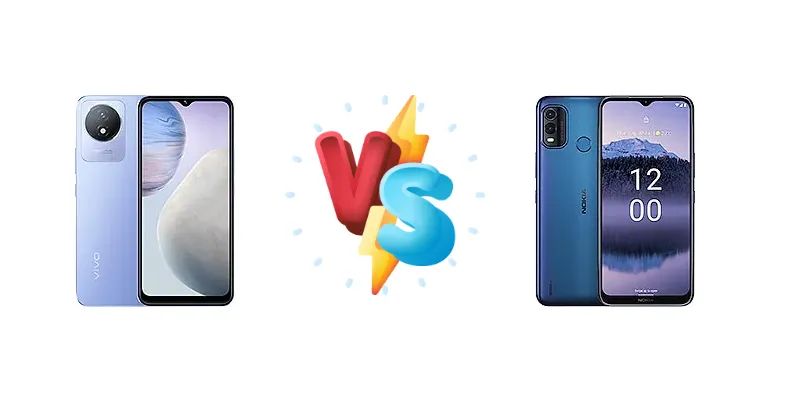
The sub-$150 smartphone market is fiercely competitive, with the vivo Y02A and Nokia G11 Plus vying for the attention of budget-conscious consumers. Both devices aim to deliver essential smartphone functionality, but they take different approaches to achieving this. This comparison dissects their core components to determine which offers the best overall experience.
🏆 Quick Verdict
For the average user prioritizing basic functionality and a slightly more responsive experience, the Nokia G11 Plus emerges as the better choice. While both phones offer similar battery life and charging speeds, the Unisoc T606’s Cortex-A75 cores provide a noticeable performance edge over the Helio P35’s all-Cortex-A53 configuration.
| Network |
|---|
| 2G bands | GSM 850 / 900 / 1800 / 1900 | GSM 850 / 900 / 1800 / 1900 |
| 3G bands | HSDPA 850 / 900 / 2100 | HSDPA 850 / 900 / 2100 - International |
| 4G bands | 1, 3, 5, 7, 8, 20, 28, 38, 40, 41 | 1, 3, 5, 7, 8, 20, 28, 38, 40, 41 - International |
| Speed | HSPA, LTE | HSPA 42.2/5.76 Mbps, LTE Cat4 150/50 Mbps |
| Technology | GSM / HSPA / LTE | GSM / HSPA / LTE |
| | - | 1, 3, 5, 8, 40, 41 - India |
| Launch |
|---|
| Announced | 2023, April 03 | 2022, June 29 |
| Status | Available. Released 2023, April 03 | Available. Released 2022, July 20 |
| Body |
|---|
| Build | Glass front, plastic back, plastic frame | Glass front, plastic frame, plastic back |
| Dimensions | 164 x 75.6 x 8.5 mm (6.46 x 2.98 x 0.33 in) | 164.8 x 75.9 x 8.6 mm (6.49 x 2.99 x 0.34 in) |
| SIM | Dual SIM (Nano-SIM, dual stand-by) | · Nano-SIM· Nano-SIM + Nano-SIM |
| Weight | 186 g (6.56 oz) | 192 g (6.77 oz) |
| | - | Splash protection |
| Display |
|---|
| Resolution | 720 x 1600 pixels, 20:9 ratio (~270 ppi density) | 720 x 1600 pixels, 20:9 ratio (~269 ppi density) |
| Size | 6.51 inches, 102.3 cm2 (~82.5% screen-to-body ratio) | 6.52 inches, 102.6 cm2 (~82.1% screen-to-body ratio) |
| Type | IPS LCD | IPS LCD, 90Hz, 400 nits (typ) |
| Platform |
|---|
| CPU | Octa-core (4x2.35 GHz Cortex-A53 & 4x1.8 GHz Cortex-A53) | Octa-core (2x1.6 GHz Cortex-A75 & 6x1.6 GHz Cortex-A55) |
| Chipset | Mediatek MT6765 Helio P35 (12 nm) | Unisoc T606 (12 nm) |
| GPU | PowerVR GE8320 | Mali-G57 MP1 |
| OS | Android 12 (Go edition), Funtouch 12 | Android 12, upgradable to Android 13 |
| Memory |
|---|
| Card slot | microSDXC (dedicated slot) | microSDXC (dedicated slot) |
| Internal | 32GB 3GB RAM | 32GB 3GB RAM, 64GB 3GB RAM, 64GB 4GB RAM, 128GB 3GB RAM |
| | eMMC 5.1 | eMMC 5.1 |
| Main Camera |
|---|
| Dual | - | 50 MP, f/1.8, (wide), 1/2.67", PDAF
Auxiliary lens |
| Features | LED flash | LED flash |
| Single | 8 MP, f/2.0 | 8 MP, f/2.0, (wide), 1/4.0" |
| Video | 1080p@30fps | 1080p@30fps |
| Selfie camera |
|---|
| Single | 5 MP, f/2.2 | 8 MP, f/2.0, (wide), 1/4.0" |
| Video | Yes | 1080p@30fps |
| Sound |
|---|
| 3.5mm jack | Yes | Yes |
| 35mm jack | Yes | Yes |
| Loudspeaker | Yes | Yes |
| Comms |
|---|
| Bluetooth | 5.0, A2DP, LE | 5.0, A2DP, LE |
| NFC | No | No |
| Positioning | GPS, GLONASS, GALILEO, BDS, QZSS | GPS |
| Radio | FM radio | FM radio |
| USB | microUSB 2.0, OTG | USB Type-C 2.0, OTG |
| WLAN | Wi-Fi 802.11 a/b/g/n/ac, dual-band | Wi-Fi 802.11 a/b/g/n/ac, dual-band, Wi-Fi Direct |
| Features |
|---|
| Sensors | Accelerometer, proximity | Fingerprint (rear-mounted), accelerometer, proximity |
| Battery |
|---|
| Charging | 10W wired
5W reverse wired | 10W wired |
| Type | 5000 mAh | Li-Ion 5000 mAh |
| Misc |
|---|
| Colors | Cosmic Grey, Orchid Blue | Lake Blue, Charcoal Grey |
| Models | V2234_PK | - |
| Price | About 110 EUR | About 130 EUR |
vivo Y02A
- Potentially smoother software experience due to lower processor demands.
- Reliable for basic communication tasks.
- Simple and easy to use interface.
- Noticeably slower performance compared to the Nokia G11 Plus.
- Older chipset architecture.
- Limited multitasking capabilities.
Nokia G11 Plus
- More responsive performance thanks to Cortex-A75 cores.
- Better suited for multitasking and light gaming.
- More modern chipset architecture.
- May experience slightly shorter battery life under heavy load.
- Software experience may be less optimized.
- Potentially more demanding on battery with more intensive tasks.
Display Comparison
Neither device boasts a standout display. Both likely utilize LCD panels, a common cost-saving measure in this segment. Without specific brightness data, it’s safe to assume both offer adequate visibility indoors, but may struggle in direct sunlight. The focus here isn’t on visual fidelity, but on basic readability and durability.
Camera Comparison
Both phones are expected to feature basic camera setups. Without detailed sensor information, it’s reasonable to assume both rely on primary sensors around the 13MP mark, paired with auxiliary lenses of limited utility. Image processing will likely be heavily reliant on software algorithms to compensate for the sensor limitations. The Nokia G11 Plus may have a slight edge due to Unisoc’s image signal processor (ISP) potentially offering more refined noise reduction and dynamic range optimization, but the difference will be minimal.
Performance
The core difference lies in the chipset. The vivo Y02A’s Mediatek Helio P35 features an octa-core configuration comprised entirely of Cortex-A53 cores, split between 2.35 GHz and 1.8 GHz. This is a relatively older architecture. Conversely, the Nokia G11 Plus utilizes the Unisoc T606, which combines two Cortex-A75 cores clocked at 1.6 GHz with six Cortex-A55 cores, also at 1.6 GHz. The inclusion of the A75 cores is significant; they offer substantially higher single-core performance, translating to snappier app launches and smoother multitasking. While both are 12nm chips, the architectural advantage favors the Nokia G11 Plus. The Y02A will likely exhibit more lag when switching between apps or loading heavier websites.
Battery Life
Both the vivo Y02A and Nokia G11 Plus feature 10W wired charging, indicating similar charging speeds – expect around 2.5 to 3 hours for a full charge. Battery capacity isn’t specified, but given the target market, both likely house batteries in the 5000mAh range. The slightly more efficient Unisoc T606 in the Nokia G11 Plus *could* translate to marginally longer battery life, but real-world usage will be the deciding factor. Both phones are designed for all-day battery life with moderate use.
Buying Guide
Buy the vivo Y02A if you need a simple, reliable device for extremely basic tasks like calls, texts, and light social media use, and prioritize a potentially smoother software experience due to the lighter demands on the processor. Buy the Nokia G11 Plus if you prefer a phone capable of handling slightly more demanding apps, multitasking, and occasional gaming, benefiting from the more modern CPU architecture.
Frequently Asked Questions
❓ Will the Nokia G11 Plus handle popular social media apps like Facebook and Instagram smoothly?
Yes, the Unisoc T606’s Cortex-A75 cores provide enough processing power to run Facebook, Instagram, and similar apps without significant lag. While it won’t offer a flagship-level experience, it will be noticeably smoother than the vivo Y02A when switching between these apps.
❓ Is the 10W charging speed on either phone sufficient for daily use?
10W charging is slow by modern standards, but adequate for these budget devices. Both phones are designed to be charged overnight, and the 10W charging will replenish the battery while you sleep. Expect a full charge to take approximately 2.5 to 3 hours.
❓ Can the vivo Y02A run multiple apps simultaneously without slowing down?
The vivo Y02A’s Helio P35 processor and all-Cortex-A53 core configuration will struggle with heavy multitasking. Running more than a few apps simultaneously will likely result in noticeable lag and slowdowns. It’s best suited for running one app at a time.
❓ Does the Nokia G11 Plus support any form of fast charging?
No, the Nokia G11 Plus only supports 10W wired charging. While it doesn't offer fast charging capabilities, the Unisoc T606 is slightly more power-efficient, potentially mitigating the impact of the slower charging speed.