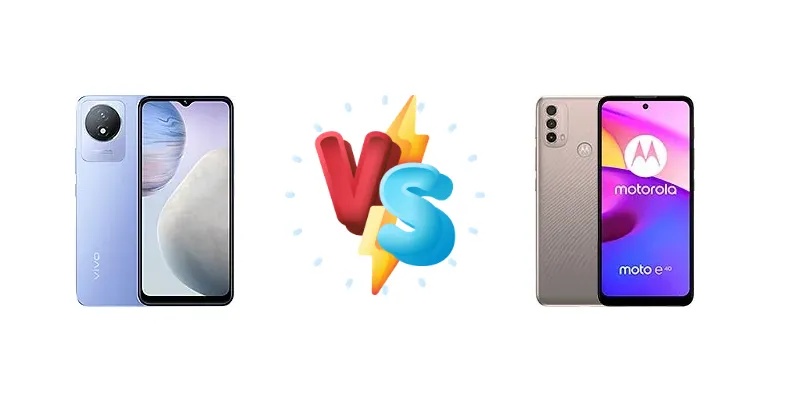
The sub-$150 smartphone market is fiercely competitive, demanding a careful balance of features and performance. Both the vivo Y02A and Motorola Moto E40 aim to deliver an affordable Android experience, but they take different approaches. The Y02A leverages Mediatek’s Helio P35, while the Moto E40 opts for the Unisoc T700. This comparison dissects their key differences to help you choose the right device.
🏆 Quick Verdict
For the average user prioritizing consistent, if modest, performance, the Motorola Moto E40 emerges as the slightly better choice. While both phones offer similar battery life and charging speeds, the Unisoc T700 generally provides a smoother experience than the aging Helio P35, making it better suited for everyday tasks.
| Network |
|---|
| 2G bands | GSM 850 / 900 / 1800 / 1900 | GSM 850 / 900 / 1800 / 1900 |
| 3G bands | HSDPA 850 / 900 / 2100 | HSDPA 850 / 900 / 1700(AWS) / 1900 / 2100 |
| 4G bands | 1, 3, 5, 7, 8, 20, 28, 38, 40, 41 | 1, 2, 3, 4, 5, 7, 8, 19, 28, 40, 66 - Brazil |
| Speed | HSPA, LTE | HSPA 42.2/5.76 Mbps, LTE Cat4 150/50 Mbps |
| Technology | GSM / HSPA / LTE | GSM / HSPA / LTE |
| Launch |
|---|
| Announced | 2023, April 03 | 2021, October 07 |
| Status | Available. Released 2023, April 03 | Available. Released 2021, October 11 |
| Body |
|---|
| Build | Glass front, plastic back, plastic frame | Glass front, plastic frame, plastic back |
| Dimensions | 164 x 75.6 x 8.5 mm (6.46 x 2.98 x 0.33 in) | 165.1 x 75.7 x 9.1 mm (6.5 x 2.98 x 0.36 in) |
| SIM | Dual SIM (Nano-SIM, dual stand-by) | · Nano-SIM· Nano-SIM + Nano-SIM |
| Weight | 186 g (6.56 oz) | 198 g (6.98 oz) |
| Display |
|---|
| Resolution | 720 x 1600 pixels, 20:9 ratio (~270 ppi density) | 720 x 1600 pixels, 20:9 ratio (~270 ppi density) |
| Size | 6.51 inches, 102.3 cm2 (~82.5% screen-to-body ratio) | 6.5 inches, 102.0 cm2 (~81.6% screen-to-body ratio) |
| Type | IPS LCD | IPS LCD, 90Hz |
| Platform |
|---|
| CPU | Octa-core (4x2.35 GHz Cortex-A53 & 4x1.8 GHz Cortex-A53) | Octa-core 1.8 GHz |
| Chipset | Mediatek MT6765 Helio P35 (12 nm) | Unisoc T700 |
| GPU | PowerVR GE8320 | Mali G52 |
| OS | Android 12 (Go edition), Funtouch 12 | Android 11 |
| Memory |
|---|
| Card slot | microSDXC (dedicated slot) | microSDXC (dedicated slot) |
| Internal | 32GB 3GB RAM | 64GB 4GB RAM |
| | eMMC 5.1 | eMMC 5.1 |
| Main Camera |
|---|
| Features | LED flash | LED flash, HDR, panorama |
| Single | 8 MP, f/2.0 | - |
| Triple | - | 48 MP, f/2.0, 26mm (wide), PDAF
2 MP (macro)
Auxiliary lens |
| Video | 1080p@30fps | 1080p@30fps |
| Selfie camera |
|---|
| Features | - | HDR |
| Single | 5 MP, f/2.2 | 8 MP, f/2.0 |
| Video | Yes | 1080p@30fps |
| Sound |
|---|
| 3.5mm jack | Yes | Yes |
| 35mm jack | Yes | Yes |
| Loudspeaker | Yes | Yes |
| Comms |
|---|
| Bluetooth | 5.0, A2DP, LE | 5.0, A2DP, LE |
| NFC | No | No |
| Positioning | GPS, GLONASS, GALILEO, BDS, QZSS | GPS, GLONASS, GALILEO |
| Radio | FM radio | FM radio |
| USB | microUSB 2.0, OTG | USB Type-C 2.0 |
| WLAN | Wi-Fi 802.11 a/b/g/n/ac, dual-band | Wi-Fi 802.11 b/g/n |
| Features |
|---|
| Sensors | Accelerometer, proximity | Fingerprint (rear-mounted), accelerometer, proximity |
| Battery |
|---|
| Charging | 10W wired
5W reverse wired | 10W wired |
| Type | 5000 mAh | Li-Po 5000 mAh |
| Misc |
|---|
| Colors | Cosmic Grey, Orchid Blue | Carbon Gray, Pink Clay |
| Models | V2234_PK | - |
| Price | About 110 EUR | About 90 EUR |
vivo Y02A
- Potentially wider brand recognition in some regions.
- Reverse wired charging offers limited emergency power bank functionality.
- Compact and lightweight design (likely).
- Older Mediatek Helio P35 chipset.
- Likely to exhibit more noticeable lag in demanding tasks.
- Image processing may be overly aggressive.
Motorola Moto E40
- More modern Unisoc T700 chipset.
- Cleaner Android experience with fewer pre-installed apps.
- Potentially better power efficiency.
- Unisoc chipsets have historically had less software support.
- May lack certain features found on vivo devices in specific regions.
- Camera image processing may be too natural for some users.
Display Comparison
Neither device boasts a standout display. Both are likely to feature LCD panels, typical for this price point. Without specific resolution or brightness data, it’s safe to assume both offer adequate, but not exceptional, viewing experiences. The focus here isn’t on visual fidelity, but on basic usability. Bezels are likely to be substantial on both, maximizing screen real estate within a compact form factor.
Camera Comparison
Camera performance is likely to be similar, and largely unimpressive. Both phones will likely feature a primary camera alongside depth or macro sensors of limited utility. Without sensor size or aperture information, it’s difficult to make definitive claims. However, image processing will play a significant role, and Motorola generally offers more natural-looking images compared to vivo’s tendency towards over-sharpening and boosted colors. Expect acceptable results in good lighting conditions, but struggles in low light.
Performance
The core difference lies in the chipsets. The Motorola Moto E40’s Unisoc T700, with its octa-core configuration running at 1.8 GHz, represents a more modern architecture than the vivo Y02A’s Mediatek Helio P35. The Helio P35, while also octa-core, splits its cores into faster 2.35 GHz Cortex-A53s and slower 1.8 GHz Cortex-A53s. This split, combined with the older 12nm manufacturing process, suggests the Unisoc T700 will deliver more consistent performance in multi-tasking and app loading. The Helio P35’s higher clock speed on some cores doesn’t necessarily translate to real-world gains due to its age and efficiency limitations. Neither phone will excel at demanding games, but the Moto E40 is likely to offer a slightly smoother experience.
Battery Life
Both the vivo Y02A and Motorola Moto E40 feature 10W wired charging, indicating similar charging speeds. A full charge will likely take over two hours in both cases. While battery capacity isn’t specified, both are likely to house around a 4000-5000 mAh battery. The Unisoc T700’s potentially better power efficiency could translate to slightly longer battery life on the Moto E40, but the difference will likely be marginal. Both phones should comfortably last a full day with moderate usage.
Buying Guide
Buy the vivo Y02A if you need a phone primarily for basic communication – calls, texts, and light social media – and value a brand with a strong presence in certain markets. Buy the Motorola Moto E40 if you prefer a device capable of handling slightly more demanding tasks like web browsing and occasional gaming, and appreciate a cleaner Android experience with fewer pre-installed apps.
Frequently Asked Questions
❓ Will the Motorola Moto E40 struggle with popular apps like Facebook and WhatsApp?
While the Unisoc T700 isn't a powerhouse, it should handle Facebook and WhatsApp without significant issues. Expect some loading times and occasional stutters when multitasking, but these apps are generally well-optimized for lower-end hardware. The Moto E40's chipset is a step up from the Helio P35 in the Y02A, making it the better choice for social media usage.
❓ Is the 10W charging on either phone fast enough for daily use?
10W charging is slow by modern standards, and neither the vivo Y02A nor the Motorola Moto E40 will charge quickly. Expect a full charge to take over two hours. This is typical for phones in this price range, and both devices are equally limited in this regard. Plan to charge overnight to ensure a full battery each day.
❓ Which phone is likely to receive more software updates?
Motorola has improved its software update commitment in recent years, but historically, vivo has offered more consistent updates, particularly for security patches. However, given the entry-level nature of both devices, don't expect major Android version upgrades. Security updates are the more important consideration, and vivo may have a slight edge here.
❓ Can either phone handle basic mobile games like PUBG Mobile or Call of Duty Mobile?
Both phones will struggle with PUBG Mobile and Call of Duty Mobile. You'll likely need to play at the lowest graphics settings and frame rates, and even then, expect significant lag and stuttering. The Unisoc T700 in the Moto E40 will offer a marginally better experience, but neither phone is designed for serious gaming.