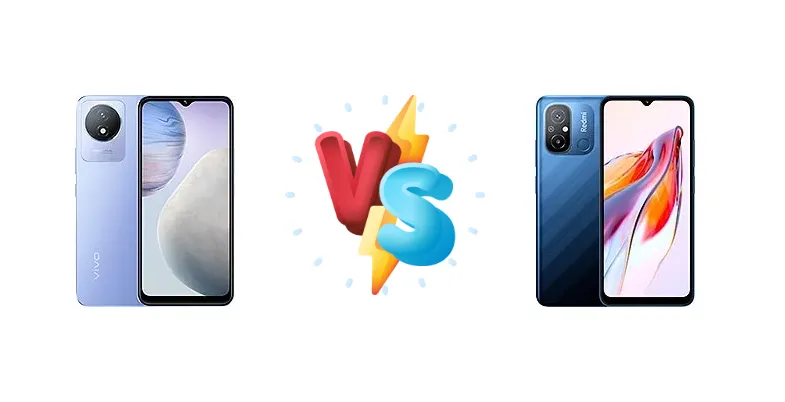
The budget smartphone market is fiercely competitive, offering incredible value for money. Two contenders vying for your attention are the vivo Y02 and the Xiaomi Redmi 12C. Both promise affordability, but which one delivers the better overall experience? Let's dive in and find out.
🏆 Quick Verdict
The Xiaomi Redmi 12C edges out the vivo Y02 thanks to its significantly more powerful Helio G85 chipset, resulting in smoother performance and a better gaming experience. While both are budget options, the Redmi 12C offers a more compelling package for the price.
| Network |
|---|
| 2G bands | GSM 850 / 900 / 1800 / 1900 | GSM 850 / 900 / 1800 / 1900 |
| 3G bands | HSDPA 850 / 900 / 2100 | HSDPA 850 / 900 / 2100 |
| 4G bands | 1, 3, 5, 8, 40 | 1, 3, 5, 7, 8, 20, 28, 38, 40, 41 - International |
| Speed | HSPA, LTE | HSPA, LTE |
| Technology | GSM / HSPA / LTE | GSM / CDMA / HSPA / EVDO / LTE |
| | - | CDMA2000 1xEV-DO |
| Launch |
|---|
| Announced | 2022, November 29 | 2022, December 31 |
| Status | Available. Released 2022, November 29 | Available. Released 2023, January 01 |
| Body |
|---|
| Build | Glass front, plastic back, plastic frame | - |
| Dimensions | 164 x 75.6 x 8.5 mm (6.46 x 2.98 x 0.33 in) | 168.8 x 76.4 x 8.8 mm (6.65 x 3.01 x 0.35 in) |
| SIM | Nano-SIM + Nano-SIM | Nano-SIM + Nano-SIM |
| Weight | 186 g (6.56 oz) | 192 g (6.77 oz) |
| Display |
|---|
| Resolution | 720 x 1600 pixels, 20:9 ratio (~270 ppi density) | 720 x 1650 pixels (~268 ppi density) |
| Size | 6.51 inches, 102.3 cm2 (~82.5% screen-to-body ratio) | 6.71 inches, 106.5 cm2 (~82.6% screen-to-body ratio) |
| Type | IPS LCD | IPS LCD, 500 nits (typ) |
| Platform |
|---|
| CPU | Octa-core 2.0 GHz Cortex-A53 | Octa-core (2x2.0 GHz Cortex-A75 & 6x1.8 GHz Cortex-A55) |
| Chipset | Mediatek MT6762 Helio P22 (12 nm) | Mediatek MT6769Z Helio G85 (12 nm) |
| GPU | PowerVR GE8320 | Mali-G52 MC2 |
| OS | Android 12 (Go edition), Funtouch 12 | Android 12, MIUI 13 |
| Memory |
|---|
| Card slot | microSDXC (dedicated slot) | microSDXC (dedicated slot) |
| Internal | 32GB 2GB RAM, 32GB 3GB RAM | 32GB 2GB RAM, 32GB 3GB RAM, 32GB 4GB RAM, 64GB 3GB RAM, 64GB 4GB RAM, 128GB 3GB RAM, 128GB 4GB RAM, 128GB 6GB RAM |
| | eMMC 5.1 | eMMC 5.1 |
| Main Camera |
|---|
| Dual | - | 50 MP, (wide), PDAF
0.08 MP (depth) |
| Features | LED flash | LED flash, HDR |
| Single | 8 MP, f/2.0 | 50 MP, f/1.8, (wide), 1/2.76", PDAF
Auxiliary lens |
| Video | 1080p@30fps | 1080p@30fps |
| Selfie camera |
|---|
| Single | 5 MP, f/2.2 | 5 MP, f/2.2, (wide) |
| Video | Yes | 1080p@30fps |
| Sound |
|---|
| 3.5mm jack | Yes | Yes |
| 35mm jack | Yes | Yes |
| Loudspeaker | Yes | Yes |
| Comms |
|---|
| Bluetooth | 5.0, A2DP, LE | 5.1, A2DP, LE |
| NFC | No | Yes (market/region dependent) |
| Positioning | GPS, GLONASS, GALILEO, BDS, QZSS | GPS, GLONASS, BDS, GALILEO |
| Radio | FM radio | FM radio |
| USB | microUSB 2.0, OTG | microUSB 2.0 |
| WLAN | Wi-Fi 802.11 a/b/g/n/ac, dual-band | Wi-Fi 802.11 a/b/g/n/ac, dual-band, Wi-Fi Direct |
| Features |
|---|
| Sensors | Accelerometer, proximity | Fingerprint (rear-mounted), accelerometer |
| | - | Virtual proximity sensing |
| Battery |
|---|
| Charging | 10W wired
5W reverse wired | 10W wired |
| Type | 5000 mAh | Li-Po 5000 mAh |
| Misc |
|---|
| Colors | Cosmic Grey, Orchid Blue | Graphite Gray, Ocean Blue, Mint Green, Lavender Purple |
| Models | - | 22120RN86G, 22120RN86I, 22126RN91Y, 2212ARNC4L |
| Price | About 90 EUR | £ 132.99 / € 107.41 |
| SAR | - | 1.08 W/kg (head) 0.64 W/kg (body) |
| SAR EU | - | 0.98 W/kg (head) 0.99 W/kg (body) |
vivo Y02
- Excellent battery life
- Simple and user-friendly interface
- Durable design (likely)
- Affordable price
- Underpowered chipset
- Basic camera performance
- Slow charging
- Low resolution display
Xiaomi Redmi 12C
- More powerful chipset (Helio G85)
- Better camera performance
- Faster charging (10W)
- Slightly better display
- Software can be cluttered with bloatware
- Design may be less premium
- Battery life slightly less than Y02
Display Comparison
Both phones feature a 6.51-inch HD+ display, offering decent viewing angles for everyday use. However, the Redmi 12C's display might appear slightly more vibrant due to potentially better color calibration, though both are adequate for the price point. Expect similar resolution and brightness levels.
Camera Comparison
The Redmi 12C generally offers a better camera experience. While both have a primary 13MP camera, the Redmi 12C often includes additional sensors (like a depth sensor) and potentially better image processing algorithms. Expect slightly better detail and dynamic range in photos taken with the Redmi 12C. Both phones likely have a basic front-facing camera suitable for video calls.
Performance
This is where the Redmi 12C shines. The Helio G85 chipset is a noticeable upgrade over the Y02's Helio P22. Expect smoother multitasking, faster app loading times, and a more enjoyable experience when playing less demanding games. The Y02 will handle basic tasks adequately, but struggles with more intensive applications.
Battery Life
Both phones feature a large 5000mAh battery, promising all-day battery life under moderate usage. The Y02's less demanding chipset might give it a slight edge in pure battery endurance, but the Redmi 12C's faster charging (10W vs 5W reverse wired) makes it more convenient to top up.
Buying Guide
The vivo Y02 is ideal for users prioritizing basic functionality, long battery life, and a simple, user-friendly interface. The Xiaomi Redmi 12C is a better choice for those who want a more responsive phone, occasional gaming capabilities, and a slightly improved camera.
Frequently Asked Questions
❓ Which phone is better for gaming?
The Xiaomi Redmi 12C is significantly better for gaming due to its more powerful Helio G85 chipset. The vivo Y02 struggles with even basic games.
❓ Does the vivo Y02 have 5G?
No, neither the vivo Y02 nor the Xiaomi Redmi 12C support 5G connectivity. They both rely on 4G LTE.
❓ What is the storage capacity of each phone?
Both phones typically come in configurations with 32GB or 64GB of internal storage, expandable via microSD card.
❓ Which phone has better software support?
Xiaomi generally offers more frequent software updates and a longer support lifespan for their devices, although both brands have room for improvement in this area.