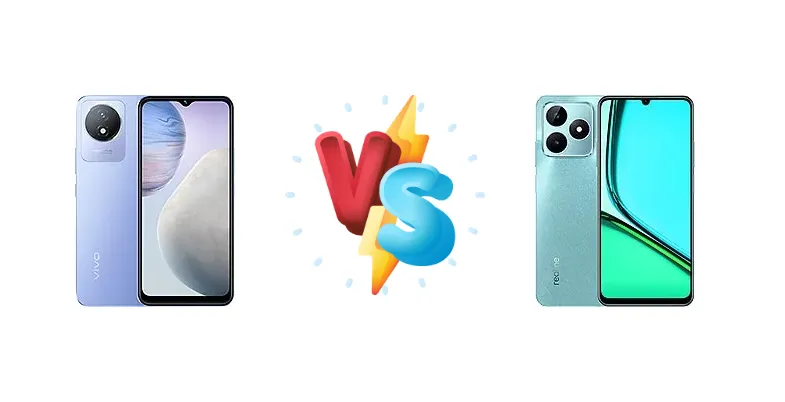
The sub-$150 smartphone market is fiercely competitive. The vivo Y02, with its established brand recognition, faces a strong challenger in the Realme C51s, which prioritizes faster charging and a more modern chipset. This comparison dissects the key differences to determine which device delivers the best value for budget-conscious consumers.
🏆 Quick Verdict
For most users, the Realme C51s emerges as the better choice. Its Unisoc Tiger T612 chipset offers a noticeable performance uplift over the vivo Y02’s Helio P22, and the 33W fast charging significantly reduces downtime. While the Y02 offers a familiar experience, the C51s provides a more future-proofed and convenient package.
| Network |
|---|
| 2G bands | GSM 850 / 900 / 1800 / 1900 | GSM 850 / 900 / 1800 / 1900 |
| 3G bands | HSDPA 850 / 900 / 2100 | HSDPA 900 / 2100 |
| 4G bands | 1, 3, 5, 8, 40 | 1, 3, 5, 8, 38, 40 |
| Speed | HSPA, LTE | HSPA, LTE |
| Technology | GSM / HSPA / LTE | GSM / HSPA / LTE |
| Launch |
|---|
| Announced | 2022, November 29 | 2024, March 15 |
| Status | Available. Released 2022, November 29 | Available. Released 2024, March 15 |
| Body |
|---|
| Build | Glass front, plastic back, plastic frame | Glass front, plastic frame, plastic back |
| Dimensions | 164 x 75.6 x 8.5 mm (6.46 x 2.98 x 0.33 in) | 167.2 x 76.7 x 7.5 mm (6.58 x 3.02 x 0.30 in) |
| SIM | Nano-SIM + Nano-SIM | Nano-SIM + Nano-SIM |
| Weight | 186 g (6.56 oz) | 182 g (6.42 oz) |
| Display |
|---|
| Resolution | 720 x 1600 pixels, 20:9 ratio (~270 ppi density) | 720 x 1600 pixels, 20:9 ratio (~260 ppi density) |
| Size | 6.51 inches, 102.3 cm2 (~82.5% screen-to-body ratio) | 6.74 inches, 109.7 cm2 (~85.5% screen-to-body ratio) |
| Type | IPS LCD | IPS LCD, 90Hz, 560 nits (peak) |
| Platform |
|---|
| CPU | Octa-core 2.0 GHz Cortex-A53 | Octa-core (2x1.8 GHz Cortex-A75 & 6x1.8 GHz Cortex-A55) |
| Chipset | Mediatek MT6762 Helio P22 (12 nm) | Unisoc Tiger T612 (12 nm) |
| GPU | PowerVR GE8320 | Mali-G57 |
| OS | Android 12 (Go edition), Funtouch 12 | Android 13, Realme UI |
| Memory |
|---|
| Card slot | microSDXC (dedicated slot) | microSDXC (dedicated slot) |
| Internal | 32GB 2GB RAM, 32GB 3GB RAM | 128GB 6GB RAM |
| | eMMC 5.1 | - |
| Main Camera |
|---|
| Features | LED flash | LED flash, HDR, panorama |
| Single | 8 MP, f/2.0 | 50 MP, f/1.8, 27mm (wide), 1/2.76", 0.64µm, PDAF
Auxiliary lens |
| Video | 1080p@30fps | 1080p@30fps |
| Selfie camera |
|---|
| Features | - | HDR |
| Single | 5 MP, f/2.2 | 5 MP, f/2.2, 28mm (wide), 1/5.0", 1.12µm |
| Video | Yes | 720p@30fps |
| Sound |
|---|
| 3.5mm jack | Yes | - |
| 35mm jack | Yes | Yes |
| Loudspeaker | Yes | Yes |
| Comms |
|---|
| Bluetooth | 5.0, A2DP, LE | 5.0, A2DP, LE |
| NFC | No | Yes, 360˚ (market/region dependent) |
| Positioning | GPS, GLONASS, GALILEO, BDS, QZSS | GPS, GLONASS, GALILEO |
| Radio | FM radio | Unspecified |
| USB | microUSB 2.0, OTG | USB Type-C |
| WLAN | Wi-Fi 802.11 a/b/g/n/ac, dual-band | Wi-Fi 802.11 a/b/g/n/ac, dual-band |
| Features |
|---|
| Sensors | Accelerometer, proximity | Fingerprint (side-mounted), accelerometer, gyro, proximity, compass |
| Battery |
|---|
| Charging | 10W wired
5W reverse wired | 33W wired, 0-50% in 28 min |
| Type | 5000 mAh | 5000 mAh |
| Misc |
|---|
| Colors | Cosmic Grey, Orchid Blue | Shiny Green, Mighty Black |
| Models | - | RMX3765 |
| Price | About 90 EUR | About 100 EUR |
vivo Y02
- Established Brand Reputation
- 5W Reverse Wired Charging
- Potentially more software optimization (vivo's Funtouch OS)
- Older Helio P22 Chipset
- Slow 10W Charging
- Likely lower performance in demanding apps
Realme C51s
- Faster Unisoc Tiger T612 Chipset
- 33W Fast Charging (0-50% in 28 mins)
- More responsive user experience
- Unisoc chipset may have less software support
- Realme UI can be feature-heavy
- Potentially less refined software experience compared to vivo
Display Comparison
Neither device boasts a standout display. Both likely utilize LCD panels, common in this price bracket. The focus here isn't on visual fidelity, but on usability. Without specific resolution or brightness data, it's reasonable to assume both offer adequate, but not exceptional, viewing experiences. Bezels are likely to be substantial on both, maximizing screen real estate within a budget.
Camera Comparison
Both phones likely feature basic camera setups, and detailed sensor information is absent. However, the Realme C51s likely benefits from the improved image signal processing (ISP) capabilities integrated within the Unisoc T612 chipset. This could result in slightly better image quality, particularly in challenging lighting conditions. The absence of OIS on either device means image stabilization will rely heavily on software processing. Expect both to struggle with low-light photography and offer limited dynamic range.
Performance
The Realme C51s’ Unisoc Tiger T612 represents a significant architectural advantage over the vivo Y02’s MediaTek Helio P22. The T612 features a combination of Cortex-A75 and A55 cores, offering a more efficient and powerful processing experience compared to the Y02’s all-Cortex-A53 setup. The A75 cores in the C51s provide a boost in single-core performance, crucial for app launch speeds and general responsiveness, while the Helio P22 is geared towards sustained multi-core tasks, but at a lower clock speed. This translates to smoother multitasking and a more enjoyable experience with demanding apps on the C51s.
Battery Life
While battery capacity isn't specified, the Realme C51s’ 33W charging is the defining advantage. The ability to charge from 0-50% in just 28 minutes is a game-changer for users who rely heavily on their phones throughout the day. The vivo Y02’s 10W charging is comparatively slow, requiring significantly longer to reach a full charge. The Y02 also offers 5W reverse wired charging, a niche feature for topping up accessories, but the C51s’ faster overall charging speed is more impactful for the average user.
Buying Guide
Buy the vivo Y02 if you prioritize a consistently stable, if slower, experience and are comfortable with a longer charging cycle. It’s ideal for users who primarily need a phone for basic communication and light tasks. Buy the Realme C51s if you value faster performance for social media, streaming, and occasional gaming, and if minimizing charging time is a priority. This phone suits users who want a more responsive and versatile device.
Frequently Asked Questions
❓ Is the Unisoc Tiger T612 in the Realme C51s powerful enough for playing games like PUBG Mobile?
The Unisoc Tiger T612 can handle PUBG Mobile, but you'll likely need to lower the graphics settings to medium or low to achieve a consistently smooth frame rate. It's not a gaming powerhouse, but it's a significant step up from the Helio P22 in the vivo Y02, offering a more playable experience.
❓ How does the software experience differ between Realme UI on the C51s and Funtouch OS on the Y02?
Realme UI is generally considered more customizable and feature-rich, but can also feel more bloated with pre-installed apps. Funtouch OS on the vivo Y02 is often described as cleaner and more streamlined, but may lack some of the advanced features found in Realme UI. Both offer a similar Android base, but the user interface and included apps differ significantly.
❓ Does the Realme C51s support over-the-air (OTA) software updates?
Yes, the Realme C51s supports OTA updates. However, the frequency and duration of software support from Realme for this budget device may be limited compared to their higher-end models. Expect security patches and minor Android version updates, but major upgrades aren't guaranteed.
❓ What type of charging cable and adapter does the vivo Y02 use?
The vivo Y02 uses a micro-USB port for charging and data transfer. It ships with a 10W charger in the box. While it supports 5W reverse charging, the charging speed is significantly slower than the Realme C51s' 33W fast charging.