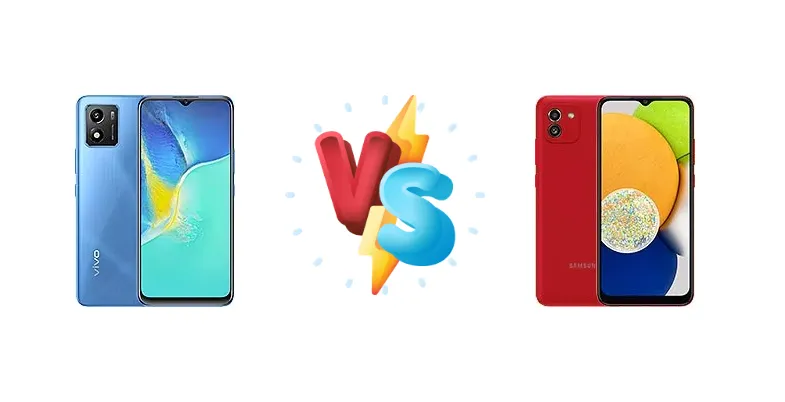
The vivo Y01 and Samsung Galaxy A03 represent the very bottom of the smartphone price spectrum, targeting first-time smartphone buyers or those needing a reliable secondary device. Both devices aim to deliver essential functionality at an incredibly affordable price point, but they achieve this with different chipsets and design philosophies. This comparison dissects the key differences to help you choose the best option for your needs.
🏆 Quick Verdict
For the average user prioritizing basic functionality and a slightly more efficient CPU architecture, the Samsung Galaxy A03 emerges as the better choice. While both phones are limited in performance, the A03’s Unisoc T606 offers a more modern CPU design, potentially leading to smoother multitasking and app loading times.
| Network |
|---|
| 2G bands | GSM 850 / 900 / 1800 / 1900 | GSM 850 / 900 / 1800 / 1900 |
| 3G bands | HSDPA 850 / 900 / 2100 | HSDPA 850 / 900 / 2100 |
| 4G bands | 1, 3, 5, 7, 8, 20, 28, 38, 40, 41 | 1, 3, 5, 7, 8, 20, 28, 38, 40, 41 |
| Speed | HSPA, LTE | HSPA 42.2/5.76 Mbps, LTE Cat4 150/50 Mbps |
| Technology | GSM / HSPA / LTE | GSM / HSPA / LTE |
| Launch |
|---|
| Announced | 2022, March 09 | 2021, November 26 |
| Status | Available. Released 2022, March 24 | Available. Released 2022, January 21 |
| Body |
|---|
| Build | Glass front, plastic back, plastic frame | Glass front, plastic back, plastic frame |
| Dimensions | 164 x 75.2 x 8.3 mm (6.46 x 2.96 x 0.33 in) | 164.2 x 75.9 x 9.1 mm (6.46 x 2.99 x 0.36 in) |
| SIM | Nano-SIM + Nano-SIM | · Nano-SIM· Nano-SIM + Nano-SIM |
| Weight | 178 g (6.28 oz) | 196 g (6.91 oz) |
| Display |
|---|
| Resolution | 720 x 1600 pixels, 20:9 ratio (~270 ppi density) | 720 x 1600 pixels, 20:9 ratio (~270 ppi density) |
| Size | 6.51 inches, 102.3 cm2 (~83.0% screen-to-body ratio) | 6.5 inches, 102.0 cm2 (~81.8% screen-to-body ratio) |
| Type | IPS LCD | PLS LCD |
| Platform |
|---|
| CPU | Octa-core (4x2.35 GHz Cortex-A53 & 4x1.8 GHz Cortex-A53) | Octa-core (2x1.6 GHz Cortex-A75 & 6x1.6 GHz Cortex-A55) |
| Chipset | Mediatek MT6765 Helio P35 (12 nm) | Unisoc T606 (12 nm) |
| GPU | PowerVR GE8320 | Mali-G57 MP1 |
| OS | Android 11 (Go edition), Funtouch 11.1 | Android 11, upgradable to Android 13, One UI core 5 |
| Memory |
|---|
| Card slot | microSDXC (dedicated slot) | microSDXC (dedicated slot) |
| Internal | 32GB 2GB RAM, 32GB 3GB RAM | 32GB 2GB RAM, 32GB 3GB RAM, 32GB 4GB RAM, 64GB 4GB RAM, 64GB 3GB RAM, 128GB 4GB RAM |
| | eMMC 5.1 | eMMC 5.1 |
| Main Camera |
|---|
| Dual | - | 48 MP, f/1.8, (wide), AF
Auxiliary lens |
| Features | LED flash | LED flash |
| Single | 8 MP, f/2.0, AF
or
13 MP, f/2.2, AF | 5 MP, f/2.2 |
| Video | 1080p@30fps | 1080p@30fps |
| Selfie camera |
|---|
| Single | 5 MP, f/2.2 | 5 MP, f/2.2 |
| Video | - | Yes |
| Sound |
|---|
| 3.5mm jack | Yes | Yes |
| 35mm jack | Yes | Yes |
| Loudspeaker | Yes | Yes |
| Comms |
|---|
| Bluetooth | 5.0, A2DP, LE | 5.0, A2DP, LE |
| NFC | No | No |
| Positioning | GPS, GLONASS, BDS, GALILEO | GPS |
| Radio | FM radio (market/operator dependent) | Unspecified |
| USB | microUSB 2.0, OTG | microUSB 2.0 |
| WLAN | Wi-Fi 802.11 a/b/g/n/ac, dual-band, Wi-Fi Direct | Wi-Fi 802.11 a/b/g/n/ac, dual-band, Wi-Fi Direct |
| Features |
|---|
| Sensors | Fingerprint (side-mounted, market/region dependent), accelerometer, proximity, compass | Accelerometer, proximity |
| Battery |
|---|
| Charging | 10W wired | - |
| Type | 5000 mAh | Li-Po 5000 mAh |
| Misc |
|---|
| Colors | Sapphire Blue, Elegant Black | Black, Blue, Red |
| Models | V2166 | SM-A035F, SM-A035F/DS, SM-A035M, SM-A035G |
| Price | About 150 EUR | € 119.90 / £ 88.00 / ₹ 11,990 |
| SAR EU | - | 0.20 W/kg (head) 1.35 W/kg (body) |
vivo Y01
- Extremely affordable price point
- Simple and easy-to-use interface
- Large battery capacity (likely 5000mAh)
- Older and less efficient processor (Helio P35)
- Slow charging speed (10W)
- Potentially sluggish performance
Samsung Galaxy A03
- More modern CPU architecture (Unisoc T606)
- Potentially smoother multitasking
- Slightly better efficiency for longer battery life
- May be slightly more expensive than the vivo Y01
- Camera quality likely similar to the Y01
- Charging speed likely limited to 10W
Display Comparison
Neither device boasts a standout display. Both are likely to feature LCD panels, typical for this price bracket. Without specific resolution or brightness data, it's safe to assume both offer basic viewing experiences. The focus here isn't on media consumption, but rather on readability for essential tasks. Bezels are expected to be substantial on both, maximizing screen real estate within a compact form factor.
Camera Comparison
Camera performance on both devices will be limited. Expect basic image quality suitable for casual snapshots in good lighting conditions. Without sensor size or aperture information, it’s difficult to make definitive claims. However, the inclusion of a 2MP macro camera on the A03 is largely a marketing gimmick, offering minimal practical benefit. The primary sensor’s quality will be the determining factor, and without detailed specs, it’s a toss-up. Image processing will likely be heavily reliant on software algorithms to enhance detail and reduce noise.
Performance
The core difference lies in the chipsets. The vivo Y01 utilizes the Mediatek MT6765 Helio P35, a 12nm chip with an octa-core configuration split between 4x2.35 GHz Cortex-A53 and 4x1.8 GHz Cortex-A53 cores. The Samsung Galaxy A03 counters with the Unisoc T606, also a 12nm process, but featuring a more modern CPU arrangement: 2x1.6 GHz Cortex-A75 and 6x1.6 GHz Cortex-A55 cores. The A75 cores in the A03 represent a significant architectural improvement over the A53 cores in the Y01, offering better single-core performance and improved efficiency. This translates to snappier app launches and smoother multitasking, even with similar RAM configurations (assumed to be 2-3GB in both).
Battery Life
Both devices likely feature around 5000mAh batteries, a common capacity for budget smartphones. The vivo Y01 is limited to 10W wired charging, suggesting a longer charge time (potentially 3-4 hours for a full charge). The Samsung Galaxy A03’s charging speed is not specified, but it’s reasonable to expect a similar 10W rate. The Unisoc T606’s potentially better efficiency could translate to slightly longer battery life on the A03, offsetting the similar battery capacity.
Buying Guide
Buy the vivo Y01 if you need a simple, extremely affordable device primarily for calls, texts, and light social media use, and are comfortable with a potentially less responsive user experience. Buy the Samsung Galaxy A03 if you prefer a slightly more capable processor for smoother app switching and a more future-proofed experience, even if it means spending a little more.
Frequently Asked Questions
❓ Will the Unisoc T606 in the Galaxy A03 handle popular apps like WhatsApp and Facebook smoothly?
Yes, the Unisoc T606 is capable of running apps like WhatsApp and Facebook without significant issues. The Cortex-A75 cores provide a performance boost over the Helio P35, ensuring a smoother experience for everyday tasks. However, don't expect to run multiple demanding apps simultaneously.
❓ Is the 10W charging on either phone a major drawback?
Yes, 10W charging is quite slow by modern standards. Expect a full charge to take around 3-4 hours. This isn't ideal if you frequently need to top up your battery quickly, but it's typical for phones in this price range. Consider investing in a portable power bank if fast charging is a priority.
❓ Can either of these phones play PUBG Mobile?
While technically possible to *launch* PUBG Mobile on both devices, the experience will be far from optimal. The Helio P35 and Unisoc T606 lack the graphical power to run the game at playable frame rates, even on the lowest settings. Expect significant lag and stuttering.
❓ Do either of these phones support software updates beyond the initial Android version?
Software update support is limited on both devices. Expect only essential security patches, if any. These phones are unlikely to receive major Android version updates due to their low price point and limited hardware capabilities.