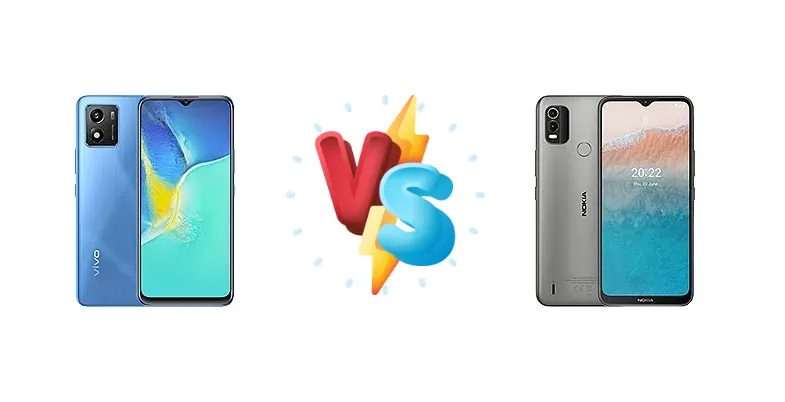
The vivo Y01 and Nokia C21 Plus represent the extreme end of the budget smartphone spectrum. Both aim to deliver essential smartphone functionality at the lowest possible price point, but they achieve this with significantly different hardware. This comparison dissects the core differences – specifically the Mediatek Helio P35 in the Y01 versus the Unisoc SC9863A in the C21 Plus – to determine which device offers the best value for users prioritizing basic functionality.
🏆 Quick Verdict
For the average user needing a reliable, if slow, smartphone for calls, messaging, and light social media, the vivo Y01 edges out the Nokia C21 Plus. The Helio P35, despite being older, offers a more efficient architecture and slightly better CPU performance, translating to a smoother, more responsive experience in everyday tasks.
| Network |
|---|
| 2G bands | GSM 850 / 900 / 1800 / 1900 | GSM 850 / 900 / 1800 / 1900 |
| 3G bands | HSDPA 850 / 900 / 2100 | HSDPA 850 / 900 / 2100 |
| 4G bands | 1, 3, 5, 7, 8, 20, 28, 38, 40, 41 | LTE |
| Speed | HSPA, LTE | HSPA 42.2/5.76 Mbps, LTE Cat4 150/50 Mbps |
| Technology | GSM / HSPA / LTE | GSM / HSPA / LTE |
| | - | HSDPA 850 / 900 / 1700(AWS) / 1900 / 2100 |
| Launch |
|---|
| Announced | 2022, March 09 | 2022, February 28 |
| Status | Available. Released 2022, March 24 | Available. Released 2022, April 29 |
| Body |
|---|
| Build | Glass front, plastic back, plastic frame | Glass front, aluminum frame, plastic back |
| Dimensions | 164 x 75.2 x 8.3 mm (6.46 x 2.96 x 0.33 in) | 164.8 x 75.9 x 8.6 mm (6.49 x 2.99 x 0.34 in) |
| SIM | Nano-SIM + Nano-SIM | · Nano-SIM· Nano-SIM + Nano-SIM |
| Weight | 178 g (6.28 oz) | 178 g or 191 g (6.28 oz) |
| | - | Splash protection |
| Display |
|---|
| Protection | - | Scratch-resistant glass |
| Resolution | 720 x 1600 pixels, 20:9 ratio (~270 ppi density) | 720 x 1600 pixels, 20:9 ratio (~269 ppi density) |
| Size | 6.51 inches, 102.3 cm2 (~83.0% screen-to-body ratio) | 6.52 inches, 102.6 cm2 (~82.1% screen-to-body ratio) |
| Type | IPS LCD | IPS LCD |
| Platform |
|---|
| CPU | Octa-core (4x2.35 GHz Cortex-A53 & 4x1.8 GHz Cortex-A53) | Octa-core (4x1.6 GHz Cortex-A55 & 4x1.2 GHz Cortex-A55) |
| Chipset | Mediatek MT6765 Helio P35 (12 nm) | Unisoc SC9863A (28 nm) |
| GPU | PowerVR GE8320 | IMG8322 |
| OS | Android 11 (Go edition), Funtouch 11.1 | Android 11 (Go edition) |
| Memory |
|---|
| Card slot | microSDXC (dedicated slot) | microSDXC (dedicated slot) |
| Internal | 32GB 2GB RAM, 32GB 3GB RAM | 32GB 2GB RAM, 32GB 3GB RAM, 64GB 2GB RAM, 64GB 3GB RAM, 64GB 4GB RAM |
| | eMMC 5.1 | eMMC 5.1 |
| Main Camera |
|---|
| Dual | - | 13 MP, (wide), AF
Auxiliary lens |
| Features | LED flash | LED flash, HDR, panorama |
| Single | 8 MP, f/2.0, AF
or
13 MP, f/2.2, AF | 5 MP |
| Video | 1080p@30fps | 1080p@30fps |
| Selfie camera |
|---|
| Features | - | LED flash |
| Single | 5 MP, f/2.2 | 5 MP |
| Video | - | 720p |
| Sound |
|---|
| 3.5mm jack | Yes | Yes |
| 35mm jack | Yes | Yes |
| Loudspeaker | Yes | Yes |
| Comms |
|---|
| Bluetooth | 5.0, A2DP, LE | 4.2, A2DP |
| NFC | No | No |
| Positioning | GPS, GLONASS, BDS, GALILEO | GPS |
| Radio | FM radio (market/operator dependent) | FM radio |
| USB | microUSB 2.0, OTG | microUSB 2.0 |
| WLAN | Wi-Fi 802.11 a/b/g/n/ac, dual-band, Wi-Fi Direct | Wi-Fi 802.11 b/g/n |
| Features |
|---|
| Sensors | Fingerprint (side-mounted, market/region dependent), accelerometer, proximity, compass | Fingerprint (rear-mounted), accelerometer, proximity |
| Battery |
|---|
| Charging | 10W wired | 10W wired |
| Type | 5000 mAh | Li-Ion 4000/5050 mAh |
| Misc |
|---|
| Colors | Sapphire Blue, Elegant Black | Dark Cyan, Warm Gray |
| Models | V2166 | TA-1433, TA-1431, TA-1426, TA-1424 |
| Price | About 150 EUR | About 120 EUR |
| SAR | - | 0.57 W/kg (head) 0.65 W/kg (body) |
| SAR EU | - | 0.40 W/kg (head) 0.99 W/kg (body) |
vivo Y01
- More powerful processor (Helio P35)
- More efficient chipset (12nm process)
- Potentially smoother user experience
- May receive fewer software updates
- Brand recognition is lower than Nokia
Nokia C21 Plus
- Nokia’s reputation for software support
- Potentially longer software update lifecycle
- Strong brand trust in some markets
- Less powerful processor (Unisoc SC9863A)
- Less efficient chipset (28nm process)
- Slower overall performance
Display Comparison
Neither device boasts a standout display. Both likely feature basic IPS LCD panels with resolutions around 720x1600. However, the lack of detailed display specs necessitates focusing on the processing power needed to drive them. The Helio P35's slightly more capable GPU may offer a marginally smoother experience when scrolling through content, but the difference will be minimal. Bezels are expected to be substantial on both, reflecting their budget nature.
Camera Comparison
Camera performance on both devices will be basic. Detailed sensor information is unavailable, but both likely feature a primary camera paired with a depth or macro sensor. Given the processing limitations of both chipsets, image processing will be minimal. The Helio P35’s slightly better ISP (Image Signal Processor) might offer marginally better image quality in good lighting conditions, but don’t expect flagship-level results. Focusing on the primary sensor resolution would be more impactful than analyzing the secondary sensors, which are typically low-resolution and offer limited utility.
Performance
The core difference lies in the chipsets. The vivo Y01’s Mediatek Helio P35 (12nm) utilizes Cortex-A53 cores clocked up to 2.35 GHz. This is a significant advantage over the Nokia C21 Plus’s Unisoc SC9863A (28nm), which features slower Cortex-A55 cores peaking at 1.6 GHz. The 12nm process node of the Helio P35 is far more efficient than the 28nm node of the Unisoc chip, meaning better power management and potentially less heat generation. While both are octa-core, the architectural improvements in the P35, despite being an older design, provide a noticeable performance edge in CPU-intensive tasks. The Unisoc chip's A55 cores are more efficient *per clock*, but the lower clock speeds and older manufacturing process ultimately limit its overall performance.
Battery Life
Both phones feature 10W wired charging, indicating similar charging speeds – expect around 2-3 hours for a full charge. Battery capacity is not specified, but given the target market, both likely house batteries in the 4000-5000 mAh range. The Helio P35’s superior power efficiency could translate to slightly longer battery life in real-world usage, offsetting any potential capacity differences. However, the impact will be modest, and both phones will likely require daily charging with moderate use.
Buying Guide
Buy the vivo Y01 if you need a slightly more responsive experience for basic tasks and appreciate a chipset with a more established track record. Buy the Nokia C21 Plus if you prioritize a potentially longer software support lifecycle from Nokia and are willing to accept a performance trade-off. Both are suitable for first-time smartphone users or as a secondary device.
Frequently Asked Questions
❓ Will the Unisoc SC9863A in the Nokia C21 Plus struggle with multitasking?
Yes, the Unisoc SC9863A is a very entry-level processor. While it can handle basic tasks like calling and messaging, running multiple apps simultaneously or switching between them quickly will likely result in noticeable lag and slowdowns. The Helio P35 in the vivo Y01 will handle multitasking slightly better, but neither phone is designed for heavy multitasking.
❓ Is the 10W charging on either phone fast enough for daily use?
10W charging is quite slow by modern standards. Both the vivo Y01 and Nokia C21 Plus will take approximately 2-3 hours to fully charge from 0%. This means you'll likely need to charge them overnight or during periods of inactivity. It's a compromise made to keep the price point low.
❓ Which phone is better for playing casual games like Candy Crush or Subway Surfers?
The vivo Y01, with its Helio P35, will provide a slightly smoother gaming experience for casual titles. The Unisoc SC9863A in the Nokia C21 Plus may exhibit more frame drops and lag, especially in more demanding casual games. However, neither phone is suitable for graphically intensive games.
❓ How long can I expect software updates to be supported on the Nokia C21 Plus?
Nokia generally provides a reasonable level of software support for its budget devices. While not guaranteed, the C21 Plus is likely to receive at least one major Android version update and several security patches. Vivo's update policy for the Y01 is less predictable, and it may receive fewer updates overall.