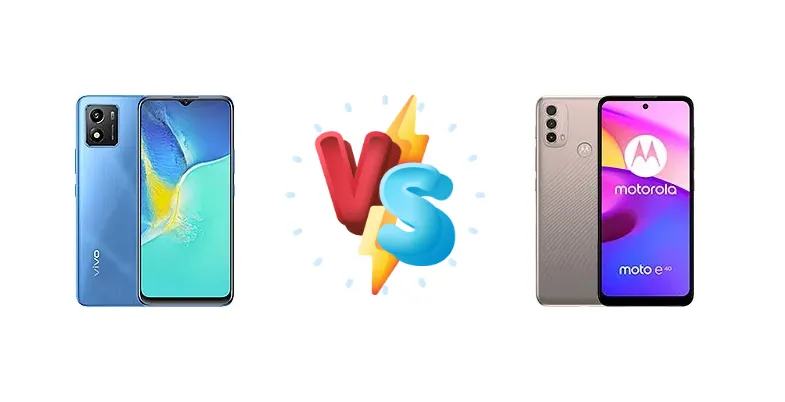
The sub-$150 smartphone market is fiercely competitive. Both the vivo Y01 and Motorola Moto E40 aim to deliver essential smartphone functionality at an accessible price point. However, they take different approaches to achieving this, relying on distinct chipsets and subtle design choices. This comparison dissects these differences to determine which device offers the best value for budget-conscious consumers.
🏆 Quick Verdict
For most users, the Motorola Moto E40 emerges as the slightly better choice. While both phones offer similar 10W charging and basic functionality, the Unisoc T700 chipset provides a more modern architecture and generally better performance than the older Mediatek Helio P35 found in the vivo Y01, making it more suitable for everyday tasks.
| Network |
|---|
| 2G bands | GSM 850 / 900 / 1800 / 1900 | GSM 850 / 900 / 1800 / 1900 |
| 3G bands | HSDPA 850 / 900 / 2100 | HSDPA 850 / 900 / 1700(AWS) / 1900 / 2100 |
| 4G bands | 1, 3, 5, 7, 8, 20, 28, 38, 40, 41 | 1, 2, 3, 4, 5, 7, 8, 19, 28, 40, 66 - Brazil |
| Speed | HSPA, LTE | HSPA 42.2/5.76 Mbps, LTE Cat4 150/50 Mbps |
| Technology | GSM / HSPA / LTE | GSM / HSPA / LTE |
| Launch |
|---|
| Announced | 2022, March 09 | 2021, October 07 |
| Status | Available. Released 2022, March 24 | Available. Released 2021, October 11 |
| Body |
|---|
| Build | Glass front, plastic back, plastic frame | Glass front, plastic frame, plastic back |
| Dimensions | 164 x 75.2 x 8.3 mm (6.46 x 2.96 x 0.33 in) | 165.1 x 75.7 x 9.1 mm (6.5 x 2.98 x 0.36 in) |
| SIM | Nano-SIM + Nano-SIM | · Nano-SIM· Nano-SIM + Nano-SIM |
| Weight | 178 g (6.28 oz) | 198 g (6.98 oz) |
| Display |
|---|
| Resolution | 720 x 1600 pixels, 20:9 ratio (~270 ppi density) | 720 x 1600 pixels, 20:9 ratio (~270 ppi density) |
| Size | 6.51 inches, 102.3 cm2 (~83.0% screen-to-body ratio) | 6.5 inches, 102.0 cm2 (~81.6% screen-to-body ratio) |
| Type | IPS LCD | IPS LCD, 90Hz |
| Platform |
|---|
| CPU | Octa-core (4x2.35 GHz Cortex-A53 & 4x1.8 GHz Cortex-A53) | Octa-core 1.8 GHz |
| Chipset | Mediatek MT6765 Helio P35 (12 nm) | Unisoc T700 |
| GPU | PowerVR GE8320 | Mali G52 |
| OS | Android 11 (Go edition), Funtouch 11.1 | Android 11 |
| Memory |
|---|
| Card slot | microSDXC (dedicated slot) | microSDXC (dedicated slot) |
| Internal | 32GB 2GB RAM, 32GB 3GB RAM | 64GB 4GB RAM |
| | eMMC 5.1 | eMMC 5.1 |
| Main Camera |
|---|
| Features | LED flash | LED flash, HDR, panorama |
| Single | 8 MP, f/2.0, AF
or
13 MP, f/2.2, AF | - |
| Triple | - | 48 MP, f/2.0, 26mm (wide), PDAF
2 MP (macro)
Auxiliary lens |
| Video | 1080p@30fps | 1080p@30fps |
| Selfie camera |
|---|
| Features | - | HDR |
| Single | 5 MP, f/2.2 | 8 MP, f/2.0 |
| Video | - | 1080p@30fps |
| Sound |
|---|
| 3.5mm jack | Yes | Yes |
| 35mm jack | Yes | Yes |
| Loudspeaker | Yes | Yes |
| Comms |
|---|
| Bluetooth | 5.0, A2DP, LE | 5.0, A2DP, LE |
| NFC | No | No |
| Positioning | GPS, GLONASS, BDS, GALILEO | GPS, GLONASS, GALILEO |
| Radio | FM radio (market/operator dependent) | FM radio |
| USB | microUSB 2.0, OTG | USB Type-C 2.0 |
| WLAN | Wi-Fi 802.11 a/b/g/n/ac, dual-band, Wi-Fi Direct | Wi-Fi 802.11 b/g/n |
| Features |
|---|
| Sensors | Fingerprint (side-mounted, market/region dependent), accelerometer, proximity, compass | Fingerprint (rear-mounted), accelerometer, proximity |
| Battery |
|---|
| Charging | 10W wired | 10W wired |
| Type | 5000 mAh | Li-Po 5000 mAh |
| Misc |
|---|
| Colors | Sapphire Blue, Elegant Black | Carbon Gray, Pink Clay |
| Models | V2166 | - |
| Price | About 150 EUR | About 90 EUR |
vivo Y01
- Potentially wider brand recognition in some regions.
- Simple and straightforward user experience.
- Affordable price point.
- Older Mediatek Helio P35 chipset.
- Likely slower performance compared to the Moto E40.
- May receive fewer software updates.
Motorola Moto E40
- More modern Unisoc T700 chipset.
- Potentially better performance and efficiency.
- Likely to receive more consistent software support.
- Better value for the price.
- Motorola's software can include bloatware.
- Build quality may be similar to the vivo Y01.
Display Comparison
Neither the vivo Y01 nor the Motorola Moto E40 are expected to deliver a premium display experience. Specifics regarding panel type (IPS vs. TFT) and resolution are not provided, but both likely feature basic LCD panels. The focus here is on functionality rather than fidelity. Bezels are likely to be substantial on both devices, reflecting their budget positioning. Color accuracy and brightness are expected to be adequate for indoor use but may struggle in direct sunlight.
Camera Comparison
Camera performance on both devices will be limited. Details regarding sensor sizes and lens apertures are unavailable, but given the price point, expectations should be tempered. Both phones likely feature a primary camera alongside basic auxiliary lenses (potentially a depth sensor or macro lens on the Moto E40). Image processing will be basic, and low-light performance will likely be poor. The absence of Optical Image Stabilization (OIS) on either device further limits their photographic capabilities. Focusing on the primary sensor's megapixel count is a poor indicator of quality; the chipset's image signal processor (ISP) is the more critical factor, and the Unisoc T700 may offer a slight advantage here due to its newer design.
Performance
The core difference between these two phones lies in their chipsets. The vivo Y01 utilizes the Mediatek MT6765 Helio P35, a 12nm process chipset featuring an octa-core CPU split into 4x2.35 GHz Cortex-A53 and 4x1.8 GHz Cortex-A53 cores. This is an older architecture. The Motorola Moto E40, conversely, employs the Unisoc T700, an octa-core processor clocked at 1.8 GHz. While the clock speed is lower, the Unisoc T700 benefits from a more modern design, potentially offering better efficiency and sustained performance. The Helio P35's older Cortex-A53 cores will likely show their age in multitasking and more demanding applications. The Unisoc T700, while not a powerhouse, represents a step forward in terms of architectural efficiency.
Battery Life
Both the vivo Y01 and Motorola Moto E40 feature 10W wired charging, indicating a similar charging experience. Actual battery capacity isn't specified, but both are likely in the 4000-5000 mAh range, typical for this price segment. The 10W charging will result in relatively slow charging times – expect several hours to reach a full charge. The Unisoc T700's potentially better power efficiency could translate to slightly longer battery life in real-world usage, offsetting any potential capacity differences.
Buying Guide
Buy the vivo Y01 if you prioritize a brand with a strong presence in certain markets and are comfortable with a slightly older chipset. It's a reasonable option for extremely basic use cases like calls and light messaging. Buy the Motorola Moto E40 if you prefer a more contemporary chipset architecture, potentially smoother multitasking, and a phone that will likely receive more consistent software updates, even within the budget segment.
Frequently Asked Questions
❓ Will the Unisoc T700 in the Moto E40 handle popular apps like WhatsApp and Facebook Messenger smoothly?
Yes, the Unisoc T700 is generally capable of handling everyday apps like WhatsApp and Facebook Messenger without significant lag. While it won't offer a flagship-level experience, it provides a more responsive experience than the older Helio P35, especially when multitasking between several apps.
❓ How will the 10W charging affect daily use on either the vivo Y01 or the Motorola Moto E40?
10W charging is relatively slow. Expect a full charge to take around 3-4 hours. This means you'll need to charge the phone overnight or during extended periods of inactivity. It's not ideal for users who need a quick top-up during the day.
❓ Are software updates likely to be provided for either the vivo Y01 or the Motorola Moto E40?
Software update support is often limited on phones in this price range. Motorola generally provides at least one major Android update for its budget devices, while vivo's update policy can vary by region. The Moto E40 is *likely* to receive slightly more consistent updates due to Motorola's broader commitment to software support.
❓ Is the performance difference between the Helio P35 and Unisoc T700 noticeable for basic tasks like calling and texting?
For extremely basic tasks like making calls and sending texts, the performance difference will be minimal. However, when opening apps, browsing the web, or switching between tasks, the Unisoc T700 in the Moto E40 will provide a noticeably smoother and more responsive experience.