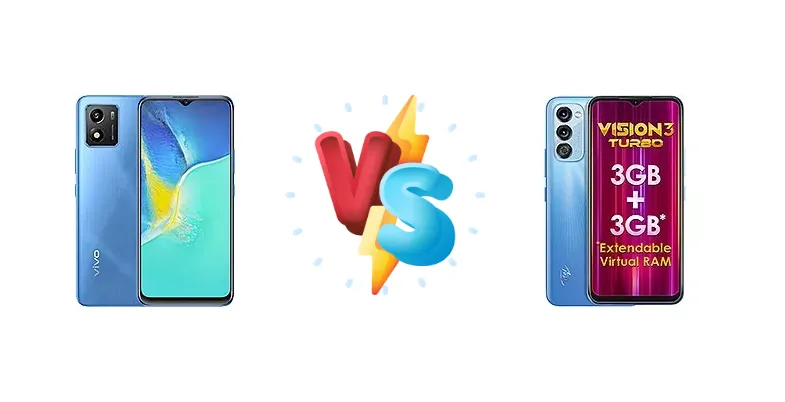
The sub-$150 smartphone market is fiercely competitive, demanding a careful balance of features and performance. We pit the vivo Y01, powered by the Mediatek Helio P35, against the itel Vision 3 Turbo, utilizing the Unisoc SC9863A, to determine which device offers the most compelling experience for budget-conscious users.
🏆 Quick Verdict
For users prioritizing consistent performance in everyday tasks, the vivo Y01 emerges as the better choice. Its Helio P35 chipset, despite being older, offers a more refined architecture and higher clock speeds than the Unisoc SC9863A, resulting in a smoother user experience. However, the itel Vision 3 Turbo’s 18W charging is a significant advantage.
| Network |
|---|
| 2G bands | GSM 850 / 900 / 1800 / 1900 | GSM 850 / 900 / 1800 / 1900 |
| 3G bands | HSDPA 850 / 900 / 2100 | HSDPA 850 / 900 / 2100 |
| 4G bands | 1, 3, 5, 7, 8, 20, 28, 38, 40, 41 | LTE |
| Speed | HSPA, LTE | HSPA, LTE |
| Technology | GSM / HSPA / LTE | GSM / HSPA / LTE |
| Launch |
|---|
| Announced | 2022, March 09 | 2022 |
| Status | Available. Released 2022, March 24 | Available. Released 2022 |
| Body |
|---|
| Build | Glass front, plastic back, plastic frame | - |
| Dimensions | 164 x 75.2 x 8.3 mm (6.46 x 2.96 x 0.33 in) | - |
| SIM | Nano-SIM + Nano-SIM | Dual SIM |
| Weight | 178 g (6.28 oz) | - |
| Display |
|---|
| Resolution | 720 x 1600 pixels, 20:9 ratio (~270 ppi density) | 720 x 1600 pixels, 20:9 ratio (~266 ppi density) |
| Size | 6.51 inches, 102.3 cm2 (~83.0% screen-to-body ratio) | 6.6 inches, 105.2 cm2 |
| Type | IPS LCD | IPS LCD |
| Platform |
|---|
| CPU | Octa-core (4x2.35 GHz Cortex-A53 & 4x1.8 GHz Cortex-A53) | Octa-core (4x1.6 GHz Cortex-A55 & 4x1.2 GHz Cortex-A55) |
| Chipset | Mediatek MT6765 Helio P35 (12 nm) | Unisoc SC9863A (28 nm) |
| GPU | PowerVR GE8320 | IMG8322 |
| OS | Android 11 (Go edition), Funtouch 11.1 | Android 11 (Go edition) |
| Memory |
|---|
| Card slot | microSDXC (dedicated slot) | microSDXC |
| Internal | 32GB 2GB RAM, 32GB 3GB RAM | 64GB 3GB RAM |
| | eMMC 5.1 | - |
| Main Camera |
|---|
| Features | LED flash | LED flash |
| Single | 8 MP, f/2.0, AF
or
13 MP, f/2.2, AF | 8 MP (wide)
Auxiliary lens |
| Video | 1080p@30fps | 1080p@30fps |
| Selfie camera |
|---|
| Single | 5 MP, f/2.2 | 5 MP |
| Video | - | Yes |
| Sound |
|---|
| 3.5mm jack | Yes | - |
| 35mm jack | Yes | Yes |
| Loudspeaker | Yes | Yes |
| Comms |
|---|
| Bluetooth | 5.0, A2DP, LE | Yes |
| NFC | No | No |
| Positioning | GPS, GLONASS, BDS, GALILEO | GPS |
| Radio | FM radio (market/operator dependent) | Unspecified |
| USB | microUSB 2.0, OTG | microUSB |
| WLAN | Wi-Fi 802.11 a/b/g/n/ac, dual-band, Wi-Fi Direct | Yes |
| Features |
|---|
| Sensors | Fingerprint (side-mounted, market/region dependent), accelerometer, proximity, compass | Fingerprint (rear-mounted), accelerometer |
| Battery |
|---|
| Charging | 10W wired | 18W wired |
| Type | 5000 mAh | 5000 mAh |
| Misc |
|---|
| Colors | Sapphire Blue, Elegant Black | Blue |
| Models | V2166 | - |
| Price | About 150 EUR | - |
vivo Y01
- More powerful processor (Helio P35)
- More efficient 12nm process node
- Potentially smoother user experience
- Slower charging speed (10W)
- Likely less battery optimization
itel Vision 3 Turbo
- Faster charging (18W)
- Potentially lower price
- More modern Cortex-A55 cores (though slower clocked)
- Less powerful processor (Unisoc SC9863A)
- Less efficient 28nm process node
- Potentially more lag during multitasking
Display Comparison
Neither device boasts a standout display. Both likely utilize LCD panels, common in this price bracket. Specifics like resolution and brightness are not provided, but the focus here is on processing power, not visual fidelity. Bezels are expected to be substantial on both, maximizing screen real estate within a budget. Color accuracy is likely standard for the segment, prioritizing power efficiency over color calibration.
Camera Comparison
Camera performance is likely similar, relying heavily on software processing. Without sensor size or aperture information, a direct comparison is difficult. Both devices likely feature a primary camera and potentially a depth or macro sensor. The image quality will be adequate for social media sharing in good lighting conditions, but expect significant noise and limited detail in low-light scenarios. The absence of Optical Image Stabilization (OIS) on either device means relying on digital stabilization, which can further degrade image quality.
Performance
The core difference lies in the chipsets. The vivo Y01’s Mediatek Helio P35 (12nm) features an octa-core configuration with Cortex-A53 cores clocked up to 2.35 GHz. This represents a more mature architecture than the itel Vision 3 Turbo’s Unisoc SC9863A (28nm). The Unisoc chip, while also octa-core, uses Cortex-A55 cores clocked lower at 1.6 GHz and 1.2 GHz. The 12nm process node of the Helio P35 is significantly more efficient than the 28nm node of the Unisoc chip, suggesting better thermal management and potentially sustained performance. While both are entry-level, the Helio P35 will handle multitasking and app loading with noticeably less lag.
Battery Life
The itel Vision 3 Turbo’s 18W wired charging is a clear advantage over the vivo Y01’s 10W charging. While battery capacity isn’t specified, the faster charging speed will translate to significantly reduced charging times. A full charge on the itel Vision 3 Turbo will likely take under two hours, while the vivo Y01 could require over three. This difference is crucial for users who rely heavily on their phones throughout the day and need quick top-ups.
Buying Guide
Buy the vivo Y01 if you need a reliably responsive device for basic communication, social media, and light app usage. The Helio P35 provides a more stable platform for these tasks. Buy the itel Vision 3 Turbo if you prioritize faster charging and are willing to accept slightly slower performance. Its 18W charging is ideal for users who frequently find themselves needing a quick power boost, and the lower price point may be attractive.
Frequently Asked Questions
❓ Will the Unisoc SC9863A in the itel Vision 3 Turbo struggle with popular apps like WhatsApp and Facebook?
While the Unisoc SC9863A can run these apps, users may experience occasional lag or slowdowns, especially when multitasking. The Helio P35 in the vivo Y01 offers a more responsive experience for these common applications due to its higher clock speeds and more mature architecture.
❓ How long will it take to fully charge the vivo Y01 with its 10W charger?
Based on typical 10W charging rates and assuming a battery capacity around 3000-4000mAh (common for this segment), a full charge from 0% to 100% on the vivo Y01 will likely take between 3 to 4 hours. The itel Vision 3 Turbo’s 18W charging significantly reduces this time.
❓ Is the difference in processor performance noticeable for everyday tasks like calling and texting?
For basic tasks like calling and texting, the difference will be minimal. However, when opening apps, switching between them, or browsing the web, the vivo Y01’s Helio P35 will provide a smoother and more responsive experience.
❓ Does either phone support fast web browsing with 4G connectivity?
Both phones support 4G connectivity, but the Helio P35 in the vivo Y01 will likely handle web browsing with slightly less lag due to its superior processing power. The Unisoc SC9863A may experience occasional slowdowns when loading complex web pages.