
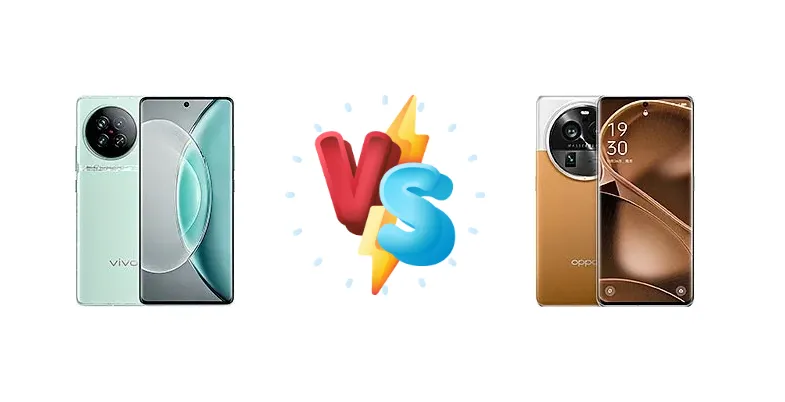
Oppo Find X6 Pro vs vivo X90s: A Deep Dive into Flagship Android Power
| Phones Images | |||||
|---|---|---|---|---|---|
|
🏆 Quick Verdict
For most users, the Oppo Find X6 Pro emerges as the superior choice. Its Snapdragon 8 Gen 2 offers a slight edge in sustained performance and efficiency, coupled with a brighter display and comparable charging speeds. While the X90s is a strong contender, the X6 Pro’s overall refinement gives it the win.
| PHONES | ||
|---|---|---|
| Phone Names | vivo X90s | Oppo Find X6 Pro |
| Network | ||
|---|---|---|
| 2G bands | GSM 850 / 900 / 1800 / 1900 | GSM 850 / 900 / 1800 / 1900 |
| 3G bands | HSDPA 800 / 850 / 900 / 1700(AWS) / 1900 / 2100 | HSDPA 800 / 850 / 900 / 1700(AWS) / 1900 / 2100 |
| 4G bands | 1, 2, 3, 4, 5, 7, 8, 18, 19, 26, 28, 34, 38, 39, 40, 41 | 1, 2, 3, 4, 5, 7, 8, 12, 17, 18, 19, 20, 26, 28, 34, 38, 39, 40, 41, 66 |
| 5G bands | 1, 3, 5, 8, 28, 41, 77, 88 SA/NSA | 1, 3, 5, 7, 8, 20, 28, 38, 40, 41, 66, 77, 78, 79 SA/NSA |
| Speed | HSPA, LTE, 5G | HSPA, LTE, 5G |
| Technology | GSM / CDMA / HSPA / CDMA2000 / LTE / 5G | GSM / CDMA / HSPA / CDMA2000 / LTE / 5G |
| - | CDMA2000 1x | |
| Launch | ||
|---|---|---|
| Announced | 2023, June 26 | 2023, March 21 |
| Status | Available. Released 2023, June 30 | Available. Released 2023, March 24 |
| Body | ||
|---|---|---|
| Build | Glass front, glass back or eco leather back | Glass front (Gorilla Glass Victus 2), glass back (Gorilla Glass 5) or eco leather back, aluminum frame |
| Dimensions | 164.1 x 74.4 x 8.5 mm or 8.9 mm | 164.8 x 76.2 x 9.1 mm or 9.5 mm |
| SIM | Nano-SIM + Nano-SIM | Nano-SIM + Nano-SIM |
| Weight | 197.5 / 201.5 / 202.2 / 203.5 g (6.98 oz) | 216 g or 218 g (7.62 oz) |
| - | IP68 dust/water resistant (up to 1.5m for 30 min) | |
| Display | ||
|---|---|---|
| Protection | - | Corning Gorilla Glass Victus 2 |
| Resolution | 1260 x 2800 pixels, 20:9 ratio (~453 ppi density) | 1440 x 3168 pixels (~510 ppi density) |
| Size | 6.78 inches, 111.0 cm2 (~90.9% screen-to-body ratio) | 6.82 inches, 113.0 cm2 (~90.0% screen-to-body ratio) |
| Type | AMOLED, 1B colors, 120Hz, HDR10+, 1300 nits (peak) | LTPO3 AMOLED, 1B colors, 120Hz, Dolby Vision, HDR10+, 800 nits (typ), 1500 nits (HBM), 2500 nits (peak) |
| Platform | ||
|---|---|---|
| CPU | Octa-core (1x3.35 GHz Cortex-X3 & 3x3.0 GHz Cortex-A715 & 4x2.0 GHz Cortex-A510) | Octa-core (1x3.2 GHz Cortex-X3 & 2x2.8 GHz Cortex-A715 & 2x2.8 GHz Cortex-A710 & 3x2.0 GHz Cortex-A510) |
| Chipset | Mediatek Dimensity 9200+ (4 nm) | Qualcomm SM8550-AB Snapdragon 8 Gen 2 (4 nm) |
| GPU | Immortalis-G715 MC11 | Adreno 740 |
| OS | Android 13, OriginOS 3 | Android 13, up to 4 major Android upgrades, ColorOS 14 |
| Memory | ||
|---|---|---|
| Card slot | No | No |
| Internal | 256GB 8GB RAM, 256GB 12GB RAM, 512GB 12GB RAM | 256GB 12GB RAM, 256GB 16GB RAM, 512GB 16GB RAM |
| - | UFS 4.0 | |
| Main Camera | ||
|---|---|---|
| Features | Laser AF, color spectrum sensor, Zeiss optics, Zeiss T* lens coating, Pixel Shift, dual-LED dual-tone flash, HDR, panorama | Laser AF, color spectrum sensor, Hasselblad Color Calibration, LED flash, HDR, panorama |
| Triple | 50 MP, f/1.8, (wide), 1/1.49", 1.0µm, PDAF, OIS 12 MP, f/2.0, 50mm (telephoto), 1/2.93", 1.22µm, AF, 2x optical zoom 12 MP, f/2.0, 16mm (ultrawide), 1/2.93", 1.22µm, AF | 50 MP, f/1.8, 23mm (wide), 1.0"-type, 1.6µm, dual pixel PDAF, OIS 50 MP, f/2.6, 65mm (periscope telephoto), 1/1.56", 1.0µm, 2.8x optical zoom, multi-directional PDAF, OIS 50 MP, f/2.2, 15mm, 110˚ (ultrawide), 1/1.56", 1.0µm, multi-directional PDAF |
| Video | 4K@30/60fps, 1080p@30/60fps, gyro-EIS | 4K@30/60fps, 1080p@30/60/240fps; gyro-EIS; HDR, 10‑bit video, Dolby Vision |
| Selfie camera | ||
|---|---|---|
| Features | HDR | Panorama |
| Single | 32 MP, f/2.5, 24mm (wide), 1/2.8", 0.8µm | 32 MP, f/2.4, 21mm (wide), 1/2.74", 0.8µm, PDAF |
| Video | 1080p@30/60fps | 4K@30fps, gyro-EIS |
| Sound | ||
|---|---|---|
| 3.5mm jack | - | No |
| 35mm jack | No | No |
| Loudspeaker | Yes, with stereo speakers | Yes, with stereo speakers |
| Comms | ||
|---|---|---|
| Bluetooth | 5.3, A2DP, LE, aptX HD | 5.3, A2DP, LE, aptX HD |
| Infrared port | Yes | Yes |
| NFC | Yes | Yes |
| Positioning | GPS (L1+L5), GLONASS (G1), BDS (B1I+B2a+B2c), GALILEO (E1+E5a), QZSS (L1+L5), NavIC (L5) | GPS (L1+L5), GLONASS (G1), BDS (B1I+B1c+B2a), GALILEO (E1+E5a), QZSS (L1+L5) |
| Radio | No | No |
| USB | USB Type-C 2.0, OTG | USB Type-C 3.1, OTG |
| WLAN | Wi-Fi 802.11 a/b/g/n/ac/6/7, tri-band | Wi-Fi 802.11 a/b/g/n/ac/6e/7, tri-band, Wi-Fi Direct |
| Features | ||
|---|---|---|
| Sensors | Fingerprint (under display, optical), accelerometer, gyro, proximity, compass | Fingerprint (under display, optical), accelerometer, gyro, proximity, compass |
| Battery | ||
|---|---|---|
| Charging | 120W wired, 50% in 8 min Reverse wired | 100W wired, PD, 45% in 10 min, 100% in 30 min 50W wireless, 50% in 22 min, 100% in 51 min 10W reverse wireless |
| Type | 4810 mAh | Li-Po 5000 mAh |
| Misc | ||
|---|---|---|
| Colors | Black, White, Red, Green | Black, Green, Brown |
| Models | V2241HA | PGEM110, PGEM10 |
| Price | About 510 EUR | About 820 EUR |
| Tests | ||
|---|---|---|
| Battery life | - | Endurance rating 114h |
| Camera | - | Photo / Video |
| Display | - | Contrast ratio: Infinite (nominal) |
| Loudspeaker | - | -25.1 LUFS (Very good) |
| Performance | - | AnTuTu: 1294797 (v9) GeekBench: 4791 (v5.1), 5226 (v6) GFXBench: 60fps (ES 3.1 onscreen) |
vivo X90s
- Faster 120W wired charging
- Potentially more affordable price point
- MediaTek Dimensity 9200+ offers strong performance
- Lacks wireless charging
- Potentially less efficient chipset than Snapdragon
Oppo Find X6 Pro
- Superior Snapdragon 8 Gen 2 performance and efficiency
- Brighter display for outdoor visibility
- Wireless charging and reverse wireless charging
- Higher price tag
- Slightly slower wired charging compared to X90s
Display Comparison
The Oppo Find X6 Pro boasts a significantly brighter display, reaching a measured 1318 nits, compared to an unspecified peak brightness for the X90s. While both likely utilize LTPO technology for adaptive refresh rates, the X6 Pro’s higher peak brightness translates to superior visibility in direct sunlight. The X6 Pro’s infinite contrast ratio (nominal) suggests a high-quality panel, though real-world color accuracy and calibration would require further testing. Bezels are expected to be minimal on both devices, typical of flagship designs.
Camera Comparison
Both phones are marketed as photography powerhouses, but specifics beyond 'Photo/Video' capabilities are limited. The Oppo Find X6 Pro is expected to feature a larger main sensor, potentially a 1-inch type sensor, offering superior light gathering and dynamic range. The X90s likely employs a high-resolution sensor, but without knowing the exact size, it’s difficult to assess its low-light performance. OIS (Optical Image Stabilization) is standard on both, but the quality of implementation varies. Image processing philosophies will also differ – Oppo typically leans towards vibrant, saturated colors, while vivo often aims for a more natural look. The absence of details on secondary lenses (ultrawide, telephoto) makes a comprehensive comparison impossible.
Performance
The core difference lies in the chipsets. The Oppo Find X6 Pro’s Snapdragon 8 Gen 2 (4nm) features a 1x3.2 GHz Cortex-X3 prime core, 2x2.8 GHz Cortex-A715 cores, 2x2.8 GHz Cortex-A710 cores, and 3x2.0 GHz Cortex-A510 cores. The vivo X90s utilizes the Dimensity 9200+ (4nm) with a 1x3.35 GHz Cortex-X3, 3x3.0 GHz Cortex-A715, and 4x2.0 GHz Cortex-A510. While the X90s has a slightly higher clocked X3 core, the Snapdragon 8 Gen 2’s architectural refinements and GPU (Adreno 740 vs. Immortalis-G715 MC11) generally provide better sustained performance and thermal management, crucial for demanding games and applications. Both devices likely feature LPDDR5x RAM, but the Snapdragon’s integrated NPU offers advantages in AI-powered tasks.
Battery Life
Both devices share an endurance rating of 114 hours, suggesting comparable battery life despite differing charging approaches. The Oppo Find X6 Pro offers 100W wired charging (45% in 10 minutes, 100% in 30 minutes), 50W wireless (50% in 22 minutes, 100% in 51 minutes), and 10W reverse wireless. The vivo X90s boasts faster 120W wired charging (50% in 8 minutes) but lacks wireless charging capabilities. The X6 Pro’s wireless charging provides added convenience, while the X90s prioritizes speed for wired top-ups.
Buying Guide
Buy the vivo X90s if you prioritize a potentially more affordable flagship experience and value MediaTek’s Dimensity 9200+ chipset. Buy the Oppo Find X6 Pro if you demand the absolute best in sustained performance, a brighter and more vibrant display, and are willing to pay a premium for Qualcomm’s Snapdragon 8 Gen 2.