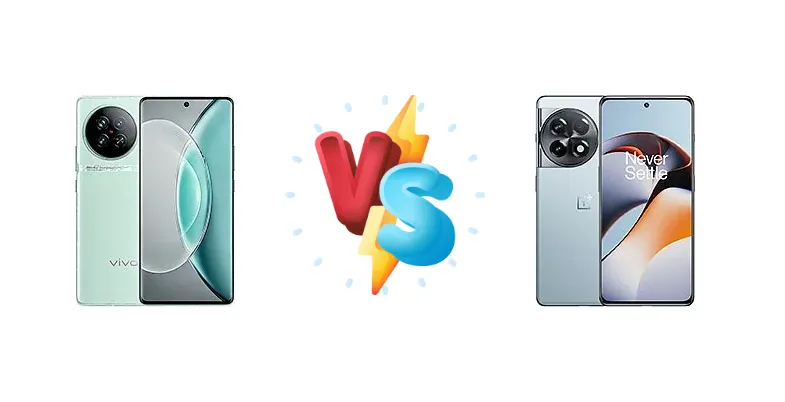
The vivo X90s and OnePlus 11R represent a fascinating intersection in the smartphone market. The X90s, leveraging Mediatek’s Dimensity 9200+ chipset, aims for raw power, while the OnePlus 11R, powered by the Snapdragon 8+ Gen 1, focuses on a balanced experience. This comparison dissects their key differences to determine which device delivers the best value for your money.
🏆 Quick Verdict
For most users, the vivo X90s emerges as the stronger contender. Its Dimensity 9200+ chipset offers a performance edge, particularly in sustained workloads, and its 120W charging is significantly faster than the OnePlus 11R’s 100W. While the OnePlus 11R remains a capable device, the X90s provides a more premium overall experience.
| Network |
|---|
| 2G bands | GSM 850 / 900 / 1800 / 1900 | GSM 850 / 900 / 1800 / 1900 |
| 3G bands | HSDPA 800 / 850 / 900 / 1700(AWS) / 1900 / 2100 | HSDPA 850 / 900 / 1700(AWS) / 2100 |
| 4G bands | 1, 2, 3, 4, 5, 7, 8, 18, 19, 26, 28, 34, 38, 39, 40, 41 | 1, 3, 4, 5, 8, 28, 34, 38, 39, 40, 41 |
| 5G bands | 1, 3, 5, 8, 28, 41, 77, 88 SA/NSA | 1, 3, 5, 8, 28, 40, 41, 77, 78 SA/NSA |
| Speed | HSPA, LTE, 5G | HSPA, LTE (3CA), 5G |
| Technology | GSM / CDMA / HSPA / CDMA2000 / LTE / 5G | GSM / CDMA / HSPA / LTE / 5G |
| | - | CDMA 800 |
| Launch |
|---|
| Announced | 2023, June 26 | 2023, February 07 |
| Status | Available. Released 2023, June 30 | Available. Released 2023, February 21 |
| Body |
|---|
| Build | Glass front, glass back or eco leather back | Glass front, glass back (Gorilla Glass 5), plastic frame |
| Dimensions | 164.1 x 74.4 x 8.5 mm or 8.9 mm | 163.4 x 74.3 x 8.7 mm (6.43 x 2.93 x 0.34 in) |
| SIM | Nano-SIM + Nano-SIM | Nano-SIM + Nano-SIM |
| Weight | 197.5 / 201.5 / 202.2 / 203.5 g (6.98 oz) | 204 g (7.20 oz) |
| Display |
|---|
| Resolution | 1260 x 2800 pixels, 20:9 ratio (~453 ppi density) | 1240 x 2772 pixels, 20:9 ratio (~451 ppi density) |
| Size | 6.78 inches, 111.0 cm2 (~90.9% screen-to-body ratio) | 6.74 inches, 109.2 cm2 (~90.0% screen-to-body ratio) |
| Type | AMOLED, 1B colors, 120Hz, HDR10+, 1300 nits (peak) | Fluid AMOLED, 1B colors, 120Hz, HDR10+, 1450 nits (peak) |
| Platform |
|---|
| CPU | Octa-core (1x3.35 GHz Cortex-X3 & 3x3.0 GHz Cortex-A715 & 4x2.0 GHz Cortex-A510) | Octa-core (1x3.0 GHz Cortex-X2 & 3x2.5 GHz Cortex-A710 & 4x1.80 GHz Cortex-A510) |
| Chipset | Mediatek Dimensity 9200+ (4 nm) | Qualcomm SM8475 Snapdragon 8+ Gen 1 (4 nm) |
| GPU | Immortalis-G715 MC11 | Adreno 730 |
| OS | Android 13, OriginOS 3 | Android 13, upgradable to Android 15, OxygenOS 15 |
| Memory |
|---|
| Card slot | No | No |
| Internal | 256GB 8GB RAM, 256GB 12GB RAM, 512GB 12GB RAM | 128GB 8GB RAM, 256GB 16GB RAM, 512GB 18GB RAM |
| | - | UFS 3.1 |
| Main Camera |
|---|
| Features | Laser AF, color spectrum sensor, Zeiss optics, Zeiss T* lens coating, Pixel Shift, dual-LED dual-tone flash, HDR, panorama | Color spectrum sensor, LED flash, HDR, panorama |
| Single | - | 16 MP, f/2.4, 24mm (wide), 1/3.09", 1.0µm |
| Triple | 50 MP, f/1.8, (wide), 1/1.49", 1.0µm, PDAF, OIS
12 MP, f/2.0, 50mm (telephoto), 1/2.93", 1.22µm, AF, 2x optical zoom
12 MP, f/2.0, 16mm (ultrawide), 1/2.93", 1.22µm, AF | 50 MP, f/1.8, 24mm (wide), 1/1.56", 1.0µm, multi-directional PDAF, OIS
8 MP, f/2.2, 120˚ (ultrawide), 1/4.0", 1.12µm
2 MP (macro) |
| Video | 4K@30/60fps, 1080p@30/60fps, gyro-EIS | 4K@30/60fps, 1080p@30/60/240fps, gyro-EIS |
| Selfie camera |
|---|
| Features | HDR | HDR |
| Single | 32 MP, f/2.5, 24mm (wide), 1/2.8", 0.8µm | 16 MP, f/2.4, 24mm (wide), 1/3.09", 1.0µm |
| Video | 1080p@30/60fps | 1080p@30fps |
| Sound |
|---|
| 3.5mm jack | - | No |
| 35mm jack | No | No |
| Loudspeaker | Yes, with stereo speakers | Yes, with stereo speakers |
| | - | 24-bit/192kHz audio |
| Comms |
|---|
| Bluetooth | 5.3, A2DP, LE, aptX HD | 5.3, A2DP, LE, aptX HD |
| Infrared port | Yes | Yes |
| NFC | Yes | Yes |
| Positioning | GPS (L1+L5), GLONASS (G1), BDS (B1I+B2a+B2c), GALILEO (E1+E5a), QZSS (L1+L5), NavIC (L5) | GPS (L1+L5), GLONASS (G1), BDS (B1I+B1c+B2a), GALILEO (E1+E5a), QZSS (L1+L5) |
| Radio | No | No |
| USB | USB Type-C 2.0, OTG | USB Type-C 2.0 |
| WLAN | Wi-Fi 802.11 a/b/g/n/ac/6/7, tri-band | Wi-Fi 802.11 a/b/g/n/ac/6, dual-band |
| Features |
|---|
| Sensors | Fingerprint (under display, optical), accelerometer, gyro, proximity, compass | Fingerprint (under display, optical), accelerometer, gyro, proximity, compass |
| Battery |
|---|
| Charging | 120W wired, 50% in 8 min
Reverse wired | 100W wired |
| Type | 4810 mAh | Li-Po 5000 mAh |
| Misc |
|---|
| Colors | Black, White, Red, Green | Galactic Silver, Sonic Black, Solar Red |
| Models | V2241HA | CPH2487 |
| Price | About 510 EUR | About 600 EUR |
| SAR | - | 1.16 W/kg (head) 0.61 W/kg (body) |
vivo X90s
- Superior CPU performance with the Dimensity 9200+
- Faster 120W charging for quicker top-ups
- Potentially better image processing with the Imagiq 890 ISP
- May run slightly warmer under sustained load (though mitigated by 4nm process)
- Software experience may vary depending on region
OnePlus 11R
- Excellent GPU performance for gaming
- Snapdragon 8+ Gen 1 is a well-established and reliable chipset
- Potentially more refined software experience (OnePlus' OxygenOS)
- Slower 100W charging compared to the X90s
- CPU performance lags behind the Dimensity 9200+
Display Comparison
While both devices likely feature high-refresh-rate AMOLED displays (specs not provided), the core difference lies in the underlying processing power driving them. The chipset’s ability to efficiently handle display tasks impacts smoothness and responsiveness. The X90s’ Dimensity 9200+ benefits from Mediatek’s advanced display engine, potentially offering superior image processing and color accuracy. Without specific display specs, it's difficult to definitively declare a winner, but the X90s’ more powerful chipset suggests an advantage.
Camera Comparison
Without detailed camera specifications, a direct comparison is limited. However, the chipset plays a vital role in image signal processing (ISP). The Dimensity 9200+ features Mediatek’s Imagiq 890 ISP, designed for advanced computational photography. The Snapdragon 8+ Gen 1’s Spectra ISP is also capable, but the newer Imagiq 890 likely offers improvements in noise reduction, dynamic range, and overall image quality. The X90s’ ISP is likely optimized for the phone’s camera system, potentially leading to superior results, especially in challenging lighting conditions. We can assume both phones will have capable main sensors, but the X90s’ chipset gives it an edge in post-processing.
Performance
The heart of the matter: the Dimensity 9200+ in the vivo X90s versus the Snapdragon 8+ Gen 1 in the OnePlus 11R. The Dimensity 9200+ boasts a Cortex-X3 prime core clocked at 3.35 GHz, a step up from the Snapdragon’s Cortex-X2 at 3.0 GHz. This, combined with the newer architecture of the A715 cores, translates to a noticeable performance advantage in CPU-intensive tasks. The Snapdragon 8+ Gen 1, however, is known for its excellent GPU performance. However, the Dimensity 9200+’s 4nm process node provides better thermal efficiency, mitigating throttling during extended gaming sessions – a crucial advantage for serious mobile gamers. The X90s’ LPDDR5x RAM further enhances memory bandwidth, contributing to smoother multitasking.
Battery Life
The OnePlus 11R’s 100W charging is fast, but the vivo X90s’ 120W charging is demonstrably quicker, achieving 50% charge in just 8 minutes. This difference is significant for users who prioritize minimizing downtime. While battery capacity isn’t specified, the more efficient Dimensity 9200+ chipset in the X90s could offset a potentially smaller battery size, resulting in comparable real-world battery life. The faster charging speed of the X90s is a clear advantage, especially for power users.
Buying Guide
Buy the vivo X90s if you prioritize peak performance for demanding tasks like video editing or gaming, and value the fastest possible charging speeds. Buy the OnePlus 11R if you prefer a slightly more conservative thermal profile and a potentially more refined software experience, and are willing to trade a bit of raw power for a potentially lower price point.
Frequently Asked Questions
❓ Does the Dimensity 9200+ in the vivo X90s suffer from overheating during prolonged gaming sessions?
While powerful, high-performance chipsets can generate heat, the Dimensity 9200+'s 4nm process node is designed for improved thermal efficiency. This means it's less prone to throttling compared to older chipsets, allowing for sustained peak performance during gaming. However, sustained gaming will still generate heat, and performance may slightly decrease over very long sessions.
❓ How does the 100W charging on the OnePlus 11R compare to other phones with similar charging speeds?
100W charging is undeniably fast, and the OnePlus 11R’s implementation is efficient. However, it’s still slower than the 120W charging on the vivo X90s. While both will significantly reduce charging times compared to standard charging, the X90s will get you back to 100% faster. The difference is most noticeable when charging from a low battery percentage.
❓ Is the Snapdragon 8+ Gen 1 in the OnePlus 11R still a capable chipset for demanding games like Genshin Impact or PUBG?
Absolutely. The Snapdragon 8+ Gen 1 remains a very capable chipset for gaming. It can handle demanding titles like Genshin Impact and PUBG at high settings with smooth frame rates. While it doesn't match the raw CPU power of the Dimensity 9200+, it provides an excellent gaming experience, especially when paired with optimized software.