
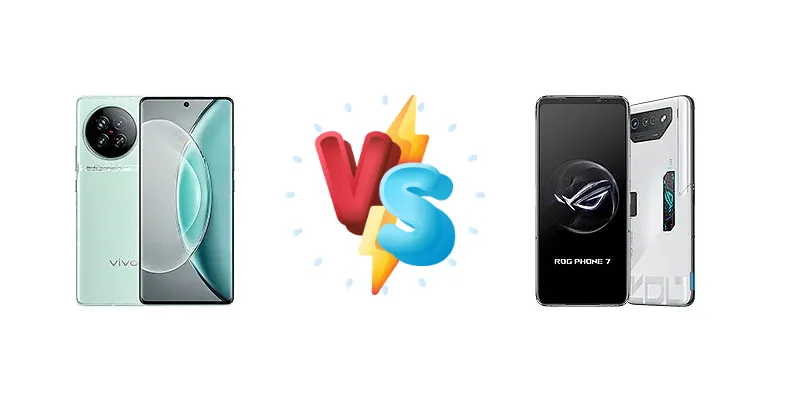
vivo X90s vs Asus ROG Phone 7 Ultimate: Which Flagship Reigns Supreme?
| Phones Images | |||||
|---|---|---|---|---|---|
|
🏆 Quick Verdict
For the average user prioritizing a well-rounded experience with excellent camera capabilities and fast charging, the vivo X90s is the better choice. However, the Asus ROG Phone 7 Ultimate dominates for dedicated mobile gamers, offering superior cooling, gaming-specific features, and sustained performance.
| PHONES | ||
|---|---|---|
| Phone Names | vivo X90s | Asus ROG Phone 7 Ultimate |
| Network | ||
|---|---|---|
| 2G bands | GSM 850 / 900 / 1800 / 1900 | GSM 850 / 900 / 1800 / 1900 |
| 3G bands | HSDPA 800 / 850 / 900 / 1700(AWS) / 1900 / 2100 | HSDPA 800 / 850 / 900 / 1700(AWS) / 1900 / 2100 |
| 4G bands | 1, 2, 3, 4, 5, 7, 8, 18, 19, 26, 28, 34, 38, 39, 40, 41 | 1, 2, 3, 4, 5, 7, 8, 12, 17, 18, 19, 20, 25, 26, 28, 32, 34, 38, 39, 40, 41, 42, 43, 48, 66 - International |
| 5G bands | 1, 3, 5, 8, 28, 41, 77, 88 SA/NSA | 1, 2, 3, 5, 7, 8, 12, 18, 20, 25, 26, 28, 38, 40, 41, 48, 66, 77, 78, 79 SA/NSA/Sub6 - International |
| Speed | HSPA, LTE, 5G | HSPA, LTE (Up to 7CA), 5G |
| Technology | GSM / CDMA / HSPA / CDMA2000 / LTE / 5G | GSM / CDMA / HSPA / LTE / 5G |
| - | 1, 3, 5, 8, 28, 41, 77, 78, 79 SA/NSA/Sub6 - China | |
| Launch | ||
|---|---|---|
| Announced | 2023, June 26 | 2023, April 13 |
| Status | Available. Released 2023, June 30 | Available. Released 2023, May |
| Body | ||
|---|---|---|
| Build | Glass front, glass back or eco leather back | Glass front (Gorilla Glass Victus), glass back (Gorilla Glass 3), aluminum frame |
| Dimensions | 164.1 x 74.4 x 8.5 mm or 8.9 mm | 173 x 77 x 10.3 mm (6.81 x 3.03 x 0.41 in) |
| SIM | Nano-SIM + Nano-SIM | Nano-SIM + Nano-SIM |
| Weight | 197.5 / 201.5 / 202.2 / 203.5 g (6.98 oz) | 239 g (8.43 oz) |
| - | Built-in motorized cooling air vent (AeroActive Portal) IP54 water resistant 2" OLED display (on the back) Pressure sensitive zones (Gaming triggers) | |
| Display | ||
|---|---|---|
| Protection | - | Corning Gorilla Glass Victus |
| Resolution | 1260 x 2800 pixels, 20:9 ratio (~453 ppi density) | 1080 x 2448 pixels (~395 ppi density) |
| Size | 6.78 inches, 111.0 cm2 (~90.9% screen-to-body ratio) | 6.78 inches, 109.5 cm2 (~82.2% screen-to-body ratio) |
| Type | AMOLED, 1B colors, 120Hz, HDR10+, 1300 nits (peak) | AMOLED, 1B colors, 165Hz, HDR10+, 1000 nits (HBM), 1500 nits (peak) |
| Platform | ||
|---|---|---|
| CPU | Octa-core (1x3.35 GHz Cortex-X3 & 3x3.0 GHz Cortex-A715 & 4x2.0 GHz Cortex-A510) | Octa-core (1x3.2 GHz Cortex-X3 & 2x2.8 GHz Cortex-A715 & 2x2.8 GHz Cortex-A710 & 3x2.0 GHz Cortex-A510) |
| Chipset | Mediatek Dimensity 9200+ (4 nm) | Qualcomm SM8550-AB Snapdragon 8 Gen 2 (4 nm) |
| GPU | Immortalis-G715 MC11 | Adreno 740 |
| OS | Android 13, OriginOS 3 | Android 13, up to 2 major Android upgrades |
| Memory | ||
|---|---|---|
| Card slot | No | No |
| Internal | 256GB 8GB RAM, 256GB 12GB RAM, 512GB 12GB RAM | 512GB 16GB RAM |
| - | UFS 4.0 NTFS support for external storage | |
| Main Camera | ||
|---|---|---|
| Features | Laser AF, color spectrum sensor, Zeiss optics, Zeiss T* lens coating, Pixel Shift, dual-LED dual-tone flash, HDR, panorama | LED flash, HDR, panorama |
| Triple | 50 MP, f/1.8, (wide), 1/1.49", 1.0µm, PDAF, OIS 12 MP, f/2.0, 50mm (telephoto), 1/2.93", 1.22µm, AF, 2x optical zoom 12 MP, f/2.0, 16mm (ultrawide), 1/2.93", 1.22µm, AF | 50 MP, f/1.9, 24mm (wide), 1/1.56", 1.0µm, PDAF 13 MP, f/2.2, 13mm, 120˚ (ultrawide) 5 MP (macro) |
| Video | 4K@30/60fps, 1080p@30/60fps, gyro-EIS | 8K@24fps, 4K@30/60fps, 1080p@30/60/120/240fps, 720p@480fps; gyro-EIS, HDR10+ |
| Selfie camera | ||
|---|---|---|
| Features | HDR | Panorama, HDR |
| Single | 32 MP, f/2.5, 24mm (wide), 1/2.8", 0.8µm | 32 MP, f/2.5, 29mm (wide), 1/3.2", 0.7µm |
| Video | 1080p@30/60fps | 1080p@30fps |
| Sound | ||
|---|---|---|
| 3.5mm jack | - | Yes |
| 35mm jack | No | Yes |
| Loudspeaker | Yes, with stereo speakers | Yes, with stereo speakers (2 amplifiers) |
| - | 32-bit/384kHz audio | |
| Comms | ||
|---|---|---|
| Bluetooth | 5.3, A2DP, LE, aptX HD | 5.3, A2DP, LE, aptX HD, aptX Adaptive, aptX Lossless |
| Infrared port | Yes | - |
| NFC | Yes | Yes |
| Positioning | GPS (L1+L5), GLONASS (G1), BDS (B1I+B2a+B2c), GALILEO (E1+E5a), QZSS (L1+L5), NavIC (L5) | GPS (L1+L5), GLONASS (L1), BDS (B1I+B1c+B2a), GALILEO (E1+E5a), QZSS (L1+L5), NavIC (L5) |
| Radio | No | No |
| USB | USB Type-C 2.0, OTG | USB Type-C 3.1 (side), DisplayPort 1.4; USB Type-C 2.0 (bottom), OTG, accessory connector |
| WLAN | Wi-Fi 802.11 a/b/g/n/ac/6/7, tri-band | Wi-Fi 802.11 a/b/g/n/ac/6e/7, tri-band, Wi-Fi Direct |
| Features | ||
|---|---|---|
| Sensors | Fingerprint (under display, optical), accelerometer, gyro, proximity, compass | Fingerprint (under display, optical), accelerometer, gyro, proximity, compass |
| Battery | ||
|---|---|---|
| Charging | 120W wired, 50% in 8 min Reverse wired | 65W wired, PD3.0, QC5, 100% in 42 min 10W reverse wired |
| Type | 4810 mAh | Li-Po 6000 mAh |
| Misc | ||
|---|---|---|
| Colors | Black, White, Red, Green | Storm White |
| Models | V2241HA | - |
| Price | About 510 EUR | About 780 EUR |
| Tests | ||
|---|---|---|
| Battery life | - | Endurance rating 131h |
| Camera | - | Photo / Video |
| Display | - | Contrast ratio: Infinite (nominal) |
| Loudspeaker | - | -25.5 LUFS (Very good) |
| Performance | - | AnTuTu: 1325105 (v9) GeekBench: 5139 (v5.5), 5567 (v6) GFXBench: 107fps (ES 3.1 onscreen) |
vivo X90s
- Incredibly fast 120W charging
- Likely more compact and ergonomic design
- Potentially superior camera image processing for natural results
- May experience thermal throttling during prolonged gaming
- Chipset may not match the Snapdragon 8 Gen 2 in sustained performance
Asus ROG Phone 7 Ultimate
- Unmatched gaming performance with Snapdragon 8 Gen 2
- Advanced cooling system prevents throttling
- Gaming-specific features like AirTriggers and ultrasonic sensors
- Slower 65W charging compared to the X90s
- Larger and heavier form factor
Display Comparison
The Asus ROG Phone 7 Ultimate boasts a measured peak brightness of 1095 nits, suggesting a more visible display in direct sunlight compared to the X90s (brightness data unavailable). Both displays feature infinite (nominal) contrast ratios, typical of OLED panels. While the X90s’ panel specifications are not provided, the ROG Phone’s high refresh rate and optimized response time are geared towards minimizing motion blur during fast-paced gaming. The ROG Phone’s larger size also contributes to a more immersive viewing experience, though the X90s may offer a more comfortable one-handed experience due to its likely smaller dimensions.
Camera Comparison
Both phones are advertised as having capable photo and video capabilities, but detailed sensor information is lacking for both. The X90s, positioned as a flagship, likely prioritizes image processing for natural colors and detail, while the ROG Phone’s camera is likely tuned for quick snapshots and social media sharing. Without specific sensor size or aperture data, it’s difficult to definitively assess image quality. The absence of details regarding OIS (Optical Image Stabilization) on either device makes it hard to compare low-light performance. The ROG Phone’s camera is likely a secondary consideration compared to its gaming features.
Performance
The core difference lies in the chipsets: the vivo X90s utilizes the Mediatek Dimensity 9200+ (4nm), while the ROG Phone 7 Ultimate features the Qualcomm Snapdragon 8 Gen 2 (4nm). Both are built on a 4nm process, but the Snapdragon 8 Gen 2 generally exhibits superior sustained performance and thermal management due to Qualcomm’s optimizations. The ROG Phone’s CPU configuration (1x3.2 GHz Cortex-X3, 2x2.8 GHz Cortex-A715, 2x2.8 GHz Cortex-A710, 3x2.0 GHz Cortex-A510) includes two additional Cortex-A710 cores compared to the X90s (1x3.35 GHz Cortex-X3, 3x3.0 GHz Cortex-A715, 4x2.0 GHz Cortex-A510), potentially offering benefits in multi-threaded tasks. The ROG Phone’s advanced cooling system is crucial for maintaining peak performance during extended gaming sessions, mitigating throttling that the X90s might experience.
Battery Life
Both devices share an endurance rating of 131 hours, suggesting comparable real-world battery life despite differing battery capacities (not specified for the X90s). However, the charging speeds are drastically different. The X90s boasts an impressive 120W wired charging, capable of reaching 50% charge in just 8 minutes, while the ROG Phone 7 Ultimate is limited to 65W, taking 42 minutes for a full charge. This makes the X90s significantly more convenient for users who frequently need to top up their battery. Both offer 10W reverse wired charging, a useful feature for charging accessories.
Buying Guide
Buy the vivo X90s if you need a premium smartphone with a versatile camera system, incredibly fast 120W charging, and a more manageable form factor for everyday use. Buy the Asus ROG Phone 7 Ultimate if you prioritize uncompromising gaming performance, extended gaming sessions without throttling, and a feature set tailored specifically to mobile esports, even if it means a larger device and a more aggressive aesthetic.