
vivo X90 vs. Samsung Galaxy S23 Ultra: Which Android Flagship Reigns Supreme?
| Phones Images | |||||
|---|---|---|---|---|---|
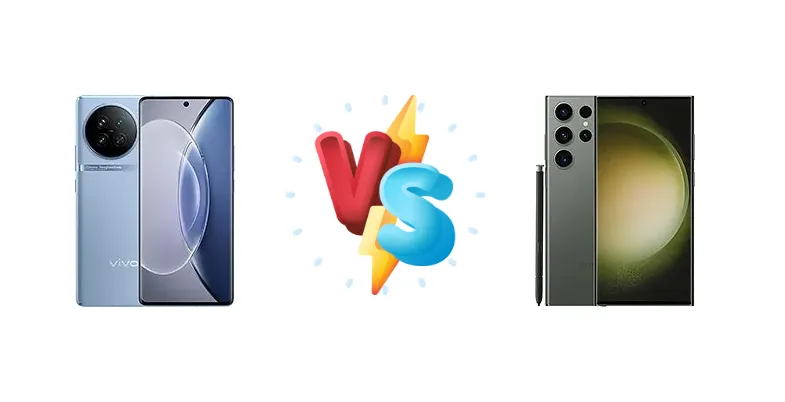
|
🏆 Quick Verdict
For the average user prioritizing all-day battery life, a versatile camera system, and long-term software support, the Samsung Galaxy S23 Ultra is the superior choice. However, the vivo X90’s incredibly fast 120W charging and strong performance make it a compelling alternative for those who value speed and convenience.
| PHONES | ||
|---|---|---|
| Phone Names | vivo X90 | Samsung Galaxy S23 Ultra |
| Network | ||
|---|---|---|
| 2G bands | GSM 850 / 900 / 1800 / 1900 | GSM 850 / 900 / 1800 / 1900 |
| 3G bands | HSDPA 800 / 850 / 900 / 1700(AWS) / 1900 / 2100 | HSDPA 850 / 900 / 1700(AWS) / 1900 / 2100 |
| 4G bands | 1, 2, 3, 4, 5, 7, 8, 18, 19, 20, 26, 28, 34, 38, 39, 40, 41 - International | 1, 2, 3, 4, 5, 7, 8, 12, 13, 17, 18, 19, 20, 25, 26, 28, 32, 38, 39, 40, 41, 66 - International |
| 5G bands | 1, 3, 5, 7, 8, 28, 38, 40, 41, 77, 78 SA/NSA - International | 1, 2, 3, 5, 7, 8, 12, 20, 25, 28, 38, 40, 41, 66, 75, 77, 78 SA/NSA/Sub6 - International |
| Speed | HSPA, LTE, 5G | HSPA, LTE (up to 7CA), 5G |
| Technology | GSM / CDMA / HSPA / CDMA2000 / LTE / 5G | GSM / CDMA / HSPA / EVDO / LTE / 5G |
| 1, 3, 5, 8, 28, 41, 77, 78 SA/NSA - China | 1, 7, 28, 41, 66, 71, 78, 258, 260, 261 SA/NSA/Sub6/mmWave - USA | |
| Launch | ||
|---|---|---|
| Announced | 2022, November 22 | 2023, February 01 |
| Status | Available. Released 2022, November 30 | Available. Released 2023, February 17 |
| Body | ||
|---|---|---|
| Build | Glass front, glass back or eco leather back | Glass front (Gorilla Glass Victus 2), glass back (Gorilla Glass Victus 2), aluminum frame |
| Dimensions | 164.1 x 74.4 x 8.5 mm or 8.9 mm | 163.4 x 78.1 x 8.9 mm (6.43 x 3.07 x 0.35 in) |
| SIM | Nano-SIM + Nano-SIM | · Nano-SIM + eSIM· Nano-SIM + Nano-SIM + eSIM (max 2 at a time) |
| Weight | 196 g / 200 g (6.91 oz) | 234 g (8.25 oz) |
| IP64 dust/water resistant | IP68 dust/water resistant (up to 1.5m for 30 min) Armor aluminum frame with tougher drop and scratch resistance (advertised) Stylus (Bluetooth integration, accelerometer, gyro) | |
| Display | ||
|---|---|---|
| Protection | - | Corning Gorilla Glass Victus 2 |
| Resolution | 1260 x 2800 pixels, 20:9 ratio (~452 ppi density) | 1440 x 3088 pixels, 19.3:9 ratio (~500 ppi density) |
| Size | 6.78 inches, 111.5 cm2 (~91.3% screen-to-body ratio) | 6.8 inches, 114.7 cm2 (~89.9% screen-to-body ratio) |
| Type | AMOLED, 1B colors, 120Hz, HDR10+ | Dynamic AMOLED 2X, 120Hz, HDR10+, 1200 nits (HBM), 1750 nits (peak) |
| - | Always-on display | |
| Platform | ||
|---|---|---|
| CPU | Octa-core (1x3.05 GHz Cortex-X3 & 3x2.85 GHz Cortex-A715 & 4x1.80 GHz Cortex-A510) | Octa-core (1x3.36 GHz Cortex-X3 & 2x2.8 GHz Cortex-A715 & 2x2.8 GHz Cortex-A710 & 3x2.0 GHz Cortex-A510) |
| Chipset | Mediatek Dimensity 9200 (4 nm) | Qualcomm SM8550-AC Snapdragon 8 Gen 2 (4 nm) |
| GPU | Immortalis-G715 MC11 | Adreno 740 |
| OS | Android 13, Funtouch 13 (Global), OriginOS 3 (China) | Android 13, up to 4 major Android upgrades, One UI 8 |
| Memory | ||
|---|---|---|
| Card slot | No | No |
| Internal | 128GB 8GB RAM, 256GB 8GB RAM, 256GB 12GB RAM, 512GB 12GB RAM | 256GB 8GB RAM, 256GB 12GB RAM, 512GB 12GB RAM, 1TB 12GB RAM |
| UFS 4.0 - 256/512GB UFS 3.1 - 128GB | UFS 4.0 | |
| Main Camera | ||
|---|---|---|
| Features | Laser AF, color spectrum sensor, Zeiss optics, Zeiss T* lens coating, Pixel Shift, dual-LED dual-tone flash, HDR, panorama | Laser AF, LED flash, auto-HDR, panorama |
| Quad | - | 200 MP, f/1.7, 24mm (wide), 1/1.3", 0.6µm, multi-directional PDAF, OIS 10 MP, f/2.4, 70mm (telephoto), 1/3.52", 1.12µm, PDAF, OIS, 3x optical zoom 10 MP, f/4.9, 230mm (periscope telephoto), 1/3.52", 1.12µm, PDAF, OIS, 10x optical zoom 12 MP, f/2.2, 13mm, 120˚ (ultrawide), 1/2.55", 1.4µm, dual pixel PDAF, Super Steady video |
| Single | 32 MP, f/2.5, 24mm (wide), 1/2.8", 0.8µm | 12 MP, f/2.2, 26mm (wide), Dual Pixel PDAF |
| Triple | 50 MP, f/1.8, (wide), 1/1.49", 1.0µm, PDAF, OIS 12 MP, f/2.0, 50mm (telephoto), 1/2.93", 1.22µm, AF, 2x optical zoom 12 MP, f/2.0, 16mm (ultrawide), 1/2.93", 1.22µm, AF | - |
| Video | 4K@30/60fps, 1080p@30/60fps, gyro-EIS | 8K@24/30fps, 4K@30/60fps, 1080p@30/60/120/240fps, HDR10+, stereo sound rec., gyro-EIS |
| Selfie camera | ||
|---|---|---|
| Features | HDR | HDR, HDR10+ |
| Single | 32 MP, f/2.5, 24mm (wide), 1/2.8", 0.8µm | 12 MP, f/2.2, 26mm (wide), 1/3.2", 1.12µm, dual pixel PDAF |
| Video | 1080p@30/60fps | 4K@30/60fps, 1080p@30fps |
| Sound | ||
|---|---|---|
| 3.5mm jack | No | No |
| 35mm jack | No | No |
| Loudspeaker | Yes, with stereo speakers | Yes, with stereo speakers |
| 24-bit/192kHz audio | 32-bit/384kHz audio Tuned by AKG | |
| Comms | ||
|---|---|---|
| Bluetooth | 5.3, A2DP, LE, aptX HD | 5.3, A2DP, LE |
| Infrared port | Yes | - |
| NFC | Yes | Yes |
| Positioning | GPS (L1+L5), GLONASS, BDS, GALILEO, QZSS, NavIC | GPS, GALILEO, GLONASS, BDS, QZSS |
| Radio | No | No |
| USB | USB Type-C 2.0, OTG | USB Type-C 3.2, OTG |
| WLAN | Wi-Fi 802.11 a/b/g/n/ac/6, dual-band, Wi-Fi Direct | Wi-Fi 802.11 a/b/g/n/ac/6e, tri-band, Wi-Fi Direct |
| Features | ||
|---|---|---|
| Sensors | Fingerprint (under display, optical), accelerometer, gyro, proximity, compass | Fingerprint (under display, ultrasonic), accelerometer, gyro, proximity, compass, barometer |
| - | Samsung DeX, Samsung Wireless DeX (desktop experience support) Bixby natural language commands and dictation Samsung Pay (Visa, MasterCard certified) Ultra Wideband (UWB) support | |
| Battery | ||
|---|---|---|
| Charging | 120W wired, 50% in 8 min Reverse wired | 45W wired, PD3.0, 65% in 30 min 15W wireless (Qi) 4.5W reverse wireless |
| Type | 4810 mAh | Li-Ion 5000 mAh |
| Misc | ||
|---|---|---|
| Colors | Asteroid Black, Breeze Blue, Red | Phantom Black, Green, Cream, Lavender, Graphite, Sky Blue, Lime, Red, BMW M Edition |
| Models | V2241A | SM-S918B, SM-S918B/DS, SM-S918U, SM-S918U1, SM-S918W, SM-S918N, SM-S9180, SM-S918E, SM-S918E/DS |
| Price | About 300 EUR | € 549.90 / $ 454.99 / £ 433.00 |
| SAR | - | 1.12 W/kg (head) 0.92 W/kg (body) |
| SAR EU | - | 0.96 W/kg (head) 1.40 W/kg (body) |
| Tests | ||
|---|---|---|
| Battery life | - | Endurance rating 126h |
| Camera | - | Photo / Video |
| Display | - | Contrast ratio: Infinite (nominal) |
| Loudspeaker | - | -25.6 LUFS (Very good) |
| Performance | - | AnTuTu: 1241531 (v9) GeekBench: 4927 (v5.1) GFXBench: 67fps (ES 3.1 onscreen) |
vivo X90
- Blazing-fast 120W wired charging
- Potentially more compact and ergonomic design
- Strong performance from the Dimensity 9200
- Battery life likely shorter than the S23 Ultra
- Less information available on camera system specifics
Samsung Galaxy S23 Ultra
- Exceptional battery life and endurance
- Versatile and high-quality camera system
- Bright and expansive display with S Pen support
- Slower 45W wired charging
- Larger size may not suit all users
Display Comparison
The Samsung Galaxy S23 Ultra boasts a significantly brighter display, peaking at 1274 nits measured, compared to an unstated peak brightness for the vivo X90. While the X90’s display quality is likely excellent, the S23 Ultra’s higher brightness translates to better outdoor visibility. Both displays feature an infinite (nominal) contrast ratio, suggesting deep blacks. The S23 Ultra’s larger size and higher resolution will appeal to media consumers, while the X90 likely prioritizes efficiency with a potentially smaller panel.
Camera Comparison
Both devices are equipped for excellent photo and video capture, but details beyond that are limited. The S23 Ultra’s camera system is known for its versatility, likely featuring a larger main sensor and advanced image processing. The X90’s camera capabilities are less defined, but vivo’s partnership with Zeiss suggests a focus on color accuracy and image quality. Without specific sensor size or aperture information for the X90, it’s difficult to assess its low-light performance relative to the S23 Ultra. The S23 Ultra’s video capabilities are likely more advanced, offering features like 8K recording and enhanced stabilization.
Performance
Both phones utilize a 4nm process, but the Qualcomm Snapdragon 8 Gen 2 in the S23 Ultra (3.36 GHz peak clock speed) edges out the MediaTek Dimensity 9200 (3.05 GHz) in raw CPU performance. The S23 Ultra’s CPU configuration – 1x Cortex-X3, 2x Cortex-A715, 2x Cortex-A710, and 3x Cortex-A510 – offers a more balanced approach than the X90’s 1x Cortex-X3, 3x Cortex-A715, and 4x Cortex-A510. This suggests the S23 Ultra may handle sustained workloads and multitasking more effectively. While the X90’s Dimensity 9200 is no slouch, the Snapdragon 8 Gen 2’s superior thermal efficiency will likely result in less throttling during extended gaming sessions.
Battery Life
The Samsung Galaxy S23 Ultra demonstrates superior battery endurance, achieving an impressive 13:24h of active use and a 126h endurance rating. While the vivo X90’s battery capacity is not specified, its 120W wired charging is a game-changer, reaching 50% charge in just 8 minutes. The S23 Ultra’s 45W charging, while supporting PD3.0, takes 30 minutes to reach 65%. This difference in charging speed is a significant advantage for the X90, catering to users who prioritize quick top-ups. The S23 Ultra’s larger battery and efficient chipset, however, provide all-day battery life for most users.
Buying Guide
Buy the vivo X90 if you need a phone that can rapidly replenish its battery – reaching 50% charge in just 8 minutes – and you prefer a slightly more manageable size. Buy the Samsung Galaxy S23 Ultra if you prefer a larger, brighter display, an integrated stylus, a more comprehensive camera experience, and the peace of mind of industry-leading battery endurance and software updates.