
Oppo Find X6 Pro vs Vivo X90: A Deep Dive into Flagship Android Performance
| Phones Images | |||||
|---|---|---|---|---|---|
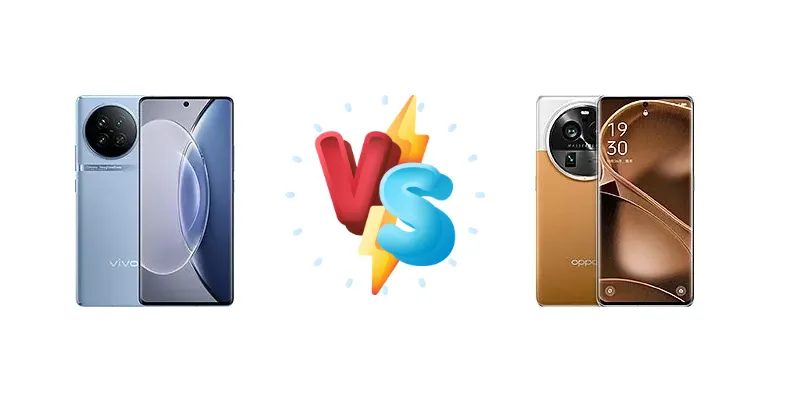
|
🏆 Quick Verdict
For most users, the Oppo Find X6 Pro emerges as the superior choice. Its Snapdragon 8 Gen 2 chipset provides a noticeable performance edge, particularly in sustained workloads, and its brighter display enhances outdoor visibility. While the Vivo X90 offers competitive features, the X6 Pro’s overall refinement and efficiency give it the win.
| PHONES | ||
|---|---|---|
| Phone Names | vivo X90 | Oppo Find X6 Pro |
| Network | ||
|---|---|---|
| 2G bands | GSM 850 / 900 / 1800 / 1900 | GSM 850 / 900 / 1800 / 1900 |
| 3G bands | HSDPA 800 / 850 / 900 / 1700(AWS) / 1900 / 2100 | HSDPA 800 / 850 / 900 / 1700(AWS) / 1900 / 2100 |
| 4G bands | 1, 2, 3, 4, 5, 7, 8, 18, 19, 20, 26, 28, 34, 38, 39, 40, 41 - International | 1, 2, 3, 4, 5, 7, 8, 12, 17, 18, 19, 20, 26, 28, 34, 38, 39, 40, 41, 66 |
| 5G bands | 1, 3, 5, 7, 8, 28, 38, 40, 41, 77, 78 SA/NSA - International | 1, 3, 5, 7, 8, 20, 28, 38, 40, 41, 66, 77, 78, 79 SA/NSA |
| Speed | HSPA, LTE, 5G | HSPA, LTE, 5G |
| Technology | GSM / CDMA / HSPA / CDMA2000 / LTE / 5G | GSM / CDMA / HSPA / CDMA2000 / LTE / 5G |
| 1, 3, 5, 8, 28, 41, 77, 78 SA/NSA - China | CDMA2000 1x | |
| Launch | ||
|---|---|---|
| Announced | 2022, November 22 | 2023, March 21 |
| Status | Available. Released 2022, November 30 | Available. Released 2023, March 24 |
| Body | ||
|---|---|---|
| Build | Glass front, glass back or eco leather back | Glass front (Gorilla Glass Victus 2), glass back (Gorilla Glass 5) or eco leather back, aluminum frame |
| Dimensions | 164.1 x 74.4 x 8.5 mm or 8.9 mm | 164.8 x 76.2 x 9.1 mm or 9.5 mm |
| SIM | Nano-SIM + Nano-SIM | Nano-SIM + Nano-SIM |
| Weight | 196 g / 200 g (6.91 oz) | 216 g or 218 g (7.62 oz) |
| IP64 dust/water resistant | IP68 dust/water resistant (up to 1.5m for 30 min) | |
| Display | ||
|---|---|---|
| Protection | - | Corning Gorilla Glass Victus 2 |
| Resolution | 1260 x 2800 pixels, 20:9 ratio (~452 ppi density) | 1440 x 3168 pixels (~510 ppi density) |
| Size | 6.78 inches, 111.5 cm2 (~91.3% screen-to-body ratio) | 6.82 inches, 113.0 cm2 (~90.0% screen-to-body ratio) |
| Type | AMOLED, 1B colors, 120Hz, HDR10+ | LTPO3 AMOLED, 1B colors, 120Hz, Dolby Vision, HDR10+, 800 nits (typ), 1500 nits (HBM), 2500 nits (peak) |
| Platform | ||
|---|---|---|
| CPU | Octa-core (1x3.05 GHz Cortex-X3 & 3x2.85 GHz Cortex-A715 & 4x1.80 GHz Cortex-A510) | Octa-core (1x3.2 GHz Cortex-X3 & 2x2.8 GHz Cortex-A715 & 2x2.8 GHz Cortex-A710 & 3x2.0 GHz Cortex-A510) |
| Chipset | Mediatek Dimensity 9200 (4 nm) | Qualcomm SM8550-AB Snapdragon 8 Gen 2 (4 nm) |
| GPU | Immortalis-G715 MC11 | Adreno 740 |
| OS | Android 13, Funtouch 13 (Global), OriginOS 3 (China) | Android 13, up to 4 major Android upgrades, ColorOS 14 |
| Memory | ||
|---|---|---|
| Card slot | No | No |
| Internal | 128GB 8GB RAM, 256GB 8GB RAM, 256GB 12GB RAM, 512GB 12GB RAM | 256GB 12GB RAM, 256GB 16GB RAM, 512GB 16GB RAM |
| UFS 4.0 - 256/512GB UFS 3.1 - 128GB | UFS 4.0 | |
| Main Camera | ||
|---|---|---|
| Features | Laser AF, color spectrum sensor, Zeiss optics, Zeiss T* lens coating, Pixel Shift, dual-LED dual-tone flash, HDR, panorama | Laser AF, color spectrum sensor, Hasselblad Color Calibration, LED flash, HDR, panorama |
| Single | 32 MP, f/2.5, 24mm (wide), 1/2.8", 0.8µm | - |
| Triple | 50 MP, f/1.8, (wide), 1/1.49", 1.0µm, PDAF, OIS 12 MP, f/2.0, 50mm (telephoto), 1/2.93", 1.22µm, AF, 2x optical zoom 12 MP, f/2.0, 16mm (ultrawide), 1/2.93", 1.22µm, AF | 50 MP, f/1.8, 23mm (wide), 1.0"-type, 1.6µm, dual pixel PDAF, OIS 50 MP, f/2.6, 65mm (periscope telephoto), 1/1.56", 1.0µm, 2.8x optical zoom, multi-directional PDAF, OIS 50 MP, f/2.2, 15mm, 110˚ (ultrawide), 1/1.56", 1.0µm, multi-directional PDAF |
| Video | 4K@30/60fps, 1080p@30/60fps, gyro-EIS | 4K@30/60fps, 1080p@30/60/240fps; gyro-EIS; HDR, 10‑bit video, Dolby Vision |
| Selfie camera | ||
|---|---|---|
| Features | HDR | Panorama |
| Single | 32 MP, f/2.5, 24mm (wide), 1/2.8", 0.8µm | 32 MP, f/2.4, 21mm (wide), 1/2.74", 0.8µm, PDAF |
| Video | 1080p@30/60fps | 4K@30fps, gyro-EIS |
| Sound | ||
|---|---|---|
| 3.5mm jack | No | No |
| 35mm jack | No | No |
| Loudspeaker | Yes, with stereo speakers | Yes, with stereo speakers |
| 24-bit/192kHz audio | - | |
| Comms | ||
|---|---|---|
| Bluetooth | 5.3, A2DP, LE, aptX HD | 5.3, A2DP, LE, aptX HD |
| Infrared port | Yes | Yes |
| NFC | Yes | Yes |
| Positioning | GPS (L1+L5), GLONASS, BDS, GALILEO, QZSS, NavIC | GPS (L1+L5), GLONASS (G1), BDS (B1I+B1c+B2a), GALILEO (E1+E5a), QZSS (L1+L5) |
| Radio | No | No |
| USB | USB Type-C 2.0, OTG | USB Type-C 3.1, OTG |
| WLAN | Wi-Fi 802.11 a/b/g/n/ac/6, dual-band, Wi-Fi Direct | Wi-Fi 802.11 a/b/g/n/ac/6e/7, tri-band, Wi-Fi Direct |
| Features | ||
|---|---|---|
| Sensors | Fingerprint (under display, optical), accelerometer, gyro, proximity, compass | Fingerprint (under display, optical), accelerometer, gyro, proximity, compass |
| Battery | ||
|---|---|---|
| Charging | 120W wired, 50% in 8 min Reverse wired | 100W wired, PD, 45% in 10 min, 100% in 30 min 50W wireless, 50% in 22 min, 100% in 51 min 10W reverse wireless |
| Type | 4810 mAh | Li-Po 5000 mAh |
| Misc | ||
|---|---|---|
| Colors | Asteroid Black, Breeze Blue, Red | Black, Green, Brown |
| Models | V2241A | PGEM110, PGEM10 |
| Price | About 300 EUR | About 820 EUR |
| Tests | ||
|---|---|---|
| Battery life | - | Endurance rating 114h |
| Camera | - | Photo / Video |
| Display | - | Contrast ratio: Infinite (nominal) |
| Loudspeaker | - | -25.1 LUFS (Very good) |
| Performance | - | AnTuTu: 1294797 (v9) GeekBench: 4791 (v5.1), 5226 (v6) GFXBench: 60fps (ES 3.1 onscreen) |
vivo X90
- Incredibly fast 120W wired charging
- Competitive Dimensity 9200 performance
- Streamlined Vivo software experience
- Lacks wireless charging
- Potentially lower sustained performance compared to Snapdragon
Oppo Find X6 Pro
- Superior Snapdragon 8 Gen 2 performance and efficiency
- Brighter display for outdoor visibility
- 50W wireless charging and reverse wireless charging
- Slightly slower wired charging than the X90
- Oppo’s ColorOS can be divisive
Display Comparison
The Oppo Find X6 Pro boasts a significantly brighter display, reaching a measured peak of 1318 nits, compared to an unspecified peak brightness for the X90. This translates to superior visibility under direct sunlight. Both displays likely utilize LTPO technology for adaptive refresh rates, conserving battery life, but the X6 Pro’s higher peak brightness is a clear advantage. Contrast ratios are nominally infinite on both, typical of OLED panels, but real-world color accuracy and calibration will be key differentiators needing further testing. Bezels appear comparable based on available imagery, suggesting a similar immersive viewing experience.
Camera Comparison
Both phones are marketed as photography powerhouses, but specifics beyond 'Photo/Video' capabilities are limited. The Oppo Find X6 Pro likely benefits from Qualcomm’s image signal processor (ISP) within the Snapdragon 8 Gen 2, offering advanced computational photography features. Sensor size and lens apertures will be critical factors. Without detailed sensor information, it’s difficult to definitively declare a winner, but Oppo’s history suggests a focus on natural color reproduction, while Vivo often leans towards more vibrant, saturated images. The absence of details on OIS (Optical Image Stabilization) is a significant omission.
Performance
The core difference lies in the chipsets. The Oppo Find X6 Pro’s Snapdragon 8 Gen 2 (4nm) features a 3.2 GHz Cortex-X3 prime core, alongside two 2.8 GHz Cortex-A715 cores and two 2.8 GHz Cortex-A710 cores, plus three 2.0 GHz Cortex-A510 efficiency cores. This contrasts with the Vivo X90’s Dimensity 9200 (4nm) which has a 3.05 GHz Cortex-X3, three 2.85 GHz Cortex-A715 cores, and four 1.80 GHz Cortex-A510 cores. While the X90’s X3 core is slightly faster, the Snapdragon 8 Gen 2’s architecture and improved thermal efficiency generally lead to more sustained performance and less throttling during demanding tasks like gaming. Both utilize LPDDR5x RAM, but the Snapdragon’s Adreno GPU is generally considered superior to the Mali-G715 MC11 in the Dimensity 9200.
Battery Life
Both devices achieve an endurance rating of 114 hours, suggesting comparable battery life despite differing charging speeds. The Oppo Find X6 Pro offers 100W wired charging (45% in 10 minutes, 100% in 30 minutes), 50W wireless (50% in 22 minutes, 100% in 51 minutes), and 10W reverse wireless. The Vivo X90 counters with 120W wired charging (50% in 8 minutes) and reverse wired charging, but lacks wireless charging. The X90’s faster wired charging is a clear advantage for those who prioritize quick top-ups, but the X6 Pro’s wireless charging adds convenience. The similar endurance ratings suggest that despite the charging speed differences, both phones offer all-day battery life under typical usage.
Buying Guide
Buy the Vivo X90 if you prioritize a slightly more streamlined software experience and are heavily invested in the Vivo ecosystem. Its 120W charging is incredibly fast, and the Dimensity 9200 is no slouch. Buy the Oppo Find X6 Pro if you demand the absolute best performance, a brighter and more vibrant display, and a more robust wireless charging solution. It’s the better choice for power users, gamers, and photography enthusiasts.