
vivo X90 vs. Google Pixel 7 Pro: A Head-to-Head Flagship Battle
| Phones Images | |||||
|---|---|---|---|---|---|
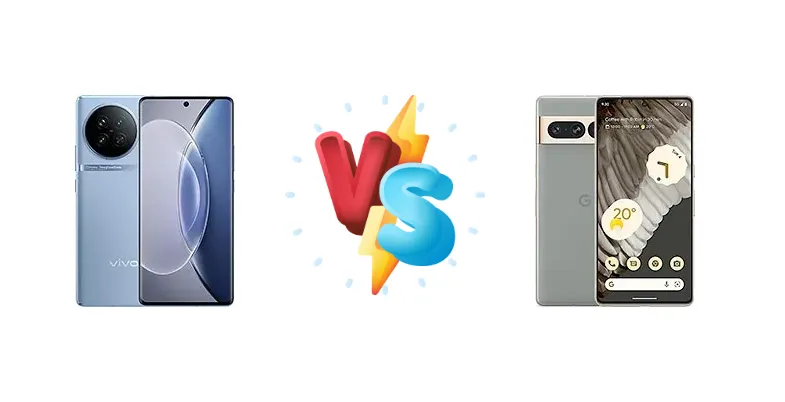
|
🏆 Quick Verdict
For users prioritizing blazing-fast charging and peak performance, the vivo X90 is the clear winner. However, the Google Pixel 7 Pro’s superior camera system, refined software experience, and consistently excellent image processing make it the better choice for photography enthusiasts and those deeply integrated into the Google ecosystem.
| PHONES | ||
|---|---|---|
| Phone Names | vivo X90 | Google Pixel 7 Pro |
| Network | ||
|---|---|---|
| 2G bands | GSM 850 / 900 / 1800 / 1900 | GSM 850 / 900 / 1800 / 1900 |
| 3G bands | HSDPA 800 / 850 / 900 / 1700(AWS) / 1900 / 2100 | HSDPA 800 / 850 / 900 / 1700(AWS) / 1900 / 2100 |
| 4G bands | 1, 2, 3, 4, 5, 7, 8, 18, 19, 20, 26, 28, 34, 38, 39, 40, 41 - International | 1, 2, 3, 4, 5, 7, 8, 12, 13, 14, 17, 18, 19, 20, 25, 26, 28, 29, 30, 38, 39, 40, 41, 42, 46, 48, 66, 71 - GE2AE |
| 5G bands | 1, 3, 5, 7, 8, 28, 38, 40, 41, 77, 78 SA/NSA - International | 1, 2, 3, 5, 7, 8, 12, 14, 20, 25, 28, 30, 38, 40, 41, 48, 66, 71, 77, 78, 257, 258, 260, 261 SA/NSA/Sub6/mmWave - GE2AE |
| Speed | HSPA, LTE, 5G | HSPA, LTE, 5G |
| Technology | GSM / CDMA / HSPA / CDMA2000 / LTE / 5G | GSM / CDMA / HSPA / EVDO / LTE / 5G |
| 1, 3, 5, 8, 28, 41, 77, 78 SA/NSA - China | 1, 2, 3, 5, 7, 8, 12, 14, 20, 25, 28, 30, 38, 40, 41, 48, 66, 71, 75, 76, 77, 78 SA/NSA/Sub6 - GP4BC | |
| Launch | ||
|---|---|---|
| Announced | 2022, November 22 | 2022, October 06 |
| Status | Available. Released 2022, November 30 | Available. Released 2022, October 13 |
| Body | ||
|---|---|---|
| Build | Glass front, glass back or eco leather back | Glass front (Gorilla Glass Victus), glass back (Gorilla Glass Victus), aluminum frame |
| Dimensions | 164.1 x 74.4 x 8.5 mm or 8.9 mm | 162.9 x 76.6 x 8.9 mm (6.41 x 3.02 x 0.35 in) |
| SIM | Nano-SIM + Nano-SIM | Nano-SIM + eSIM |
| Weight | 196 g / 200 g (6.91 oz) | 212 g (7.48 oz) |
| IP64 dust/water resistant | IP68 dust/water resistant (up to 1.5m for 30 min) | |
| Display | ||
|---|---|---|
| Protection | - | Corning Gorilla Glass Victus |
| Resolution | 1260 x 2800 pixels, 20:9 ratio (~452 ppi density) | 1440 x 3120 pixels, 19.5:9 ratio (~512 ppi density) |
| Size | 6.78 inches, 111.5 cm2 (~91.3% screen-to-body ratio) | 6.7 inches, 110.6 cm2 (~88.7% screen-to-body ratio) |
| Type | AMOLED, 1B colors, 120Hz, HDR10+ | LTPO AMOLED, 120Hz, HDR10+, 1000 nits (HBM), 1500 nits (peak) |
| - | Always-on display | |
| Platform | ||
|---|---|---|
| CPU | Octa-core (1x3.05 GHz Cortex-X3 & 3x2.85 GHz Cortex-A715 & 4x1.80 GHz Cortex-A510) | Octa-core (2x2.85 GHz Cortex-X1 & 2x2.35 GHz Cortex-A78 & 4x1.80 GHz Cortex-A55) |
| Chipset | Mediatek Dimensity 9200 (4 nm) | Google Tensor G2 (5 nm) |
| GPU | Immortalis-G715 MC11 | Mali-G710 MP7 |
| OS | Android 13, Funtouch 13 (Global), OriginOS 3 (China) | Android 13, upgradable to Android 15, up to 5 major Android upgrades |
| Memory | ||
|---|---|---|
| Card slot | No | No |
| Internal | 128GB 8GB RAM, 256GB 8GB RAM, 256GB 12GB RAM, 512GB 12GB RAM | 128GB 8GB RAM, 256GB 8GB RAM, 128GB 12GB RAM, 256GB 12GB RAM, 512GB 12GB RAM |
| UFS 4.0 - 256/512GB UFS 3.1 - 128GB | UFS 3.1 | |
| Main Camera | ||
|---|---|---|
| Features | Laser AF, color spectrum sensor, Zeiss optics, Zeiss T* lens coating, Pixel Shift, dual-LED dual-tone flash, HDR, panorama | Laser AF, Dual-LED flash, Pixel Shift, Auto-HDR, panorama |
| Single | 32 MP, f/2.5, 24mm (wide), 1/2.8", 0.8µm | 10.8 MP, f/2.2, 21mm (ultrawide), 1/3.1", 1.22µm |
| Triple | 50 MP, f/1.8, (wide), 1/1.49", 1.0µm, PDAF, OIS 12 MP, f/2.0, 50mm (telephoto), 1/2.93", 1.22µm, AF, 2x optical zoom 12 MP, f/2.0, 16mm (ultrawide), 1/2.93", 1.22µm, AF | 50 MP, f/1.9, 25mm (wide), 1/1.31", 1.2µm, dual pixel PDAF, OIS 48 MP, f/3.5, 120mm (periscope telephoto), 1/2.55", 0.7µm, dual pixel PDAF, OIS, 5x optical zoom 12 MP, f/2.2, 126˚ (ultrawide), 1/2.9", 1.25µm, AF |
| Video | 4K@30/60fps, 1080p@30/60fps, gyro-EIS | 4K@30/60fps, 1080p@30/60/120/240fps; gyro-EIS, OIS, 10-bit HDR |
| Selfie camera | ||
|---|---|---|
| Features | HDR | HDR, panorama |
| Single | 32 MP, f/2.5, 24mm (wide), 1/2.8", 0.8µm | 10.8 MP, f/2.2, 21mm (ultrawide), 1/3.1", 1.22µm |
| Video | 1080p@30/60fps | 4K@30/60fps, 1080p@30/60fps |
| Sound | ||
|---|---|---|
| 3.5mm jack | No | No |
| 35mm jack | No | No |
| Loudspeaker | Yes, with stereo speakers | Yes, with stereo speakers |
| 24-bit/192kHz audio | - | |
| Comms | ||
|---|---|---|
| Bluetooth | 5.3, A2DP, LE, aptX HD | 5.2, A2DP, LE, aptX HD |
| Infrared port | Yes | - |
| NFC | Yes | Yes |
| Positioning | GPS (L1+L5), GLONASS, BDS, GALILEO, QZSS, NavIC | GPS (L1+L5), GLONASS (G1), BDS (B1I+B1c+B2a), GALILEO (E1+E5a), QZSS (L1+L5) |
| Radio | No | No |
| USB | USB Type-C 2.0, OTG | USB Type-C 3.2 |
| WLAN | Wi-Fi 802.11 a/b/g/n/ac/6, dual-band, Wi-Fi Direct | Wi-Fi 802.11 a/b/g/n/ac/6e, tri-band, Wi-Fi Direct |
| Features | ||
|---|---|---|
| Sensors | Fingerprint (under display, optical), accelerometer, gyro, proximity, compass | Fingerprint (under display, optical), accelerometer, gyro, proximity, compass, barometer |
| - | Ultra Wideband (UWB) support | |
| Battery | ||
|---|---|---|
| Charging | 120W wired, 50% in 8 min Reverse wired | 23W wired, PD3.0, 50% in 30 min 23W wireless Reverse wireless |
| Type | 4810 mAh | Li-Ion 5000 mAh |
| Misc | ||
|---|---|---|
| Colors | Asteroid Black, Breeze Blue, Red | Obsidian, Snow, Hazel |
| Models | V2241A | GP4BC, GE2AE, GFE4J |
| Price | About 300 EUR | € 248.84 / $ 204.00 / £ 259.99 / ₹ 36,999 |
| Tests | ||
|---|---|---|
| Battery life | - | Endurance rating 83h |
| Camera | - | Photo / Video |
| Display | - | Contrast ratio: Infinite (nominal) |
| Loudspeaker | - | -24.8 LUFS (Very good) |
| Performance | - | AnTuTu: 796369 (v9) GeekBench: 3187 (v5.1) GFXBench: 34fps (ES 3.1 onscreen) |
vivo X90
- Blazing-fast 120W wired charging
- Powerful Mediatek Dimensity 9200 chipset
- Potentially superior thermal management due to 4nm node
- Battery capacity not specified
- Software experience may not be as refined as Pixel
Google Pixel 7 Pro
- Exceptional camera system with Google’s image processing
- Smooth and refined software experience
- Wireless charging and reverse wireless charging
- Significantly slower 23W wired charging
- Older generation Tensor G2 chipset
Display Comparison
The Google Pixel 7 Pro boasts a measured peak brightness of 1090 nits, providing excellent visibility outdoors. While the X90’s display specs aren’t provided, vivo typically employs high-quality AMOLED panels. The Pixel 7 Pro’s ‘infinite’ contrast ratio (nominal) suggests a true black level, enhancing visual depth. The absence of refresh rate information for the X90 is a gap, but the Pixel 7 Pro’s smooth scrolling experience is a key advantage. The Pixel 7 Pro’s display is likely tuned for color accuracy, catering to content creators, while the X90 may prioritize vibrant colors for entertainment.
Camera Comparison
Both phones are advertised as excelling in photo and video, but their approaches differ. The Pixel 7 Pro leverages Google’s computational photography expertise, delivering consistently excellent results in various conditions. While sensor sizes aren’t specified, the Pixel 7 Pro’s image processing is renowned for its dynamic range and accurate color reproduction. The X90’s camera system, while likely capable, relies more on hardware prowess. Without detailed sensor information, it’s difficult to assess its low-light performance relative to the Pixel 7 Pro. The Pixel 7 Pro’s Super Res Zoom is a significant advantage, offering impressive detail at long distances.
Performance
The vivo X90’s Mediatek Dimensity 9200 (4nm) is built on a more advanced node than the Google Tensor G2 (5nm), suggesting potentially better power efficiency and thermal performance. The X90’s CPU configuration – 1x3.05 GHz Cortex-X3, 3x2.85 GHz Cortex-A715, and 4x1.80 GHz Cortex-A510 – features the latest Cortex-X3 prime core, promising significant performance gains over the Pixel 7 Pro’s older Cortex-X1 cores (2x2.85 GHz). However, the Tensor G2’s strength lies in its dedicated machine learning cores, enabling features like Magic Eraser and Real Tone. The X90 will likely excel in raw benchmark scores and sustained performance, while the Pixel 7 Pro prioritizes intelligent features and AI-powered tasks.
Battery Life
Both devices achieve an endurance rating of 83 hours, indicating comparable battery life despite differing capacities (not specified for the X90). However, the charging speeds are drastically different. The vivo X90’s 120W wired charging can replenish 50% of the battery in just 8 minutes, a massive advantage over the Pixel 7 Pro’s 23W wired charging (50% in 30 minutes). The X90 also offers reverse wired charging, while the Pixel 7 Pro adds 23W wireless charging and reverse wireless charging. The X90’s charging speed is a game-changer for users who frequently need to top up their battery quickly.
Buying Guide
Buy the vivo X90 if you need uncompromising performance for demanding tasks like gaming and video editing, and if minimizing downtime with incredibly fast 120W charging is a top priority. Buy the Google Pixel 7 Pro if you prefer a seamless software experience, exceptional camera capabilities with Google’s signature image processing, and a phone that consistently improves with software updates.