
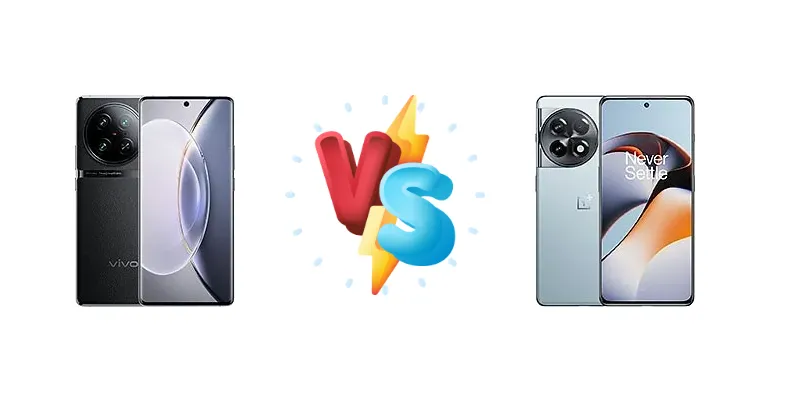
vivo X90 Pro vs OnePlus 11R: Which Flagship Reigns Supreme?
| Phones Images | |||||
|---|---|---|---|---|---|
|
🏆 Quick Verdict
For most users, the vivo X90 Pro emerges as the superior choice. Its more efficient Dimensity 9200 chipset, coupled with its faster 120W wired and 50W wireless charging, provides a smoother, more versatile experience. While the OnePlus 11R offers strong performance, it lacks the X90 Pro’s charging versatility and overall refinement.
| PHONES | ||
|---|---|---|
| Phone Names | vivo X90 Pro | OnePlus 11R |
| Network | ||
|---|---|---|
| 2G bands | GSM 850 / 900 / 1800 / 1900 | GSM 850 / 900 / 1800 / 1900 |
| 3G bands | HSDPA 800 / 850 / 900 / 1700(AWS) / 1900 / 2100 | HSDPA 850 / 900 / 1700(AWS) / 2100 |
| 4G bands | 1, 2, 3, 4, 5, 7, 8, 12, 13, 17, 18, 19, 20, 25, 26, 28, 32, 38, 39, 40, 41, 42, 66 - International | 1, 3, 4, 5, 8, 28, 34, 38, 39, 40, 41 |
| 5G bands | 1, 2, 3, 5, 7, 8, 20, 28, 38, 40, 41, 71, 75, 77, 78, 79 SA/NSA - International | 1, 3, 5, 8, 28, 40, 41, 77, 78 SA/NSA |
| Speed | HSPA, LTE, 5G | HSPA, LTE (3CA), 5G |
| Technology | GSM / CDMA / HSPA / EVDO / LTE / 5G | GSM / CDMA / HSPA / LTE / 5G |
| 1, 3, 5, 8, 28, 38, 40, 41, 77, 78, 79 SA/NSA - China | CDMA 800 | |
| Launch | ||
|---|---|---|
| Announced | 2022, November 22 | 2023, February 07 |
| Status | Available. Released 2022, December 06 | Available. Released 2023, February 21 |
| Body | ||
|---|---|---|
| Build | Glass front, aluminum frame, eco leather back | Glass front, glass back (Gorilla Glass 5), plastic frame |
| Dimensions | 164.1 x 74.5 x 9.3 mm (6.46 x 2.93 x 0.37 in) | 163.4 x 74.3 x 8.7 mm (6.43 x 2.93 x 0.34 in) |
| SIM | · Nano-SIM + Nano-SIM + eSIM (max 2 at a time)· Nano-SIM + Nano-SIM | Nano-SIM + Nano-SIM |
| Weight | 214.9 g (7.58 oz) | 204 g (7.20 oz) |
| IP68 dust/water resistant (up to 1.5m for 30 min) | - | |
| Display | ||
|---|---|---|
| Resolution | 1260 x 2800 pixels, 20:9 ratio (~453 ppi density) | 1240 x 2772 pixels, 20:9 ratio (~451 ppi density) |
| Size | 6.78 inches, 111.0 cm2 (~90.8% screen-to-body ratio) | 6.74 inches, 109.2 cm2 (~90.0% screen-to-body ratio) |
| Type | AMOLED, 1B colors, 120Hz, HDR10+, 1300 nits (peak) | Fluid AMOLED, 1B colors, 120Hz, HDR10+, 1450 nits (peak) |
| Platform | ||
|---|---|---|
| CPU | Octa-core (1x3.05 GHz Cortex-X3 & 3x2.85 GHz Cortex-A715 & 4x1.80 GHz Cortex-A510) | Octa-core (1x3.0 GHz Cortex-X2 & 3x2.5 GHz Cortex-A710 & 4x1.80 GHz Cortex-A510) |
| Chipset | Mediatek Dimensity 9200 (4 nm) | Qualcomm SM8475 Snapdragon 8+ Gen 1 (4 nm) |
| GPU | Immortalis-G715 MC11 | Adreno 730 |
| OS | Android 13, upgradable to Android 14, Funtouch 14 (Global), OriginOS 3 (China) | Android 13, upgradable to Android 15, OxygenOS 15 |
| Memory | ||
|---|---|---|
| Card slot | No | No |
| Internal | 256GB 8GB RAM, 256GB 12GB RAM, 512GB 12GB RAM | 128GB 8GB RAM, 256GB 16GB RAM, 512GB 18GB RAM |
| UFS 4.0 | UFS 3.1 | |
| Main Camera | ||
|---|---|---|
| Features | Laser AF, color spectrum sensor, Zeiss optics, Zeiss T* lens coating, Pixel Shift, dual-LED dual-tone flash, HDR, panorama | Color spectrum sensor, LED flash, HDR, panorama |
| Single | 32 MP, f/2.5, 24mm (wide), 1/2.8", 0.8µm | 16 MP, f/2.4, 24mm (wide), 1/3.09", 1.0µm |
| Triple | 50.3 MP, f/1.8, 23mm (wide), 1.0"-type, 1.6µm, dual pixel PDAF, OIS 50 MP, f/1.6, 50mm (telephoto), 1/2.4", 0.7µm, AF, 2x optical zoom, OIS 12 MP, f/2.0, 108˚ 16mm (ultrawide), AF | 50 MP, f/1.8, 24mm (wide), 1/1.56", 1.0µm, multi-directional PDAF, OIS 8 MP, f/2.2, 120˚ (ultrawide), 1/4.0", 1.12µm 2 MP (macro) |
| Video | 8K@24fps, 4K@30/60fps, 1080p@30/60fps, gyro-EIS | 4K@30/60fps, 1080p@30/60/240fps, gyro-EIS |
| Selfie camera | ||
|---|---|---|
| Features | HDR | HDR |
| Single | 32 MP, f/2.5, 24mm (wide), 1/2.8", 0.8µm | 16 MP, f/2.4, 24mm (wide), 1/3.09", 1.0µm |
| Video | 1080p@30/60fps | 1080p@30fps |
| Sound | ||
|---|---|---|
| 3.5mm jack | No | No |
| 35mm jack | No | No |
| Loudspeaker | Yes, with stereo speakers | Yes, with stereo speakers |
| 24-bit/192kHz audio | 24-bit/192kHz audio | |
| Comms | ||
|---|---|---|
| Bluetooth | 5.3, A2DP, LE, aptX HD | 5.3, A2DP, LE, aptX HD |
| Infrared port | Yes | Yes |
| NFC | Yes | Yes |
| Positioning | GPS (L1+L5), GLONASS, BDS, GALILEO, QZSS, NavIC | GPS (L1+L5), GLONASS (G1), BDS (B1I+B1c+B2a), GALILEO (E1+E5a), QZSS (L1+L5) |
| Radio | No | No |
| USB | USB Type-C 3.2, OTG | USB Type-C 2.0 |
| WLAN | Wi-Fi 802.11 a/b/g/n/ac/6, dual-band, Wi-Fi Direct | Wi-Fi 802.11 a/b/g/n/ac/6, dual-band |
| Features | ||
|---|---|---|
| Sensors | Fingerprint (under display, optical), accelerometer, gyro, proximity, compass | Fingerprint (under display, optical), accelerometer, gyro, proximity, compass |
| Battery | ||
|---|---|---|
| Charging | 120W wired, 50% in 8 min 50W wireless Reverse wired | 100W wired |
| Type | 4870 mAh | Li-Po 5000 mAh |
| Misc | ||
|---|---|---|
| Colors | Legendary Black, Red | Galactic Silver, Sonic Black, Solar Red |
| Models | V2242A, V2219 | CPH2487 |
| Price | About 1200 EUR | About 600 EUR |
| SAR | - | 1.16 W/kg (head) 0.61 W/kg (body) |
| Tests | ||
|---|---|---|
| Battery life | Endurance rating 96h | - |
| Camera | Photo / Video | - |
| Display | Contrast ratio: Infinite (nominal) | - |
| Loudspeaker | -24.5 LUFS (Very good) | - |
| Performance | AnTuTu: 1228735 (v9) GeekBench: 4273 (v5.1) GFXBench: 74fps (ES 3.1 onscreen) | - |
vivo X90 Pro
- Faster 120W wired and 50W wireless charging
- Potentially better battery life due to Dimensity 9200 efficiency
- More versatile charging options (reverse wired)
- Camera details are limited in provided context
- Price may be higher than the OnePlus 11R
OnePlus 11R
- Strong Snapdragon 8+ Gen 1 performance
- Potentially lower price point
- Fast 100W wired charging
- Lacks wireless charging
- Snapdragon 8+ Gen 1 may throttle under sustained load
- Potentially shorter battery life
Display Comparison
Both phones feature 4nm chipsets, but their displays differ. The vivo X90 Pro boasts a measured peak brightness of 934 nits, suggesting a vibrant viewing experience. While the OnePlus 11R’s display specs aren’t provided, OnePlus typically prioritizes high refresh rates. The X90 Pro’s ‘Infinite’ contrast ratio (nominal) indicates a likely OLED panel, offering deep blacks. Without specific details on the 11R’s panel technology, it’s difficult to assess its color accuracy or viewing angles relative to the X90 Pro.
Camera Comparison
Both devices are marketed with a focus on camera capabilities, but specific details are limited. The context data only indicates 'Photo / Video' for the X90 Pro. The X90 Pro’s image processing is likely tuned for color accuracy and detail, typical of vivo’s flagship offerings. Without sensor size or aperture information for either phone, a direct comparison is difficult. However, the X90 Pro’s positioning suggests a more comprehensive camera system, potentially with a larger main sensor and more advanced features. We can assume the OnePlus 11R will lean towards a more vibrant, social-media-ready image profile.
Performance
The core of the performance difference lies in the chipsets. The vivo X90 Pro utilizes the Mediatek Dimensity 9200 (4nm), featuring a Cortex-X3 prime core clocked at 3.05 GHz. The OnePlus 11R employs the Qualcomm Snapdragon 8+ Gen 1 (4nm) with a Cortex-X2 prime core at 3.0 GHz. While clock speeds are similar, the Dimensity 9200’s newer architecture and potentially more efficient 4nm process could translate to better sustained performance and thermal management. The 11R’s A710 cores are slightly faster than the X90 Pro’s A715 cores, but the overall system-level optimization of the Dimensity 9200 is likely to provide a smoother experience. Both utilize LPDDR5x RAM, ensuring fast memory access.
Battery Life
The vivo X90 Pro boasts an impressive endurance rating of 96 hours, suggesting excellent battery life. Its charging capabilities are a standout feature, offering 120W wired charging (50% in 8 minutes) and 50W wireless charging, alongside reverse wired charging. The OnePlus 11R offers 100W wired charging, which is still very fast, but lacks wireless charging. While the 11R’s battery capacity isn’t specified, the X90 Pro’s 96-hour endurance rating, combined with the Dimensity 9200’s efficiency, suggests it will likely outperform the 11R in real-world battery tests, especially under sustained load.
Buying Guide
Buy the vivo X90 Pro if you prioritize a balanced experience with exceptional charging speeds, potentially longer battery life due to chipset efficiency, and a more complete feature set. Buy the OnePlus 11R if you are a performance-focused user who prioritizes raw gaming power and are comfortable with a slightly less refined charging experience, and potentially shorter battery life under heavy load.