
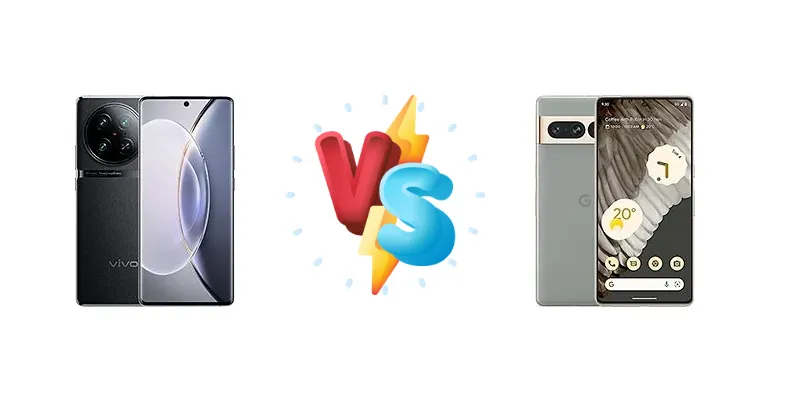
vivo X90 Pro vs. Google Pixel 7 Pro: Which Flagship Reigns Supreme?
| Phones Images | |||||
|---|---|---|---|---|---|
|
🏆 Quick Verdict
For users prioritizing peak performance and blazing-fast charging, the vivo X90 Pro is the clear winner. Its Dimensity 9200 chipset and 120W charging significantly outperform the Pixel 7 Pro. However, the Pixel 7 Pro’s superior camera software and seamless Google ecosystem make it the better choice for photography enthusiasts and those deeply invested in Google services.
| PHONES | ||
|---|---|---|
| Phone Names | vivo X90 Pro | Google Pixel 7 Pro |
| Network | ||
|---|---|---|
| 2G bands | GSM 850 / 900 / 1800 / 1900 | GSM 850 / 900 / 1800 / 1900 |
| 3G bands | HSDPA 800 / 850 / 900 / 1700(AWS) / 1900 / 2100 | HSDPA 800 / 850 / 900 / 1700(AWS) / 1900 / 2100 |
| 4G bands | 1, 2, 3, 4, 5, 7, 8, 12, 13, 17, 18, 19, 20, 25, 26, 28, 32, 38, 39, 40, 41, 42, 66 - International | 1, 2, 3, 4, 5, 7, 8, 12, 13, 14, 17, 18, 19, 20, 25, 26, 28, 29, 30, 38, 39, 40, 41, 42, 46, 48, 66, 71 - GE2AE |
| 5G bands | 1, 2, 3, 5, 7, 8, 20, 28, 38, 40, 41, 71, 75, 77, 78, 79 SA/NSA - International | 1, 2, 3, 5, 7, 8, 12, 14, 20, 25, 28, 30, 38, 40, 41, 48, 66, 71, 77, 78, 257, 258, 260, 261 SA/NSA/Sub6/mmWave - GE2AE |
| Speed | HSPA, LTE, 5G | HSPA, LTE, 5G |
| Technology | GSM / CDMA / HSPA / EVDO / LTE / 5G | GSM / CDMA / HSPA / EVDO / LTE / 5G |
| 1, 3, 5, 8, 28, 38, 40, 41, 77, 78, 79 SA/NSA - China | 1, 2, 3, 5, 7, 8, 12, 14, 20, 25, 28, 30, 38, 40, 41, 48, 66, 71, 75, 76, 77, 78 SA/NSA/Sub6 - GP4BC | |
| Launch | ||
|---|---|---|
| Announced | 2022, November 22 | 2022, October 06 |
| Status | Available. Released 2022, December 06 | Available. Released 2022, October 13 |
| Body | ||
|---|---|---|
| Build | Glass front, aluminum frame, eco leather back | Glass front (Gorilla Glass Victus), glass back (Gorilla Glass Victus), aluminum frame |
| Dimensions | 164.1 x 74.5 x 9.3 mm (6.46 x 2.93 x 0.37 in) | 162.9 x 76.6 x 8.9 mm (6.41 x 3.02 x 0.35 in) |
| SIM | · Nano-SIM + Nano-SIM + eSIM (max 2 at a time)· Nano-SIM + Nano-SIM | Nano-SIM + eSIM |
| Weight | 214.9 g (7.58 oz) | 212 g (7.48 oz) |
| IP68 dust/water resistant (up to 1.5m for 30 min) | IP68 dust/water resistant (up to 1.5m for 30 min) | |
| Display | ||
|---|---|---|
| Protection | - | Corning Gorilla Glass Victus |
| Resolution | 1260 x 2800 pixels, 20:9 ratio (~453 ppi density) | 1440 x 3120 pixels, 19.5:9 ratio (~512 ppi density) |
| Size | 6.78 inches, 111.0 cm2 (~90.8% screen-to-body ratio) | 6.7 inches, 110.6 cm2 (~88.7% screen-to-body ratio) |
| Type | AMOLED, 1B colors, 120Hz, HDR10+, 1300 nits (peak) | LTPO AMOLED, 120Hz, HDR10+, 1000 nits (HBM), 1500 nits (peak) |
| - | Always-on display | |
| Platform | ||
|---|---|---|
| CPU | Octa-core (1x3.05 GHz Cortex-X3 & 3x2.85 GHz Cortex-A715 & 4x1.80 GHz Cortex-A510) | Octa-core (2x2.85 GHz Cortex-X1 & 2x2.35 GHz Cortex-A78 & 4x1.80 GHz Cortex-A55) |
| Chipset | Mediatek Dimensity 9200 (4 nm) | Google Tensor G2 (5 nm) |
| GPU | Immortalis-G715 MC11 | Mali-G710 MP7 |
| OS | Android 13, upgradable to Android 14, Funtouch 14 (Global), OriginOS 3 (China) | Android 13, upgradable to Android 15, up to 5 major Android upgrades |
| Memory | ||
|---|---|---|
| Card slot | No | No |
| Internal | 256GB 8GB RAM, 256GB 12GB RAM, 512GB 12GB RAM | 128GB 8GB RAM, 256GB 8GB RAM, 128GB 12GB RAM, 256GB 12GB RAM, 512GB 12GB RAM |
| UFS 4.0 | UFS 3.1 | |
| Main Camera | ||
|---|---|---|
| Features | Laser AF, color spectrum sensor, Zeiss optics, Zeiss T* lens coating, Pixel Shift, dual-LED dual-tone flash, HDR, panorama | Laser AF, Dual-LED flash, Pixel Shift, Auto-HDR, panorama |
| Single | 32 MP, f/2.5, 24mm (wide), 1/2.8", 0.8µm | 10.8 MP, f/2.2, 21mm (ultrawide), 1/3.1", 1.22µm |
| Triple | 50.3 MP, f/1.8, 23mm (wide), 1.0"-type, 1.6µm, dual pixel PDAF, OIS 50 MP, f/1.6, 50mm (telephoto), 1/2.4", 0.7µm, AF, 2x optical zoom, OIS 12 MP, f/2.0, 108˚ 16mm (ultrawide), AF | 50 MP, f/1.9, 25mm (wide), 1/1.31", 1.2µm, dual pixel PDAF, OIS 48 MP, f/3.5, 120mm (periscope telephoto), 1/2.55", 0.7µm, dual pixel PDAF, OIS, 5x optical zoom 12 MP, f/2.2, 126˚ (ultrawide), 1/2.9", 1.25µm, AF |
| Video | 8K@24fps, 4K@30/60fps, 1080p@30/60fps, gyro-EIS | 4K@30/60fps, 1080p@30/60/120/240fps; gyro-EIS, OIS, 10-bit HDR |
| Selfie camera | ||
|---|---|---|
| Features | HDR | HDR, panorama |
| Single | 32 MP, f/2.5, 24mm (wide), 1/2.8", 0.8µm | 10.8 MP, f/2.2, 21mm (ultrawide), 1/3.1", 1.22µm |
| Video | 1080p@30/60fps | 4K@30/60fps, 1080p@30/60fps |
| Sound | ||
|---|---|---|
| 3.5mm jack | No | No |
| 35mm jack | No | No |
| Loudspeaker | Yes, with stereo speakers | Yes, with stereo speakers |
| 24-bit/192kHz audio | - | |
| Comms | ||
|---|---|---|
| Bluetooth | 5.3, A2DP, LE, aptX HD | 5.2, A2DP, LE, aptX HD |
| Infrared port | Yes | - |
| NFC | Yes | Yes |
| Positioning | GPS (L1+L5), GLONASS, BDS, GALILEO, QZSS, NavIC | GPS (L1+L5), GLONASS (G1), BDS (B1I+B1c+B2a), GALILEO (E1+E5a), QZSS (L1+L5) |
| Radio | No | No |
| USB | USB Type-C 3.2, OTG | USB Type-C 3.2 |
| WLAN | Wi-Fi 802.11 a/b/g/n/ac/6, dual-band, Wi-Fi Direct | Wi-Fi 802.11 a/b/g/n/ac/6e, tri-band, Wi-Fi Direct |
| Features | ||
|---|---|---|
| Sensors | Fingerprint (under display, optical), accelerometer, gyro, proximity, compass | Fingerprint (under display, optical), accelerometer, gyro, proximity, compass, barometer |
| - | Ultra Wideband (UWB) support | |
| Battery | ||
|---|---|---|
| Charging | 120W wired, 50% in 8 min 50W wireless Reverse wired | 23W wired, PD3.0, 50% in 30 min 23W wireless Reverse wireless |
| Type | 4870 mAh | Li-Ion 5000 mAh |
| Misc | ||
|---|---|---|
| Colors | Legendary Black, Red | Obsidian, Snow, Hazel |
| Models | V2242A, V2219 | GP4BC, GE2AE, GFE4J |
| Price | About 1200 EUR | € 248.84 / $ 204.00 / £ 259.99 / ₹ 36,999 |
| Tests | ||
|---|---|---|
| Battery life | Endurance rating 96h | Endurance rating 83h |
| Camera | Photo / Video | Photo / Video |
| Display | Contrast ratio: Infinite (nominal) | Contrast ratio: Infinite (nominal) |
| Loudspeaker | -24.5 LUFS (Very good) | -24.8 LUFS (Very good) |
| Performance | AnTuTu: 1228735 (v9) GeekBench: 4273 (v5.1) GFXBench: 74fps (ES 3.1 onscreen) | AnTuTu: 796369 (v9) GeekBench: 3187 (v5.1) GFXBench: 34fps (ES 3.1 onscreen) |
vivo X90 Pro
- Blazing-fast 120W wired charging
- Superior CPU performance with Dimensity 9200
- Potentially longer battery life (96h endurance)
- Lower peak display brightness
- Less refined camera software compared to Pixel
Google Pixel 7 Pro
- Exceptional camera software and image processing
- Brighter display for outdoor visibility
- Seamless Google ecosystem integration
- Slower charging speeds (23W wired)
- Less powerful chipset (Tensor G2)
Display Comparison
Both devices feature infinite contrast ratio displays, typical of OLED panels. However, the Pixel 7 Pro boasts a significantly higher peak brightness of 1090 nits compared to the X90 Pro’s 934 nits. This translates to better visibility under direct sunlight. While both offer excellent viewing experiences, the Pixel 7 Pro’s brighter display provides a tangible advantage in outdoor scenarios. Details regarding refresh rate and panel type (LTPO) are missing, but both are expected to offer adaptive refresh rates for power efficiency.
Camera Comparison
Both phones are equipped with versatile camera systems, but their approaches differ. While both offer photo and video capabilities, the Pixel 7 Pro excels in computational photography, leveraging Google’s renowned image processing algorithms. The X90 Pro likely relies more on its hardware, potentially offering a different aesthetic. Without specific sensor details beyond 'Photo/Video', it’s difficult to make a definitive judgment. However, Google’s Super Res Zoom and Magic Eraser features are exclusive to the Pixel line and provide significant value for many users. The X90 Pro’s image processing is likely tuned for vibrant colors, while the Pixel 7 Pro aims for more natural tones.
Performance
The core difference lies in the chipsets. The vivo X90 Pro utilizes the MediaTek Dimensity 9200 (4nm), featuring a Cortex-X3 prime core clocked at 3.05 GHz. The Pixel 7 Pro, on the other hand, employs Google’s Tensor G2 (5nm). While the Tensor G2 benefits from a more efficient node, the Dimensity 9200’s architectural advantages – particularly the newer Cortex-X3 core – provide a noticeable performance edge in CPU-intensive tasks. The Pixel 7 Pro’s older Cortex-X1 cores and A78 cores are less efficient. This difference will be most apparent in demanding games and applications. The X90 Pro’s LPDDR5x RAM further contributes to its performance advantage.
Battery Life
The vivo X90 Pro boasts an endurance rating of 96 hours, while the Pixel 7 Pro manages 83 hours. This suggests the X90 Pro offers superior battery life, despite not necessarily having a larger battery capacity (data missing). However, the X90 Pro’s true advantage lies in its charging speed: 120W wired charging can replenish 50% of the battery in just 8 minutes, a massive advantage over the Pixel 7 Pro’s 23W charging, which takes 30 minutes for the same result. The X90 Pro also supports 50W wireless charging, significantly faster than the Pixel 7 Pro’s 23W wireless charging. Both offer reverse wired/wireless charging, but the X90 Pro’s faster charging speeds make it more practical.
Buying Guide
Buy the vivo X90 Pro if you need uncompromising performance for demanding tasks like gaming and video editing, and if minimizing downtime with incredibly fast charging is a priority. Buy the Google Pixel 7 Pro if you prefer a refined camera experience with exceptional computational photography, a clean Android interface, and long-term software support, even if it means sacrificing some raw processing power.