
vivo X90 Pro vs Apple iPhone 14 Pro Max: A Deep Dive Comparison
| Phones Images | |||||
|---|---|---|---|---|---|
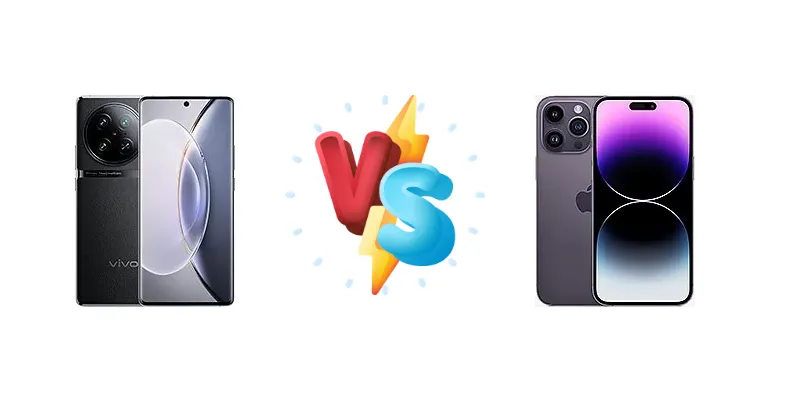
|
🏆 Quick Verdict
For the average user prioritizing long-term performance and a refined software experience, the Apple iPhone 14 Pro Max is the superior choice. Its A16 Bionic chip and significantly longer battery endurance outweigh the vivo X90 Pro’s faster charging and slightly brighter display.
| PHONES | ||
|---|---|---|
| Phone Names | vivo X90 Pro | Apple iPhone 14 Pro Max |
| Network | ||
|---|---|---|
| 2G bands | GSM 850 / 900 / 1800 / 1900 | GSM 850 / 900 / 1800 / 1900 |
| 3G bands | HSDPA 800 / 850 / 900 / 1700(AWS) / 1900 / 2100 | HSDPA 850 / 900 / 1700(AWS) / 1900 / 2100 |
| 4G bands | 1, 2, 3, 4, 5, 7, 8, 12, 13, 17, 18, 19, 20, 25, 26, 28, 32, 38, 39, 40, 41, 42, 66 - International | 1, 2, 3, 4, 5, 7, 8, 12, 13, 17, 18, 19, 20, 25, 26, 28, 30, 32, 34, 38, 39, 40, 41, 42, 46, 48, 66 - A2894, A2896 |
| 5G bands | 1, 2, 3, 5, 7, 8, 20, 28, 38, 40, 41, 71, 75, 77, 78, 79 SA/NSA - International | 1, 2, 3, 5, 7, 8, 12, 20, 25, 26, 28, 30, 38, 40, 41, 48, 66, 70, 77, 78, 79 SA/NSA/Sub6 - A2894, A2896 |
| Speed | HSPA, LTE, 5G | HSPA, LTE, 5G, EV-DO Rev.A 3.1 Mbps |
| Technology | GSM / CDMA / HSPA / EVDO / LTE / 5G | GSM / CDMA / HSPA / EVDO / LTE / 5G |
| 1, 3, 5, 8, 28, 38, 40, 41, 77, 78, 79 SA/NSA - China | 1, 2, 3, 5, 7, 8, 12, 20, 25, 26, 28, 30, 38, 40, 41, 48, 66, 70, 77, 78, 79 SA/NSA/Sub6 - A2895 | |
| Launch | ||
|---|---|---|
| Announced | 2022, November 22 | 2022, September 07 |
| Status | Available. Released 2022, December 06 | Available. Released 2022, September 16 |
| Body | ||
|---|---|---|
| Build | Glass front, aluminum frame, eco leather back | Glass front, glass back, stainless steel frame |
| Dimensions | 164.1 x 74.5 x 9.3 mm (6.46 x 2.93 x 0.37 in) | 160.7 x 77.6 x 7.9 mm (6.33 x 3.06 x 0.31 in) |
| SIM | · Nano-SIM + Nano-SIM + eSIM (max 2 at a time)· Nano-SIM + Nano-SIM | · Nano-SIM + eSIM + eSIM (max 2 at a time; International)· eSIM + eSIM (8 or more, max 2 at a time; USA)· Nano-SIM + Nano-SIM (China) |
| Weight | 214.9 g (7.58 oz) | 240 g (8.47 oz) |
| IP68 dust/water resistant (up to 1.5m for 30 min) | IP68 dust/water resistant (up to 6m for 30 min) Apple Pay (Visa, MasterCard, AMEX certified) | |
| Display | ||
|---|---|---|
| Protection | - | Ceramic Shield glass |
| Resolution | 1260 x 2800 pixels, 20:9 ratio (~453 ppi density) | 1290 x 2796 pixels, 19.5:9 ratio (~460 ppi density) |
| Size | 6.78 inches, 111.0 cm2 (~90.8% screen-to-body ratio) | 6.7 inches, 110.2 cm2 (~88.3% screen-to-body ratio) |
| Type | AMOLED, 1B colors, 120Hz, HDR10+, 1300 nits (peak) | LTPO Super Retina XDR OLED, 120Hz, HDR10, Dolby Vision, 1000 nits (typ), 2000 nits (HBM) |
| - | Always-On display | |
| Platform | ||
|---|---|---|
| CPU | Octa-core (1x3.05 GHz Cortex-X3 & 3x2.85 GHz Cortex-A715 & 4x1.80 GHz Cortex-A510) | Hexa-core (2x3.46 GHz Everest + 4x2.02 GHz Sawtooth) |
| Chipset | Mediatek Dimensity 9200 (4 nm) | Apple A16 Bionic (4 nm) |
| GPU | Immortalis-G715 MC11 | Apple GPU (5-core graphics) |
| OS | Android 13, upgradable to Android 14, Funtouch 14 (Global), OriginOS 3 (China) | iOS 16, upgradable to iOS 26.1 |
| Memory | ||
|---|---|---|
| Card slot | No | No |
| Internal | 256GB 8GB RAM, 256GB 12GB RAM, 512GB 12GB RAM | 128GB 6GB RAM, 256GB 6GB RAM, 512GB 6GB RAM, 1TB 6GB RAM |
| UFS 4.0 | NVMe | |
| Main Camera | ||
|---|---|---|
| Features | Laser AF, color spectrum sensor, Zeiss optics, Zeiss T* lens coating, Pixel Shift, dual-LED dual-tone flash, HDR, panorama | Dual-LED dual-tone flash, HDR (photo/panorama) |
| Single | 32 MP, f/2.5, 24mm (wide), 1/2.8", 0.8µm | 12 MP, f/1.9, 23mm (wide), 1/3.6", PDAF, OIS (unconfirmed) SL 3D, (depth/biometrics sensor) |
| Triple | 50.3 MP, f/1.8, 23mm (wide), 1.0"-type, 1.6µm, dual pixel PDAF, OIS 50 MP, f/1.6, 50mm (telephoto), 1/2.4", 0.7µm, AF, 2x optical zoom, OIS 12 MP, f/2.0, 108˚ 16mm (ultrawide), AF | 48 MP, f/1.8, 24mm (wide), 1/1.28", 1.22µm, dual pixel PDAF, sensor-shift OIS 12 MP, f/2.8, 77mm (telephoto), 1/3.5", 1.0µm, PDAF, OIS, 3x optical zoom 12 MP, f/2.2, 13mm, 120˚ (ultrawide), 1/2.55", 1.4µm, dual pixel PDAF TOF 3D LiDAR scanner (depth) |
| Video | 8K@24fps, 4K@30/60fps, 1080p@30/60fps, gyro-EIS | 4K@24/25/30/60fps, 1080p@25/30/60/120/240fps, 10-bit HDR, Dolby Vision HDR (up to 60fps), ProRes, stereo sound rec. |
| Selfie camera | ||
|---|---|---|
| Features | HDR | HDR |
| Single | 32 MP, f/2.5, 24mm (wide), 1/2.8", 0.8µm | 12 MP, f/1.9, 23mm (wide), 1/3.6", 1.0µm, PDAF, OIS SL 3D, (depth/biometrics sensor) |
| Video | 1080p@30/60fps | 4K@24/25/30/60fps, 1080p@25/30/60/120fps, gyro-EIS |
| Sound | ||
|---|---|---|
| 3.5mm jack | No | No |
| 35mm jack | No | No |
| Loudspeaker | Yes, with stereo speakers | Yes, with stereo speakers |
| 24-bit/192kHz audio | - | |
| Comms | ||
|---|---|---|
| Bluetooth | 5.3, A2DP, LE, aptX HD | 5.3, A2DP, LE |
| Infrared port | Yes | - |
| NFC | Yes | Yes |
| Positioning | GPS (L1+L5), GLONASS, BDS, GALILEO, QZSS, NavIC | GPS (L1+L5), GLONASS, GALILEO, BDS, QZSS |
| Radio | No | No |
| USB | USB Type-C 3.2, OTG | Lightning, USB 2.0 |
| WLAN | Wi-Fi 802.11 a/b/g/n/ac/6, dual-band, Wi-Fi Direct | Wi-Fi 802.11 a/b/g/n/ac/6, dual-band, hotspot |
| Features | ||
|---|---|---|
| Sensors | Fingerprint (under display, optical), accelerometer, gyro, proximity, compass | Face ID, accelerometer, gyro, proximity, compass, barometer |
| - | Ultra Wideband (UWB) support Emergency SOS via satellite (SMS sending/receiving) | |
| Battery | ||
|---|---|---|
| Charging | 120W wired, 50% in 8 min 50W wireless Reverse wired | Wired, PD2.0, 50% in 30 min 15W wireless (MagSafe) 15W wireless (Qi2) - requires iOS 17.2 update |
| Type | 4870 mAh | Li-Ion 4323 mAh (16.68 Wh) |
| Misc | ||
|---|---|---|
| Colors | Legendary Black, Red | Space Black, Silver, Gold, Deep Purple |
| Models | V2242A, V2219 | A2894, A2651, A2893, A2895, A2896, iphone15,3 |
| Price | About 1200 EUR | € 530.79 / $ 489.81 / £ 446.75 |
| SAR | - | 1.15 W/kg (head) 1.07 W/kg (body) |
| SAR EU | - | 0.99 W/kg (head) 0.98 W/kg (body) |
| Tests | ||
|---|---|---|
| Battery life | Endurance rating 96h | Endurance rating 121h |
| Camera | Photo / Video | Photo / Video |
| Display | Contrast ratio: Infinite (nominal) | Contrast ratio: Infinite (nominal) |
| Loudspeaker | -24.5 LUFS (Very good) | -24.3 LUFS (Very good) |
| Performance | AnTuTu: 1228735 (v9) GeekBench: 4273 (v5.1) GFXBench: 74fps (ES 3.1 onscreen) | AnTuTu: 955884 (v9) GeekBench: 5423 (v5.1) GFXBench: 54fps (ES 3.1 onscreen) |
vivo X90 Pro
- Blazing-fast 120W wired charging
- 50W wireless charging and reverse charging
- Vibrant and bright display
- Customizable Android experience
- Shorter battery life compared to iPhone
- Performance lags behind A16 Bionic
Apple iPhone 14 Pro Max
- Exceptional battery life (121h endurance)
- Industry-leading A16 Bionic performance
- Superior camera consistency and video quality
- Seamless Apple ecosystem integration
- Slower wired charging (50% in 30 min)
- Less customizable software
Display Comparison
The iPhone 14 Pro Max’s display dominates in peak brightness, reaching a measured 1760 nits compared to the vivo X90 Pro’s 934 nits. This translates to significantly better visibility in direct sunlight. Both displays share an infinite (nominal) contrast ratio, but the iPhone’s higher brightness provides a more impactful HDR experience. While the X90 Pro’s display is excellent, the iPhone’s is demonstrably superior for outdoor use and visual pop. The iPhone also benefits from ProMotion, Apple’s adaptive refresh rate technology, which dynamically adjusts up to 120Hz for smoother scrolling and animations, a feature also present on the X90 Pro.
Camera Comparison
Both phones excel in photography and videography, but approach it differently. While detailed sensor specs are missing for the X90 Pro, its camera system is known for its vibrant color science and strong low-light performance. The iPhone 14 Pro Max, with its larger main sensor (48MP), delivers exceptional detail and dynamic range, particularly in well-lit conditions. Apple’s image processing prioritizes natural-looking images, while vivo tends towards more saturated colors. The iPhone’s Cinematic mode for video recording remains a standout feature, offering shallow depth-of-field effects with rack focus capabilities. Both offer excellent video stabilization.
Performance
The core difference lies in the chipsets. Apple’s A16 Bionic, a hexa-core processor built on a 4nm process, consistently outperforms the MediaTek Dimensity 9200 in CPU and GPU benchmarks. While the Dimensity 9200’s octa-core configuration (1x3.05 GHz Cortex-X3, 3x2.85 GHz Cortex-A715, 4x1.80 GHz Cortex-A510) is powerful, the A16’s architecture and software optimization provide a noticeable edge in real-world performance, especially in demanding tasks like video editing and gaming. The iPhone’s sustained performance is also superior, benefiting from Apple’s efficient thermal management. Both utilize 4nm fabrication, but Apple’s chip design is more efficient.
Battery Life
The iPhone 14 Pro Max’s endurance rating of 121 hours significantly surpasses the vivo X90 Pro’s 96 hours. This translates to a full day of heavy use with more headroom on the iPhone. While the X90 Pro’s 120W wired charging is incredibly fast – reaching 50% charge in just 8 minutes – the iPhone’s 50% charge in 30 minutes is considerably slower. However, the iPhone’s superior battery life mitigates the slower charging speed for most users. The X90 Pro also offers 50W wireless charging and reverse wired charging, features absent on the iPhone, which relies on 15W MagSafe and Qi2 wireless charging.
Buying Guide
Buy the vivo X90 Pro if you need incredibly fast charging – 120W is a game-changer for topping up quickly – and prefer a more customizable Android experience. It’s ideal for users who frequently find themselves needing a rapid power boost. Buy the Apple iPhone 14 Pro Max if you prioritize consistent performance over extended periods, a seamless user experience within the Apple ecosystem, and a camera system known for its reliability and video capabilities. It’s the better choice for content creators and power users.