
vivo X80 vs Xiaomi 12 Pro (Dimensity): A Deep Dive into Mediatek Flagships
| Phones Images | |||||
|---|---|---|---|---|---|
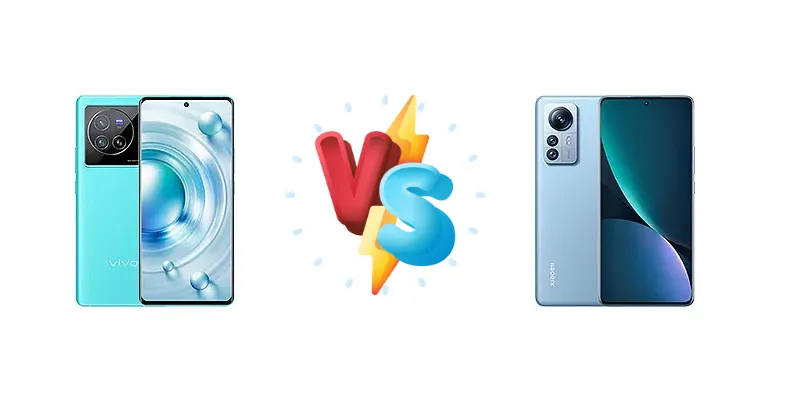
|
🏆 Quick Verdict
For most users, the Xiaomi 12 Pro (Dimensity) is the stronger choice. Its Dimensity 9000+ chipset provides a slight performance edge, and while charging is slower than the X80’s 80W, the overall package offers a more refined experience. However, the X80’s faster charging is a compelling advantage for those prioritizing speed.
| PHONES | ||
|---|---|---|
| Phone Names | vivo X80 | Xiaomi 12 Pro (Dimensity) |
| Network | ||
|---|---|---|
| 2G bands | GSM 850 / 900 / 1800 / 1900 | GSM 850 / 900 / 1800 / 1900 |
| 3G bands | HSDPA 850 / 900 / 1900 / 2100 - International | HSDPA 800 / 850 / 900 / 1700(AWS) / 1900 / 2100 |
| 4G bands | 1, 2, 3, 4, 5, 7, 8, 20, 28, 38, 39, 40, 41 - International, China | 1, 2, 3, 4, 5, 7, 8, 18, 19, 26, 34, 38, 39, 40, 41, 42 |
| 5G bands | 1, 3, 5, 7, 8, 28, 38, 40, 41, 78 SA/NSA - International | 1, 3, 5, 8, 28, 38, 40, 41, 77, 78 SA/NSA |
| Speed | HSPA, LTE, 5G | HSPA, LTE, 5G |
| Technology | GSM / CDMA / HSPA / CDMA2000 / LTE / 5G | GSM / CDMA / HSPA / EVDO / LTE / 5G |
| 1, 3, 5, 8, 28, 41, 77, 78 SA/NSA - China | CDMA2000 1xEV-DO | |
| Launch | ||
|---|---|---|
| Announced | 2022, April 25 | 2022, July 04 |
| Status | Available. Released 2022, April 29 | Available. Released 2022, July 13 |
| Body | ||
|---|---|---|
| Build | Glass front, glass back or eco leather back | - |
| Dimensions | 165 x 75.2 x 8.3 mm or 8.8 mm | 163.6 x 74.6 x 8.2 mm (6.44 x 2.94 x 0.32 in) |
| SIM | Nano-SIM + Nano-SIM | Nano-SIM + Nano-SIM |
| Weight | 203 g / 206 g (7.16 oz) | 201 g (7.09 oz) |
| Display | ||
|---|---|---|
| Protection | - | Corning Gorilla Glass Victus |
| Resolution | 1080 x 2400 pixels, 20:9 ratio (~388 ppi density) | 1440 x 3200 pixels, 20:9 ratio (~521 ppi density) |
| Size | 6.78 inches, 111.0 cm2 (~89.4% screen-to-body ratio) | 6.73 inches, 109.4 cm2 (~89.6% screen-to-body ratio) |
| Type | AMOLED, 120Hz, HDR, 1500 nits (peak) | LTPO2 AMOLED, 1B colors, 120Hz, Dolby Vision, HDR10+, 1000 nits (HBM), 1500 nits (peak) |
| Platform | ||
|---|---|---|
| CPU | Octa-core (1x3.05 GHz Cortex-X2 & 3x2.85 GHz Cortex-A710 & 4x1.80 GHz Cortex-A510) | Octa-core (1x3.20 GHz Cortex-X2 & 3x2.85 GHz Cortex-A710 & 4x1.80 GHz Cortex-A510) |
| Chipset | Mediatek Dimensity 9000 (4 nm) | Mediatek Dimensity 9000+ (4 nm) |
| GPU | Mali-G710 MC10 | Mali-G710 MC10 |
| OS | Android 12, upgradable to Android 14, Funtouch 14 (Global), OriginOS Ocean (China) | Android 12, MIUI 13 |
| Memory | ||
|---|---|---|
| Card slot | No | No |
| Internal | 128GB 8GB RAM, 256GB 8GB RAM, 256GB 12GB RAM, 512GB 12GB RAM | 128GB 8GB RAM, 256GB 12GB RAM |
| UFS 3.1 | UFS 3.1 | |
| Main Camera | ||
|---|---|---|
| Features | Laser AF, color spectrum sensor, Zeiss optics, Zeiss T* lens coating, Pixel Shift, dual-LED dual-tone flash, HDR, panorama | Color spectrum sensor, Dual-LED dual-tone flash, HDR, panorama |
| Single | 32 MP, f/2.5, 24mm (wide), 1/2.8", 0.8µm | 32 MP, f/2.5, 26mm (wide), 0.7µm |
| Triple | 50 MP, f/1.8, (wide), 1/1.49", 1.0µm, PDAF, OIS 12 MP, f/2.0, 50mm (telephoto), 1/2.93", 1.22µm, PDAF, 2x optical zoom 12 MP, f/2.0, 16mm (ultrawide), 1/2.93", 1.22µm, AF | 50 MP, f/1.9, 24mm (wide), 1/1.28", 1.22µm, dual pixel PDAF, OIS 13 MP, f/2.4, 15mm, 123˚ (ultrawide), 1/3.06", 1.12µm 5 MP, f/2.4, 50mm (telephoto macro), AF |
| Video | 4K@30/60fps, 1080p@30/60fps, gyro-EIS | 4K@30/60fps, 1080p@30/60/120fps, gyro-EIS |
| Selfie camera | ||
|---|---|---|
| Features | HDR | HDR, panorama |
| Single | 32 MP, f/2.5, 24mm (wide), 1/2.8", 0.8µm | 32 MP, f/2.5, 26mm (wide), 0.7µm |
| Video | 1080p@30fps | 1080p@30/60fps, 720p@120fps |
| Sound | ||
|---|---|---|
| 3.5mm jack | No | No |
| 35mm jack | No | No |
| Loudspeaker | Yes, with stereo speakers | Yes, with stereo speakers |
| 32-bit/192kHz audio | 24-bit/192kHz audio Tuned by Harman Kardon | |
| Comms | ||
|---|---|---|
| Bluetooth | 5.3, A2DP, LE, aptX HD | 5.3, A2DP, LE |
| Infrared port | Yes | Yes |
| NFC | Yes | Yes |
| Positioning | GPS (L1+L5), GLONASS, BDS, GALILEO, QZSS, NavIC | GPS (L1+L5), GLONASS (L1), BDS (B1I+B1c+B2a), GALILEO (E1+E5a), QZSS (L1+L5), NavIC (L5) |
| Radio | No | No |
| USB | USB Type-C 2.0, OTG | USB Type-C 2.0, OTG |
| WLAN | Wi-Fi 802.11 a/b/g/n/ac/6, dual-band, Wi-Fi Direct | Wi-Fi 802.11 a/b/g/n/ac/6, dual-band, Wi-Fi Direct |
| Features | ||
|---|---|---|
| Sensors | Fingerprint (under display, optical), accelerometer, gyro, proximity, compass | Fingerprint (under display, optical), accelerometer, gyro, proximity, compass |
| Battery | ||
|---|---|---|
| Charging | 80W wired, 50% in 11 min Reverse wired | 67W wired, PD3.0, QC4 |
| Type | 4500 mAh | Li-Po 5160 mAh |
| Misc | ||
|---|---|---|
| Colors | Cosmic Black, Urban Blue, Orange | Gray, Blue |
| Models | V2183A, V2144 | 2207122MC |
| Price | About 560 EUR | About 570 EUR |
vivo X80
- Significantly faster 80W wired charging
- Reverse wired charging capability
- Potentially more natural image processing
- Slightly less powerful processor (Dimensity 9000)
- Charging standard less widely supported than PD/QC
Xiaomi 12 Pro (Dimensity)
- More powerful processor (Dimensity 9000+)
- PD3.0 and QC4 charging compatibility
- Potentially brighter and more vibrant display
- Slower 67W wired charging
- Image processing may be overly saturated for some
Display Comparison
While both phones likely feature high-quality AMOLED panels, specific details like peak brightness and color calibration are missing. However, the Xiaomi 12 Pro’s potential for a higher peak brightness, common in Xiaomi flagships, could translate to better visibility in direct sunlight. Both will likely offer 120Hz refresh rates, but the presence of LTPO technology in either device is unconfirmed. Bezels are expected to be minimal on both, reflecting their flagship status.
Camera Comparison
Without detailed sensor specifications, a direct comparison is challenging. However, both brands are known for their camera prowess. The Xiaomi 12 Pro typically emphasizes vibrant, saturated colors, while vivo often aims for a more natural look. The Dimensity 9000+’s ISP capabilities are slightly improved over the Dimensity 9000, potentially leading to faster image processing and better low-light performance on the Xiaomi 12 Pro. The presence of OIS on the main sensor is expected on both, crucial for stable videos and sharp low-light photos. We can assume both will have capable ultrawide and telephoto lenses, but sensor sizes and apertures will dictate their performance.
Performance
The core difference lies in the chipsets: the vivo X80 utilizes the Dimensity 9000, while the Xiaomi 12 Pro boasts the Dimensity 9000+. The ‘+’ variant features a slightly higher CPU clock speed (3.20 GHz vs 3.05 GHz on the X2 core), resulting in a measurable, though not massive, performance uplift in benchmarks and sustained workloads. Both utilize the same CPU core configuration (1x Cortex-X2, 3x Cortex-A710, 4x Cortex-A510) and are built on a 4nm process. The Xiaomi 12 Pro’s advantage will be most noticeable in graphically intensive games and demanding applications. Both phones will benefit from LPDDR5X RAM, ensuring fast data access.
Battery Life
The vivo X80’s 80W wired charging is a significant advantage, promising a 50% charge in just 11 minutes. The Xiaomi 12 Pro’s 67W charging, while still fast, is noticeably slower. However, battery capacity is not specified for either device. The faster charging of the X80 is ideal for users who frequently need to top up their phone quickly. The Xiaomi 12 Pro supports PD3.0 and QC4, offering broader compatibility with chargers, while the X80 offers reverse wired charging, a useful feature for topping up accessories.
Buying Guide
Buy the vivo X80 if you prioritize the absolute fastest wired charging available and value a slightly more conservative, balanced approach to image processing. Buy the Xiaomi 12 Pro (Dimensity) if you prefer a marginally more powerful processor for demanding tasks like gaming and video editing, and appreciate a potentially more vibrant display experience. Both phones are excellent, but cater to slightly different priorities.