
vivo X80 vs vivo X90: A Detailed Comparison
| Phones Images | |||||
|---|---|---|---|---|---|
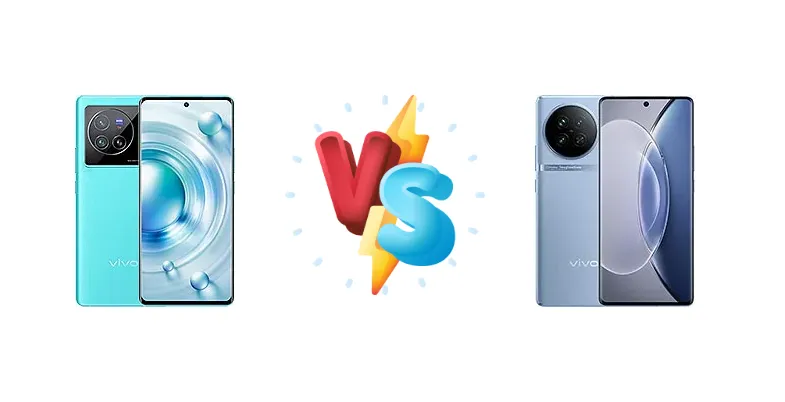
|
🏆 Quick Verdict
The vivo X90 is the clear winner, boasting a faster chipset, significantly quicker charging, and likely improved camera capabilities. However, the X80 remains a compelling option, especially if you can find it at a discounted price, offering excellent value for its features.
| PHONES | ||
|---|---|---|
| Phone Names | vivo X80 | vivo X90 |
| Network | ||
|---|---|---|
| 2G bands | GSM 850 / 900 / 1800 / 1900 | GSM 850 / 900 / 1800 / 1900 |
| 3G bands | HSDPA 850 / 900 / 1900 / 2100 - International | HSDPA 800 / 850 / 900 / 1700(AWS) / 1900 / 2100 |
| 4G bands | 1, 2, 3, 4, 5, 7, 8, 20, 28, 38, 39, 40, 41 - International, China | 1, 2, 3, 4, 5, 7, 8, 18, 19, 20, 26, 28, 34, 38, 39, 40, 41 - International |
| 5G bands | 1, 3, 5, 7, 8, 28, 38, 40, 41, 78 SA/NSA - International | 1, 3, 5, 7, 8, 28, 38, 40, 41, 77, 78 SA/NSA - International |
| Speed | HSPA, LTE, 5G | HSPA, LTE, 5G |
| Technology | GSM / CDMA / HSPA / CDMA2000 / LTE / 5G | GSM / CDMA / HSPA / CDMA2000 / LTE / 5G |
| 1, 3, 5, 8, 28, 41, 77, 78 SA/NSA - China | 1, 3, 5, 8, 28, 41, 77, 78 SA/NSA - China | |
| Launch | ||
|---|---|---|
| Announced | 2022, April 25 | 2022, November 22 |
| Status | Available. Released 2022, April 29 | Available. Released 2022, November 30 |
| Body | ||
|---|---|---|
| Build | Glass front, glass back or eco leather back | Glass front, glass back or eco leather back |
| Dimensions | 165 x 75.2 x 8.3 mm or 8.8 mm | 164.1 x 74.4 x 8.5 mm or 8.9 mm |
| SIM | Nano-SIM + Nano-SIM | Nano-SIM + Nano-SIM |
| Weight | 203 g / 206 g (7.16 oz) | 196 g / 200 g (6.91 oz) |
| - | IP64 dust/water resistant | |
| Display | ||
|---|---|---|
| Resolution | 1080 x 2400 pixels, 20:9 ratio (~388 ppi density) | 1260 x 2800 pixels, 20:9 ratio (~452 ppi density) |
| Size | 6.78 inches, 111.0 cm2 (~89.4% screen-to-body ratio) | 6.78 inches, 111.5 cm2 (~91.3% screen-to-body ratio) |
| Type | AMOLED, 120Hz, HDR, 1500 nits (peak) | AMOLED, 1B colors, 120Hz, HDR10+ |
| Platform | ||
|---|---|---|
| CPU | Octa-core (1x3.05 GHz Cortex-X2 & 3x2.85 GHz Cortex-A710 & 4x1.80 GHz Cortex-A510) | Octa-core (1x3.05 GHz Cortex-X3 & 3x2.85 GHz Cortex-A715 & 4x1.80 GHz Cortex-A510) |
| Chipset | Mediatek Dimensity 9000 (4 nm) | Mediatek Dimensity 9200 (4 nm) |
| GPU | Mali-G710 MC10 | Immortalis-G715 MC11 |
| OS | Android 12, upgradable to Android 14, Funtouch 14 (Global), OriginOS Ocean (China) | Android 13, Funtouch 13 (Global), OriginOS 3 (China) |
| Memory | ||
|---|---|---|
| Card slot | No | No |
| Internal | 128GB 8GB RAM, 256GB 8GB RAM, 256GB 12GB RAM, 512GB 12GB RAM | 128GB 8GB RAM, 256GB 8GB RAM, 256GB 12GB RAM, 512GB 12GB RAM |
| UFS 3.1 | UFS 4.0 - 256/512GB UFS 3.1 - 128GB | |
| Main Camera | ||
|---|---|---|
| Features | Laser AF, color spectrum sensor, Zeiss optics, Zeiss T* lens coating, Pixel Shift, dual-LED dual-tone flash, HDR, panorama | Laser AF, color spectrum sensor, Zeiss optics, Zeiss T* lens coating, Pixel Shift, dual-LED dual-tone flash, HDR, panorama |
| Single | 32 MP, f/2.5, 24mm (wide), 1/2.8", 0.8µm | 32 MP, f/2.5, 24mm (wide), 1/2.8", 0.8µm |
| Triple | 50 MP, f/1.8, (wide), 1/1.49", 1.0µm, PDAF, OIS 12 MP, f/2.0, 50mm (telephoto), 1/2.93", 1.22µm, PDAF, 2x optical zoom 12 MP, f/2.0, 16mm (ultrawide), 1/2.93", 1.22µm, AF | 50 MP, f/1.8, (wide), 1/1.49", 1.0µm, PDAF, OIS 12 MP, f/2.0, 50mm (telephoto), 1/2.93", 1.22µm, AF, 2x optical zoom 12 MP, f/2.0, 16mm (ultrawide), 1/2.93", 1.22µm, AF |
| Video | 4K@30/60fps, 1080p@30/60fps, gyro-EIS | 4K@30/60fps, 1080p@30/60fps, gyro-EIS |
| Selfie camera | ||
|---|---|---|
| Features | HDR | HDR |
| Single | 32 MP, f/2.5, 24mm (wide), 1/2.8", 0.8µm | 32 MP, f/2.5, 24mm (wide), 1/2.8", 0.8µm |
| Video | 1080p@30fps | 1080p@30/60fps |
| Sound | ||
|---|---|---|
| 3.5mm jack | No | No |
| 35mm jack | No | No |
| Loudspeaker | Yes, with stereo speakers | Yes, with stereo speakers |
| 32-bit/192kHz audio | 24-bit/192kHz audio | |
| Comms | ||
|---|---|---|
| Bluetooth | 5.3, A2DP, LE, aptX HD | 5.3, A2DP, LE, aptX HD |
| Infrared port | Yes | Yes |
| NFC | Yes | Yes |
| Positioning | GPS (L1+L5), GLONASS, BDS, GALILEO, QZSS, NavIC | GPS (L1+L5), GLONASS, BDS, GALILEO, QZSS, NavIC |
| Radio | No | No |
| USB | USB Type-C 2.0, OTG | USB Type-C 2.0, OTG |
| WLAN | Wi-Fi 802.11 a/b/g/n/ac/6, dual-band, Wi-Fi Direct | Wi-Fi 802.11 a/b/g/n/ac/6, dual-band, Wi-Fi Direct |
| Features | ||
|---|---|---|
| Sensors | Fingerprint (under display, optical), accelerometer, gyro, proximity, compass | Fingerprint (under display, optical), accelerometer, gyro, proximity, compass |
| Battery | ||
|---|---|---|
| Charging | 80W wired, 50% in 11 min Reverse wired | 120W wired, 50% in 8 min Reverse wired |
| Type | 4500 mAh | 4810 mAh |
| Misc | ||
|---|---|---|
| Colors | Cosmic Black, Urban Blue, Orange | Asteroid Black, Breeze Blue, Red |
| Models | V2183A, V2144 | V2241A |
| Price | About 560 EUR | About 300 EUR |
vivo X80
- Excellent camera system
- Smooth performance
- Premium design
- 80W fast charging
- Potentially lower price
- Older chipset compared to X90
- Slower charging than X90
- May lack some of the latest features
vivo X90
- Cutting-edge Dimensity 9200 chipset
- Blazing-fast 120W charging
- Improved camera performance
- Premium design
- Latest features
- Higher price
- Potential for software quirks (early release)
Display Comparison
Both phones likely feature vibrant AMOLED displays with high refresh rates (likely 120Hz). The X90 may have a slightly brighter panel and potentially improved color accuracy due to newer display technology. Expect similar resolution and size, around 6.7 inches.
Camera Comparison
While both phones feature excellent camera systems, the X90 is expected to have improvements. The X90 likely utilizes a larger sensor and enhanced image processing algorithms, resulting in better low-light performance, dynamic range, and overall image quality. Both likely feature a periscope telephoto lens for impressive zoom capabilities.
Performance
The Dimensity 9200 in the X90 offers a substantial performance boost over the Dimensity 9000 in the X80. Expect faster app loading, smoother multitasking, and better gaming performance on the X90. Both phones have ample RAM (likely 8GB or 12GB) to handle demanding tasks.
Battery Life
The X90's 120W charging is a game-changer, allowing for incredibly fast charging times. The X80's 80W charging is still respectable, but the X90 offers a significant advantage in this area. Battery capacity is likely similar, around 4800-5000mAh on both devices.
Buying Guide
The vivo X80 is ideal for users seeking a premium smartphone experience with a strong camera and smooth performance at a potentially lower price point. The vivo X90 is for those who demand the absolute best in performance, charging speed, and cutting-edge camera technology, and are willing to pay a premium.