
vivo X80 vs vivo V27 Pro: A Comprehensive Comparison
| Phones Images | |||||
|---|---|---|---|---|---|
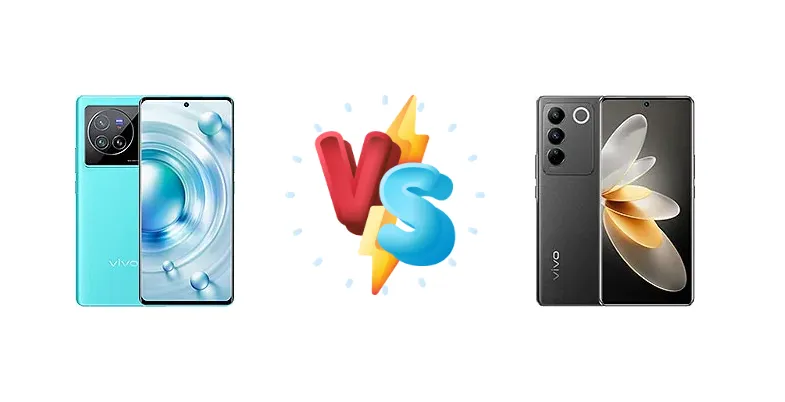
|
🏆 Quick Verdict
The vivo X80 boasts a more powerful Dimensity 9000 chipset and faster charging, making it the performance champion. However, the V27 Pro shines with its impressive display brightness, long-lasting battery, and potentially more refined camera software. It's a close call, but the X80 edges ahead for power users.
| PHONES | ||
|---|---|---|
| Phone Names | vivo X80 | vivo V27 Pro |
| Network | ||
|---|---|---|
| 2G bands | GSM 850 / 900 / 1800 / 1900 | GSM 850 / 900 / 1800 / 1900 |
| 3G bands | HSDPA 850 / 900 / 1900 / 2100 - International | HSDPA 850 / 900 / 1700(AWS) / 2100 |
| 4G bands | 1, 2, 3, 4, 5, 7, 8, 20, 28, 38, 39, 40, 41 - International, China | 1, 3, 4, 5, 8, 28, 38, 40, 41 |
| 5G bands | 1, 3, 5, 7, 8, 28, 38, 40, 41, 78 SA/NSA - International | 1, 3, 5, 8, 28, 77, 78 SA/NSA |
| Speed | HSPA, LTE, 5G | HSPA, LTE, 5G |
| Technology | GSM / CDMA / HSPA / CDMA2000 / LTE / 5G | GSM / HSPA / LTE / 5G |
| 1, 3, 5, 8, 28, 41, 77, 78 SA/NSA - China | - | |
| Launch | ||
|---|---|---|
| Announced | 2022, April 25 | 2023, March 01 |
| Status | Available. Released 2022, April 29 | Available. Released 2023, March 01 |
| Body | ||
|---|---|---|
| Build | Glass front, glass back or eco leather back | Glass front, plastic frame, glass back |
| Dimensions | 165 x 75.2 x 8.3 mm or 8.8 mm | 164.1 x 74.8 x 7.4 mm (6.46 x 2.94 x 0.29 in) |
| SIM | Nano-SIM + Nano-SIM | Nano-SIM + Nano-SIM |
| Weight | 203 g / 206 g (7.16 oz) | 182 g (6.42 oz) |
| - | Color changing back panel color | |
| Display | ||
|---|---|---|
| Resolution | 1080 x 2400 pixels, 20:9 ratio (~388 ppi density) | 1080 x 2400 pixels, 20:9 ratio (~388 ppi density) |
| Size | 6.78 inches, 111.0 cm2 (~89.4% screen-to-body ratio) | 6.78 inches, 111.0 cm2 (~90.4% screen-to-body ratio) |
| Type | AMOLED, 120Hz, HDR, 1500 nits (peak) | AMOLED, 1B colors, 120Hz, HDR10+ |
| Platform | ||
|---|---|---|
| CPU | Octa-core (1x3.05 GHz Cortex-X2 & 3x2.85 GHz Cortex-A710 & 4x1.80 GHz Cortex-A510) | Octa-core (1x3.1 GHz Cortex-A78 & 3x3.0 GHz Cortex-A78 & 4x2.0 GHz Cortex-A55) |
| Chipset | Mediatek Dimensity 9000 (4 nm) | Mediatek Dimensity 8200 (4 nm) |
| GPU | Mali-G710 MC10 | Mali-G610 MC6 |
| OS | Android 12, upgradable to Android 14, Funtouch 14 (Global), OriginOS Ocean (China) | Android 13, Funtouch 13 |
| Memory | ||
|---|---|---|
| Card slot | No | No |
| Internal | 128GB 8GB RAM, 256GB 8GB RAM, 256GB 12GB RAM, 512GB 12GB RAM | 128GB 8GB RAM, 256GB 8GB RAM, 256GB 12GB RAM |
| UFS 3.1 | UFS 3.1 | |
| Main Camera | ||
|---|---|---|
| Features | Laser AF, color spectrum sensor, Zeiss optics, Zeiss T* lens coating, Pixel Shift, dual-LED dual-tone flash, HDR, panorama | Ring-LED flash, panorama, HDR |
| Single | 32 MP, f/2.5, 24mm (wide), 1/2.8", 0.8µm | 50 MP, f/2.5, (wide), AF |
| Triple | 50 MP, f/1.8, (wide), 1/1.49", 1.0µm, PDAF, OIS 12 MP, f/2.0, 50mm (telephoto), 1/2.93", 1.22µm, PDAF, 2x optical zoom 12 MP, f/2.0, 16mm (ultrawide), 1/2.93", 1.22µm, AF | 50 MP, f/1.9, (wide), 1/1.56", 1.0µm, PDAF, OIS 8 MP, f/2.2, 16mm, 120˚ (ultrawide), 1/4.0", 1.12µm 2 MP (macro) |
| Video | 4K@30/60fps, 1080p@30/60fps, gyro-EIS | 4K@30/60fps, 1080p@30fps, gyro-EIS |
| Selfie camera | ||
|---|---|---|
| Features | HDR | Dual-LED flash, HDR |
| Single | 32 MP, f/2.5, 24mm (wide), 1/2.8", 0.8µm | 50 MP, f/2.5, (wide), AF |
| Video | 1080p@30fps | 4K@30/60fps, 1080p@30fps, gyro-EIS |
| Sound | ||
|---|---|---|
| 3.5mm jack | No | No |
| 35mm jack | No | No |
| Loudspeaker | Yes, with stereo speakers | Yes |
| 32-bit/192kHz audio | 24-bit/192kHz audio | |
| Comms | ||
|---|---|---|
| Bluetooth | 5.3, A2DP, LE, aptX HD | 5.3, A2DP, LE |
| Infrared port | Yes | - |
| NFC | Yes | Yes |
| Positioning | GPS (L1+L5), GLONASS, BDS, GALILEO, QZSS, NavIC | GPS, GLONASS, GALILEO, BDS, NavIC |
| Radio | No | No |
| USB | USB Type-C 2.0, OTG | USB Type-C 2.0, OTG |
| WLAN | Wi-Fi 802.11 a/b/g/n/ac/6, dual-band, Wi-Fi Direct | Wi-Fi 802.11 a/b/g/n/ac/6, dual-band, Wi-Fi Direct |
| Features | ||
|---|---|---|
| Sensors | Fingerprint (under display, optical), accelerometer, gyro, proximity, compass | Fingerprint (under display, optical), accelerometer, gyro, proximity, compass |
| Battery | ||
|---|---|---|
| Charging | 80W wired, 50% in 11 min Reverse wired | 66W wired, 50% in 19 min, 72% in 30 min |
| Type | 4500 mAh | 4600 mAh |
| Misc | ||
|---|---|---|
| Colors | Cosmic Black, Urban Blue, Orange | Magic Blue, Noble Black |
| Models | V2183A, V2144 | V2230 |
| Price | About 560 EUR | About 440 EUR |
| SAR | - | 1.22 W/kg (head) 0.89 W/kg (body) |
| Tests | ||
|---|---|---|
| Battery life | - | Endurance rating 121h |
| Camera | - | Photo / Video |
| Display | - | Contrast ratio: Infinite (nominal) |
| Loudspeaker | - | -29.1 LUFS (Average) |
| Performance | - | AnTuTu: 846767 (v9) GeekBench: 3933 (v5.1), 3421 (v6) GFXBench: 57fps (ES 3.1 onscreen) |
vivo X80
- More powerful Dimensity 9000 chipset
- Faster 80W charging
- Premium build quality (assumed)
- Potentially better video recording
- Battery life not as impressive as V27 Pro
- Display brightness not as high
- Price likely higher
vivo V27 Pro
- Exceptional battery life (121h endurance)
- Brighter display (978 nits)
- Potentially refined camera software
- Stylish design
- Less powerful Dimensity 8200 chipset
- Slower charging (66W)
- Build quality potentially less premium
Display Comparison
The vivo V27 Pro takes the display crown with a measured peak brightness of 978 nits, offering a significantly brighter viewing experience, especially outdoors. While the X80's display is excellent, it doesn't reach the same level of brightness. The V27 Pro's 'infinite' contrast ratio (nominal) suggests deep blacks and vibrant colors, further enhancing its visual appeal. Both phones likely feature AMOLED panels with smooth refresh rates.
Camera Comparison
Both phones offer excellent camera capabilities, but the specifics are less clear from the provided data. The V27 Pro is likely to have a focus on refined camera software and potentially improved portrait modes. The X80, with its more powerful processor, might offer better image processing and video recording capabilities, especially in low light. Real-world testing would be needed to definitively declare a winner.
Performance
The vivo X80's Dimensity 9000 chipset is undeniably more powerful than the V27 Pro's Dimensity 8200. This translates to faster app loading times, smoother multitasking, and better performance in demanding games. The X80's Cortex-X2 core provides a significant boost for peak performance, while the V27 Pro's chipset is still very capable for everyday tasks.
Battery Life
The vivo V27 Pro demonstrates exceptional battery endurance, boasting an impressive 121h endurance rating. While the X80's battery life is likely good, it doesn't match the V27 Pro's longevity. The X80's 80W charging is faster, reaching 50% in just 11 minutes, while the V27 Pro takes 19 minutes for the same charge.
Buying Guide
The vivo X80 is ideal for users prioritizing raw performance, faster charging, and a slightly more premium feel. The vivo V27 Pro is a great choice for those who value exceptional battery life, a vibrant display for media consumption, and a potentially more user-friendly camera experience.