
vivo X80 vs iQOO 11: A Detailed Showdown
| Phones Images | |||||
|---|---|---|---|---|---|
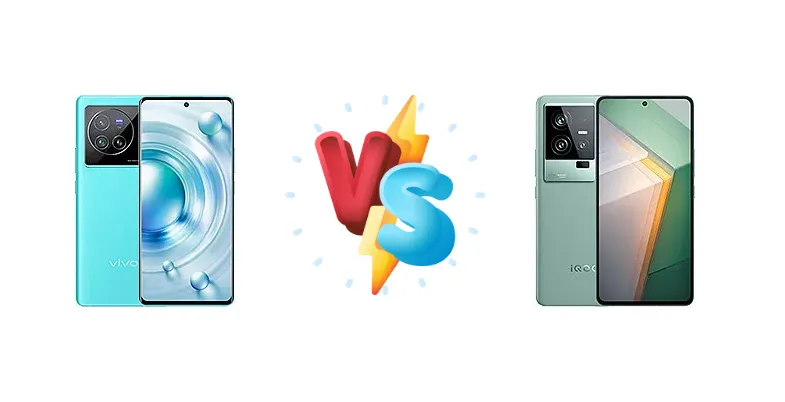
|
🏆 Quick Verdict
The iQOO 11 emerges as the overall winner thanks to its significantly faster charging, superior Snapdragon 8 Gen 2 chipset, and brighter display. However, the X80 remains a strong contender, particularly for those prioritizing a refined design and potentially a more balanced camera experience.
| PHONES | ||
|---|---|---|
| Phone Names | vivo X80 | vivo iQOO 11 |
| Network | ||
|---|---|---|
| 2G bands | GSM 850 / 900 / 1800 / 1900 | GSM 850 / 900 / 1800 / 1900 |
| 3G bands | HSDPA 850 / 900 / 1900 / 2100 - International | HSDPA 800 / 850 / 900 / 1700(AWS) / 1900 / 2100 |
| 4G bands | 1, 2, 3, 4, 5, 7, 8, 20, 28, 38, 39, 40, 41 - International, China | 1, 2, 3, 4, 5, 7, 8, 12, 17, 18, 19, 20, 26, 28, 34, 38, 39, 40, 41 - International |
| 5G bands | 1, 3, 5, 7, 8, 28, 38, 40, 41, 78 SA/NSA - International | 1, 3, 5, 8, 28, 40, 41, 77, 78 SA/NSA |
| Speed | HSPA, LTE, 5G | HSPA, LTE, 5G |
| Technology | GSM / CDMA / HSPA / CDMA2000 / LTE / 5G | GSM / CDMA / HSPA / CDMA2000 / LTE / 5G |
| 1, 3, 5, 8, 28, 41, 77, 78 SA/NSA - China | 1, 2, 3, 4, 5, 7, 8, 12, 17, 18, 19, 20, 25, 26, 28, 34, 38, 39, 40, 41, 66 - China | |
| Launch | ||
|---|---|---|
| Announced | 2022, April 25 | 2022, December 08 |
| Status | Available. Released 2022, April 29 | Available. Released 2022, December 08 |
| Body | ||
|---|---|---|
| Build | Glass front, glass back or eco leather back | - |
| Dimensions | 165 x 75.2 x 8.3 mm or 8.8 mm | 164.9 x 77.1 x 8.4 mm or 8.7 mm |
| SIM | Nano-SIM + Nano-SIM | Nano-SIM + Nano-SIM |
| Weight | 203 g / 206 g (7.16 oz) | 205 g or 208 g (7.23 oz) |
| Display | ||
|---|---|---|
| Protection | - | Corning Gorilla Glass Victus |
| Resolution | 1080 x 2400 pixels, 20:9 ratio (~388 ppi density) | 1440 x 3200 pixels, 20:9 ratio (~518 ppi density) |
| Size | 6.78 inches, 111.0 cm2 (~89.4% screen-to-body ratio) | 6.78 inches, 111.0 cm2 (~87.3% screen-to-body ratio) |
| Type | AMOLED, 120Hz, HDR, 1500 nits (peak) | LTPO4 AMOLED, 1B colors, 144Hz, HDR10+, 1800 nits (peak) |
| Platform | ||
|---|---|---|
| CPU | Octa-core (1x3.05 GHz Cortex-X2 & 3x2.85 GHz Cortex-A710 & 4x1.80 GHz Cortex-A510) | Octa-core (1x3.2 GHz Cortex-X3 & 2x2.8 GHz Cortex-A715 & 2x2.8 GHz Cortex-A710 & 3x2.0 GHz Cortex-A510) |
| Chipset | Mediatek Dimensity 9000 (4 nm) | Qualcomm SM8550-AB Snapdragon 8 Gen 2 (4 nm) |
| GPU | Mali-G710 MC10 | Adreno 740 |
| OS | Android 12, upgradable to Android 14, Funtouch 14 (Global), OriginOS Ocean (China) | Android 13, upgradable to Android 14, Funtouch 14 (International), OriginOS 3 (China) |
| Memory | ||
|---|---|---|
| Card slot | No | No |
| Internal | 128GB 8GB RAM, 256GB 8GB RAM, 256GB 12GB RAM, 512GB 12GB RAM | 128GB 8GB RAM, 256GB 8GB RAM, 256GB 12GB RAM, 256GB 16GB RAM, 512GB 16GB RAM |
| UFS 3.1 | UFS 3.1 - 128GB UFS 4.0 - 256/512GB | |
| Main Camera | ||
|---|---|---|
| Features | Laser AF, color spectrum sensor, Zeiss optics, Zeiss T* lens coating, Pixel Shift, dual-LED dual-tone flash, HDR, panorama | Dual-LED flash, HDR, panorama |
| Single | 32 MP, f/2.5, 24mm (wide), 1/2.8", 0.8µm | 16 MP, f/2.5, (wide) |
| Triple | 50 MP, f/1.8, (wide), 1/1.49", 1.0µm, PDAF, OIS 12 MP, f/2.0, 50mm (telephoto), 1/2.93", 1.22µm, PDAF, 2x optical zoom 12 MP, f/2.0, 16mm (ultrawide), 1/2.93", 1.22µm, AF | 50 MP, f/1.9, 23mm (wide), 1/1.57", 1.0µm, PDAF, OIS 13 MP, f/2.5, 47mm (telephoto), PDAF, 2x optical zoom 8 MP, f/2.2, 16mm (ultrawide) |
| Video | 4K@30/60fps, 1080p@30/60fps, gyro-EIS | 8K@30fps, 4K@30/60fps, 1080p@30/60/120/240fps, gyro-EIS |
| Selfie camera | ||
|---|---|---|
| Features | HDR | HDR |
| Single | 32 MP, f/2.5, 24mm (wide), 1/2.8", 0.8µm | 16 MP, f/2.5, (wide) |
| Video | 1080p@30fps | 1080p@30fps, gyro-EIS |
| Sound | ||
|---|---|---|
| 3.5mm jack | No | No |
| 35mm jack | No | No |
| Loudspeaker | Yes, with stereo speakers | Yes, with stereo speakers |
| 32-bit/192kHz audio | 24-bit/192kHz audio | |
| Comms | ||
|---|---|---|
| Bluetooth | 5.3, A2DP, LE, aptX HD | 5.3, A2DP, LE, aptX HD, aptX Adaptive, aptX Lossless |
| Infrared port | Yes | Yes |
| NFC | Yes | Yes |
| Positioning | GPS (L1+L5), GLONASS, BDS, GALILEO, QZSS, NavIC | GPS, GLONASS, GALILEO, BDS, NavIC |
| Radio | No | No |
| USB | USB Type-C 2.0, OTG | USB Type-C 2.0, OTG |
| WLAN | Wi-Fi 802.11 a/b/g/n/ac/6, dual-band, Wi-Fi Direct | Wi-Fi 802.11 a/b/g/n/ac/6, dual-band, Wi-Fi Direct |
| Features | ||
|---|---|---|
| Sensors | Fingerprint (under display, optical), accelerometer, gyro, proximity, compass | Fingerprint (under display, optical), accelerometer, gyro, proximity, compass |
| Battery | ||
|---|---|---|
| Charging | 80W wired, 50% in 11 min Reverse wired | 120W wired, PD3.0, 100% in 25 min |
| Type | 4500 mAh | 5000 mAh |
| Misc | ||
|---|---|---|
| Colors | Cosmic Black, Urban Blue, Orange | Black, Green, White (BMW M branding) |
| Models | V2183A, V2144 | V2243A |
| Price | About 560 EUR | About 650 EUR |
| Tests | ||
|---|---|---|
| Battery life | - | Endurance rating 127h |
| Camera | - | Photo / Video |
| Display | - | Contrast ratio: Infinite (nominal) |
| Loudspeaker | - | -26.3 LUFS (Good) |
| Performance | - | AnTuTu: 1281665 (v9) GeekBench: 4803 (v5.1) GFXBench: 67fps (ES 3.1 onscreen) |
vivo X80
- Sleek and refined design
- Potentially more balanced camera processing
- Reliable performance
- Slower charging speed
- Less powerful chipset compared to iQOO 11
- Brightness likely lower than iQOO 11
vivo iQOO 11
- Blazing-fast 120W charging
- Top-tier Snapdragon 8 Gen 2 chipset
- Brighter and more vibrant display
- Excellent battery life
- Design might be less refined than X80
- Camera processing potentially less natural
- May prioritize performance over camera features
Display Comparison
The iQOO 11 boasts a significantly brighter display, reaching a measured 1147 nits compared to the X80's likely lower peak brightness (spec not provided, but generally lower than iQOO). The iQOO 11's 'infinite' contrast ratio suggests excellent blacks and vibrant colors. Both likely feature AMOLED panels with smooth refresh rates, but the iQOO 11's brightness advantage is noticeable.
Camera Comparison
Both phones feature 'Photo / Video' capabilities, but detailed camera specs are missing. Generally, the X80 is known for its more refined and natural image processing, while the iQOO 11 might prioritize more vibrant and saturated colors. Real-world testing would be needed to determine a definitive winner.
Performance
The iQOO 11's Snapdragon 8 Gen 2 chipset is a clear winner over the vivo X80's Dimensity 9000. The Snapdragon offers superior CPU and GPU performance, making it ideal for demanding games and multitasking. While the Dimensity 9000 is still a capable chip, the 8 Gen 2 provides a noticeable performance boost.
Battery Life
The iQOO 11's 120W charging is a game-changer, allowing for a full charge in just 25 minutes. The X80's 80W charging is still fast, but significantly slower. Both phones have excellent endurance ratings (127h), suggesting long battery life under typical usage.
Buying Guide
The vivo X80 is ideal for users who value a sleek design, a well-rounded camera system, and a smooth, reliable experience. The iQOO 11 is perfect for gamers, power users, and anyone who demands the absolute fastest charging speeds and top-tier performance.