
vivo X80 vs Sony Xperia 1 IV: Which Flagship Reigns Supreme?
| Phones Images | |||||
|---|---|---|---|---|---|
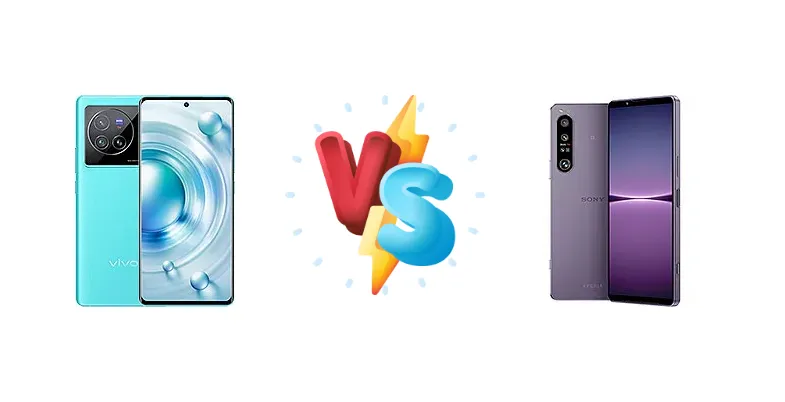
|
🏆 Quick Verdict
For the average user prioritizing value and charging speed, the vivo X80 emerges as the winner. Its Dimensity 9000 delivers comparable performance to the Snapdragon 8 Gen 1, coupled with significantly faster 80W charging. However, the Xperia 1 IV excels for content creators and those deeply invested in Sony's ecosystem.
| PHONES | ||
|---|---|---|
| Phone Names | vivo X80 | Sony Xperia 1 IV |
| Network | ||
|---|---|---|
| 2G bands | GSM 850 / 900 / 1800 / 1900 | GSM 850 / 900 / 1800 / 1900 |
| 3G bands | HSDPA 850 / 900 / 1900 / 2100 - International | HSDPA 800 / 850 / 900 / 1700(AWS) / 1900 / 2100 |
| 4G bands | 1, 2, 3, 4, 5, 7, 8, 20, 28, 38, 39, 40, 41 - International, China | 1, 2, 3, 4, 5, 7, 8, 12, 13, 17, 19, 20, 25, 26, 28, 29, 32, 34, 38, 39, 40, 41, 46, 66 - Europe |
| 5G bands | 1, 3, 5, 7, 8, 28, 38, 40, 41, 78 SA/NSA - International | 1, 3, 5, 7, 8, 20, 28, 38, 40, 41, 77, 78 SA/NSA/Sub6 - Europe |
| Speed | HSPA, LTE, 5G | HSPA, LTE, 5G |
| Technology | GSM / CDMA / HSPA / CDMA2000 / LTE / 5G | GSM / HSPA / LTE / 5G |
| 1, 3, 5, 8, 28, 41, 77, 78 SA/NSA - China | 1, 3, 5, 7, 8, 28, 38, 40, 41, 77, 78, 79 SA/NSA/Sub6 - Asia | |
| Launch | ||
|---|---|---|
| Announced | 2022, April 25 | 2022, May 11 |
| Status | Available. Released 2022, April 29 | Available. Released 2022, June 11 |
| Body | ||
|---|---|---|
| Build | Glass front, glass back or eco leather back | Glass front (Gorilla Glass Victus), glass back (Gorilla Glass Victus), aluminum frame |
| Dimensions | 165 x 75.2 x 8.3 mm or 8.8 mm | 165 x 71 x 8.2 mm (6.50 x 2.80 x 0.32 in) |
| SIM | Nano-SIM + Nano-SIM | · Nano-SIM + eSIM· Nano-SIM + Nano-SIM |
| Weight | 203 g / 206 g (7.16 oz) | 185 g (6.53 oz) |
| - | IP65/IP68 dust/water resistant (up to 1.5m for 30 min) | |
| Display | ||
|---|---|---|
| Protection | - | Corning Gorilla Glass Victus |
| Resolution | 1080 x 2400 pixels, 20:9 ratio (~388 ppi density) | 1644 x 3840 pixels, 21:9 ratio (~643 ppi density) |
| Size | 6.78 inches, 111.0 cm2 (~89.4% screen-to-body ratio) | 6.5 inches, 98.6 cm2 (~84.2% screen-to-body ratio) |
| Type | AMOLED, 120Hz, HDR, 1500 nits (peak) | OLED, 1B colors, 120Hz, HDR BT.2020 |
| - | Runs at 1096 x 2560 pixels except for select use cases | |
| Platform | ||
|---|---|---|
| CPU | Octa-core (1x3.05 GHz Cortex-X2 & 3x2.85 GHz Cortex-A710 & 4x1.80 GHz Cortex-A510) | Octa-core (1x3.00 GHz Cortex-X2 & 3x2.50 GHz Cortex-A710 & 4x1.80 GHz Cortex-A510) |
| Chipset | Mediatek Dimensity 9000 (4 nm) | Qualcomm SM8450 Snapdragon 8 Gen 1 (4 nm) |
| GPU | Mali-G710 MC10 | Adreno 730 |
| OS | Android 12, upgradable to Android 14, Funtouch 14 (Global), OriginOS Ocean (China) | Android 12, upgradable to Android 13 |
| Memory | ||
|---|---|---|
| Card slot | No | microSDXC (uses shared SIM slot) |
| Internal | 128GB 8GB RAM, 256GB 8GB RAM, 256GB 12GB RAM, 512GB 12GB RAM | 256GB 12GB RAM, 512GB 12GB RAM, 512GB 16GB RAM |
| UFS 3.1 | UFS 3.X | |
| Main Camera | ||
|---|---|---|
| Features | Laser AF, color spectrum sensor, Zeiss optics, Zeiss T* lens coating, Pixel Shift, dual-LED dual-tone flash, HDR, panorama | Zeiss optics, Zeiss T* lens coating, color spectrum sensor, LED flash, panorama, HDR, eye tracking |
| Single | 32 MP, f/2.5, 24mm (wide), 1/2.8", 0.8µm | 12 MP, f/2.0, 24mm (wide), 1/2.9", 1.25µm |
| Triple | 50 MP, f/1.8, (wide), 1/1.49", 1.0µm, PDAF, OIS 12 MP, f/2.0, 50mm (telephoto), 1/2.93", 1.22µm, PDAF, 2x optical zoom 12 MP, f/2.0, 16mm (ultrawide), 1/2.93", 1.22µm, AF | 12 MP, f/1.7, 24mm (wide), 1/1.7", 1.8µm, dual pixel PDAF, OIS 12 MP, f/2.3, 85mm (telephoto), f/2.8, 125mm (telephoto), 1/3.5", dual pixel PDAF, 3.5x-5.2x continuous optical zoom, OIS 12 MP, f/2.2, 124˚, 16mm (ultrawide), 1/2.5", dual pixel PDAF 0.3 MP, TOF 3D, (depth) |
| Video | 4K@30/60fps, 1080p@30/60fps, gyro-EIS | 4K@24/25/30/60/120fps HDR, 1080p@30/60/120fps; 5-axis gyro-EIS, OIS |
| Selfie camera | ||
|---|---|---|
| Features | HDR | HDR |
| Single | 32 MP, f/2.5, 24mm (wide), 1/2.8", 0.8µm | 12 MP, f/2.0, 24mm (wide), 1/2.9", 1.25µm |
| Video | 1080p@30fps | 4K@30fps, 1080p@30/60fps, 5-axis gyro-EIS |
| Sound | ||
|---|---|---|
| 3.5mm jack | No | Yes |
| 35mm jack | No | Yes |
| Loudspeaker | Yes, with stereo speakers | Yes, with stereo speakers |
| 32-bit/192kHz audio | 24-bit/192kHz audio Dynamic vibration system | |
| Comms | ||
|---|---|---|
| Bluetooth | 5.3, A2DP, LE, aptX HD | 5.2, A2DP, LE Audio, aptX HD, aptX Adaptive |
| Infrared port | Yes | - |
| NFC | Yes | Yes |
| Positioning | GPS (L1+L5), GLONASS, BDS, GALILEO, QZSS, NavIC | GPS, GLONASS, BDS, GALILEO, QZSS |
| Radio | No | No |
| USB | USB Type-C 2.0, OTG | USB Type-C 3.2, OTG, video output |
| WLAN | Wi-Fi 802.11 a/b/g/n/ac/6, dual-band, Wi-Fi Direct | Wi-Fi 802.11 a/b/g/n/ac/6e, dual-band or tri-band (region dependent), Wi-Fi Direct, DLNA |
| Features | ||
|---|---|---|
| Sensors | Fingerprint (under display, optical), accelerometer, gyro, proximity, compass | Fingerprint (side-mounted), accelerometer, gyro, proximity, barometer, compass |
| - | Native Sony Alpha camera support | |
| Battery | ||
|---|---|---|
| Charging | 80W wired, 50% in 11 min Reverse wired | 30W wired, PD3.0, PPS, 50% in 30 min Wireless Reverse wireless |
| Type | 4500 mAh | Li-Po 5000 mAh |
| Misc | ||
|---|---|---|
| Colors | Cosmic Black, Urban Blue, Orange | Black, Violet, White |
| Models | V2183A, V2144 | XQCT62-B, XQCT54, XQCT54C0V.YD, XQCT54C0B.YD, XQCT54C0W.YD, XQCT54C0V.EEAC, XQCT54C0B.EEAC, XQ-CT72, XQ-CT54, XQ-CT62, SO-51C |
| Price | About 560 EUR | $ 1,120.00 / € 489.00 |
| Tests | ||
|---|---|---|
| Battery life | - | Endurance rating 100h |
| Camera | - | Photo / Video |
| Display | - | Contrast ratio: Infinite (nominal) |
| Loudspeaker | - | -27.6 LUFS (Good) |
| Performance | - | AnTuTu: 838832 (v9) GeekBench: 3403 (v5.1) GFXBench: 74fps (ES 3.1 onscreen) |
vivo X80
- Significantly faster 80W wired charging
- Potentially better sustained performance due to Dimensity 9000's thermal efficiency
- Likely more competitive pricing
- Lacks wireless charging
- Camera details are limited, making a direct comparison difficult
Sony Xperia 1 IV
- Professional-grade camera system with advanced video features
- Wireless and reverse wireless charging
- Sony’s refined software experience
- Slower 30W wired charging
- Snapdragon 8 Gen 1 prone to thermal throttling
- Higher price point
Display Comparison
The Sony Xperia 1 IV boasts a 602 nit peak brightness, providing good visibility outdoors, but lacks specifics on panel technology beyond an 'infinite' contrast ratio. The X80’s display specs are not provided, but vivo typically employs AMOLED panels known for vibrant colors. The Xperia 1 IV’s focus on a 21:9 aspect ratio caters to video consumption, while the X80 likely adopts a more conventional 19.5:9 ratio. Without knowing the X80’s refresh rate, it’s difficult to assess motion clarity, but the Xperia 1 IV’s display is geared towards cinematic viewing.
Camera Comparison
Both devices are marketed as having strong photo and video capabilities, but details are sparse. The Xperia 1 IV’s strength lies in its professional video features and Sony’s image processing expertise. Without sensor size or aperture information for either device, a direct comparison is difficult. However, Sony’s history suggests a focus on natural color reproduction, while vivo often leans towards more vibrant, saturated images. The absence of details on the X80’s camera system makes it hard to assess its capabilities beyond marketing claims.
Performance
Both phones utilize the Cortex-X2 prime core, but the Xperia 1 IV’s Snapdragon 8 Gen 1 operates at 3.00 GHz, slightly underclocked compared to the X80’s Dimensity 9000 at 3.05 GHz. The Xperia 1 IV’s Cortex-A710 cores are clocked higher at 2.50 GHz versus the X80’s 2.85 GHz. Both use the same Cortex-A510 efficiency cores. The 4nm fabrication process is shared, but the Snapdragon 8 Gen 1 is known to be more prone to thermal throttling under sustained load, potentially impacting long gaming sessions. The Dimensity 9000’s architecture may offer better sustained performance due to its more efficient design. Both devices likely feature LPDDR5 RAM, but the speed isn't specified.
Battery Life
Both phones achieve an endurance rating of 100 hours, suggesting similar overall battery life despite differing battery capacities (not specified). However, charging speeds are drastically different. The vivo X80’s 80W wired charging can reach 50% in just 11 minutes, a significant advantage over the Xperia 1 IV’s 30W charging, which takes 30 minutes for the same level. The Xperia 1 IV adds wireless and reverse wireless charging, features absent on the X80. The faster wired charging of the X80 is a major convenience factor for users who frequently need to top up their battery.
Buying Guide
Buy the vivo X80 if you need a powerhouse performer for gaming and everyday tasks, and value incredibly fast charging speeds. It's the ideal choice for users who want top-tier specs without the premium price tag. Buy the Sony Xperia 1 IV if you prioritize a professional-grade camera system with extensive video capabilities, a more refined software experience, and wireless charging convenience, and are willing to pay a premium for it.