
vivo X80 vs Oppo Find X5 Pro: A Deep Dive into Flagship Performance and Photography
| Phones Images | |||||
|---|---|---|---|---|---|
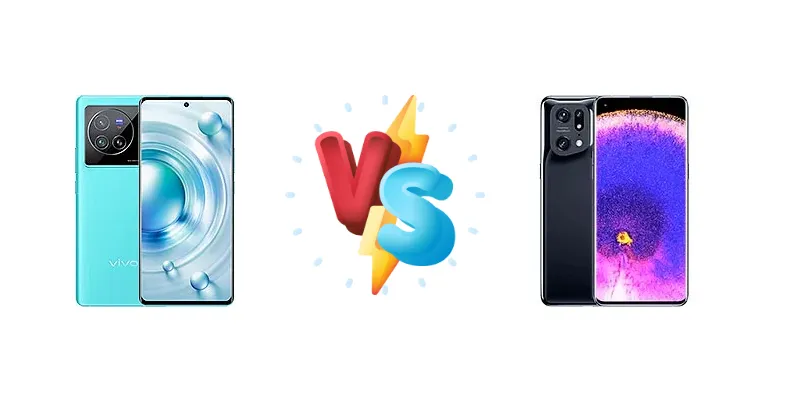
|
🏆 Quick Verdict
For most users, the vivo X80 emerges as the slightly stronger recommendation. Its Dimensity 9000 chipset offers comparable performance to the Snapdragon 8 Gen 1, often with better thermal management, and it achieves this at a potentially lower price point. While the Find X5 Pro boasts wireless charging and a slightly brighter display, the X80’s overall balance of features and efficiency is more compelling.
| PHONES | ||
|---|---|---|
| Phone Names | vivo X80 | Oppo Find X5 Pro |
| Network | ||
|---|---|---|
| 2G bands | GSM 850 / 900 / 1800 / 1900 | GSM 850 / 900 / 1800 / 1900 |
| 3G bands | HSDPA 850 / 900 / 1900 / 2100 - International | HSDPA 800 / 850 / 900 / 1700(AWS) / 1900 / 2100 |
| 4G bands | 1, 2, 3, 4, 5, 7, 8, 20, 28, 38, 39, 40, 41 - International, China | 1, 2, 3, 4, 5, 7, 8, 12, 13, 17, 18, 19, 20, 25, 26, 28, 32, 34, 38, 39, 40, 41, 42, 66 - Global |
| 5G bands | 1, 3, 5, 7, 8, 28, 38, 40, 41, 78 SA/NSA - International | 1, 2, 3, 5, 7, 8, 12, 13, 18, 20, 25, 26, 28, 38, 40, 41, 66, 77, 78, 79 SA/NSA - Global |
| Speed | HSPA, LTE, 5G | HSPA, LTE, 5G |
| Technology | GSM / CDMA / HSPA / CDMA2000 / LTE / 5G | GSM / CDMA / HSPA / CDMA2000 / LTE / 5G |
| 1, 3, 5, 8, 28, 41, 77, 78 SA/NSA - China | 1, 2, 3, 5, 8, 20, 28, 38, 41, 66, 77, 78, 79 SA/NSA - China | |
| Launch | ||
|---|---|---|
| Announced | 2022, April 25 | 2022, February 24 |
| Status | Available. Released 2022, April 29 | Available. Released 2022, March 14 |
| Body | ||
|---|---|---|
| Build | Glass front, glass back or eco leather back | Glass front (Gorilla Glass Victus), ceramic back or eco leather back, aluminum frame |
| Dimensions | 165 x 75.2 x 8.3 mm or 8.8 mm | 163.7 x 73.9 x 8.5 or 8.8 mm |
| SIM | Nano-SIM + Nano-SIM | Nano-SIM + eSIM |
| Weight | 203 g / 206 g (7.16 oz) | 218 g or 195 g (6.88 oz) |
| - | IP68 dust/water resistant (up to 1.5m for 30 min) | |
| Display | ||
|---|---|---|
| Protection | - | Corning Gorilla Glass Victus |
| Resolution | 1080 x 2400 pixels, 20:9 ratio (~388 ppi density) | 1440 x 3216 pixels, 20:9 ratio (~525 ppi density) |
| Size | 6.78 inches, 111.0 cm2 (~89.4% screen-to-body ratio) | 6.7 inches, 108.4 cm2 (~89.6% screen-to-body ratio) |
| Type | AMOLED, 120Hz, HDR, 1500 nits (peak) | LTPO2 AMOLED, 1B colors, 120Hz, HDR10+, BT.2020, 500 nits (typ), 800 nits (HBM), 1300 nits (peak) |
| Platform | ||
|---|---|---|
| CPU | Octa-core (1x3.05 GHz Cortex-X2 & 3x2.85 GHz Cortex-A710 & 4x1.80 GHz Cortex-A510) | Octa-core (1x3.00 GHz Cortex-X2 & 3x2.50 GHz Cortex-A710 & 4x1.80 GHz Cortex-A510) - GlobalOcta-core (1x3.05 GHz Cortex-X2 & 3x2.85 GHz Cortex-A710 & 4x1.80 GHz Cortex-A510) - China |
| Chipset | Mediatek Dimensity 9000 (4 nm) | Qualcomm SM8450 Snapdragon 8 Gen 1 (4 nm) - GlobalMediatek Dimensity 9000 (4 nm) - China |
| GPU | Mali-G710 MC10 | Adreno 730 - GlobalMali-G710 MC10 - China |
| OS | Android 12, upgradable to Android 14, Funtouch 14 (Global), OriginOS Ocean (China) | Android 12, upgradable to Android 14, ColorOS 14 |
| Memory | ||
|---|---|---|
| Card slot | No | No |
| Internal | 128GB 8GB RAM, 256GB 8GB RAM, 256GB 12GB RAM, 512GB 12GB RAM | 256GB 8GB RAM, 256GB 12GB RAM, 512GB 12GB RAM |
| UFS 3.1 | UFS 3.1 | |
| Main Camera | ||
|---|---|---|
| Features | Laser AF, color spectrum sensor, Zeiss optics, Zeiss T* lens coating, Pixel Shift, dual-LED dual-tone flash, HDR, panorama | Hasselblad Color Calibration, color spectrum sensor, LED flash, HDR, panorama |
| Single | 32 MP, f/2.5, 24mm (wide), 1/2.8", 0.8µm | 32 MP, f/2.4, 21mm (wide), 1/2.74", 0.8µm |
| Triple | 50 MP, f/1.8, (wide), 1/1.49", 1.0µm, PDAF, OIS 12 MP, f/2.0, 50mm (telephoto), 1/2.93", 1.22µm, PDAF, 2x optical zoom 12 MP, f/2.0, 16mm (ultrawide), 1/2.93", 1.22µm, AF | 50 MP, f/1.7, 25mm (wide), 1/1.56", 1.0µm, multi-directional PDAF, OIS (3-axis sensor-shift, 2-axis lens-shift) 13 MP, f/2.4, 52mm (telephoto), 1/3.4", 2x optical zoom, PDAF 50 MP, f/2.2, 15mm, 110˚ (ultrawide), 1/1.56", 1.0µm, multi-directional PDAF |
| Video | 4K@30/60fps, 1080p@30/60fps, gyro-EIS | 4K@30/60fps, 1080p@30/60/240fps; gyro-EIS; HDR, 10‑bit video |
| Selfie camera | ||
|---|---|---|
| Features | HDR | Panorama |
| Single | 32 MP, f/2.5, 24mm (wide), 1/2.8", 0.8µm | 32 MP, f/2.4, 21mm (wide), 1/2.74", 0.8µm |
| Video | 1080p@30fps | 1080p@30fps, gyro-EIS |
| Sound | ||
|---|---|---|
| 3.5mm jack | No | No |
| 35mm jack | No | No |
| Loudspeaker | Yes, with stereo speakers | Yes, with stereo speakers |
| 32-bit/192kHz audio | - | |
| Comms | ||
|---|---|---|
| Bluetooth | 5.3, A2DP, LE, aptX HD | 5.2, A2DP, LE, aptX HD |
| Infrared port | Yes | - |
| NFC | Yes | Yes |
| Positioning | GPS (L1+L5), GLONASS, BDS, GALILEO, QZSS, NavIC | GPS (L1), GLONASS (L1), BDS (B1I+B1c), GALILEO (E1+E5a), QZSS (L1) |
| Radio | No | No |
| USB | USB Type-C 2.0, OTG | USB Type-C 3.1, OTG |
| WLAN | Wi-Fi 802.11 a/b/g/n/ac/6, dual-band, Wi-Fi Direct | Wi-Fi 802.11 a/b/g/n/ac/6e, dual-band, Wi-Fi Direct |
| Features | ||
|---|---|---|
| Sensors | Fingerprint (under display, optical), accelerometer, gyro, proximity, compass | Fingerprint (under display, optical), accelerometer, gyro, proximity, compass |
| - | Oppo Find X5 Pro Dimensity model has no MariSilicon X image chip, 5-axis OIS and Hasselblad’s color calibration | |
| Battery | ||
|---|---|---|
| Charging | 80W wired, 50% in 11 min Reverse wired | 80W wired, PD, 50% in 12 min 50W wireless, 100% in 47 min 10W reverse wireless |
| Type | 4500 mAh | Li-Po 5000 mAh |
| Misc | ||
|---|---|---|
| Colors | Cosmic Black, Urban Blue, Orange | Ceramic Black, Ceramic White, Blue (eco leather) |
| Models | V2183A, V2144 | PFEM10, CPH2305, PFFM20 |
| Price | About 560 EUR | € 449.00 / $ 430.24 / £ 1,049.00 |
| Tests | ||
|---|---|---|
| Battery life | - | Endurance rating 101h |
| Camera | - | Photo / Video |
| Display | - | Contrast ratio: Infinite (nominal) |
| Loudspeaker | - | -24.7 LUFS (Very good) |
| Performance | - | AnTuTu: 1012896 (v9) GeekBench: 3433 (v5.1) GFXBench: 44fps (ES 3.1 onscreen) |
vivo X80
- Potentially better thermal management with Dimensity 9000
- Higher clocked CPU cores for multi-tasking
- Generally more affordable price point
- Lacks wireless charging capabilities
- Display brightness specs not readily available
Oppo Find X5 Pro
- 50W wireless charging for added convenience
- Measured 762 nits peak display brightness
- MariSilicon X NPU for enhanced image processing
- Snapdragon 8 Gen 1 prone to thermal throttling
- Potentially higher price tag
Display Comparison
Both phones offer premium display experiences, though with subtle differences. The Oppo Find X5 Pro’s display is measured at 762 nits of peak brightness, suggesting a more vibrant outdoor viewing experience. While the X80’s display specs aren’t provided, both likely utilize LTPO technology for adaptive refresh rates, conserving battery life. The Find X5 Pro’s ‘Infinite’ contrast ratio (nominal) is typical of OLED panels, but without specific details on color accuracy or calibration, it’s difficult to definitively declare a winner. Bezels are likely comparable, focusing on maximizing screen real estate.
Camera Comparison
Both devices are marketed as photography powerhouses, but detailed sensor information is lacking. The absence of specific details necessitates a focus on processing. Oppo’s Find X5 Pro benefits from its MariSilicon X NPU, dedicated to image processing, potentially enhancing low-light performance and color accuracy. However, without knowing the main sensor sizes or lens apertures, it’s difficult to assess the raw image quality differences. The inclusion of 'Photo/Video' as a feature for both suggests a strong emphasis on both capture modes, but the X80’s image processing style is generally known for a more natural look, while Oppo tends towards more vibrant, saturated colors.
Performance
The core of the difference lies in the chipsets. Both the Snapdragon 8 Gen 1 (global Find X5 Pro) and the Dimensity 9000 (both phones) are fabricated on a 4nm process, but architectural nuances matter. The Snapdragon 8 Gen 1, with its 3.00 GHz Cortex-X2 prime core, is slightly clocked lower than the X80’s 3.05 GHz Cortex-X2. However, the Cortex-A710 cores on the X80 are clocked higher at 2.85 GHz versus the Find X5 Pro’s 2.50 GHz. This suggests the X80 might have an edge in multi-core workloads. Critically, the Snapdragon 8 Gen 1 is known to be more prone to thermal throttling under sustained load, potentially giving the Dimensity 9000 in the X80 a real-world advantage in prolonged gaming sessions. Both utilize LPDDR5 RAM, but specific speeds aren’t provided.
Battery Life
Both phones achieve an endurance rating of 101 hours, indicating similar overall battery life despite differing approaches to charging. The Oppo Find X5 Pro offers the convenience of 50W wireless charging (100% in 47 minutes) and 10W reverse wireless charging, features absent on the X80. Both support 80W wired charging, achieving 50% charge in roughly 11-12 minutes. The X80’s lack of wireless charging is a trade-off, but its potentially more efficient chipset could offset this in real-world usage.
Buying Guide
Buy the vivo X80 if you prioritize sustained performance during demanding tasks like gaming and video editing, and value a potentially cooler running phone. It’s ideal for users who want flagship-level specs without necessarily needing wireless charging. Buy the Oppo Find X5 Pro if wireless charging is a must-have feature, and you appreciate a display with a measured peak brightness of 762 nits. It caters to users who prefer a more polished software experience and are willing to pay a premium for those extras.