
Honor Magic4 Pro vs vivo X80: A Deep Dive into Flagship Android Performance
| Phones Images | |||||
|---|---|---|---|---|---|
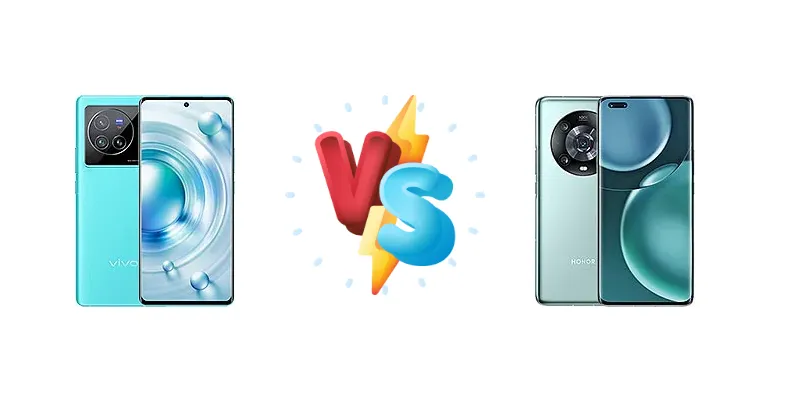
|
🏆 Quick Verdict
For most users, the Honor Magic4 Pro emerges as the stronger contender. Its 100W wired *and* wireless charging, coupled with a brighter display and comparable performance, provides a more complete premium experience. However, the vivo X80’s Dimensity 9000 offers a strong alternative for those prioritizing potentially better thermal management during sustained loads.
| PHONES | ||
|---|---|---|
| Phone Names | vivo X80 | Honor Magic4 Pro |
| Network | ||
|---|---|---|
| 2G bands | GSM 850 / 900 / 1800 / 1900 | GSM 850 / 900 / 1800 / 1900 |
| 3G bands | HSDPA 850 / 900 / 1900 / 2100 - International | HSDPA 800 / 850 / 900 / 1700(AWS) / 1900 / 2100 |
| 4G bands | 1, 2, 3, 4, 5, 7, 8, 20, 28, 38, 39, 40, 41 - International, China | 1, 2, 3, 4, 5, 7, 8, 12, 17, 18, 19, 20, 26, 28, 34, 38, 39, 40, 41 - China |
| 5G bands | 1, 3, 5, 7, 8, 28, 38, 40, 41, 78 SA/NSA - International | 1, 3, 5, 8, 28, 38, 41, 77, 78, 79 SA/NSA - China |
| Speed | HSPA, LTE, 5G | HSPA, LTE, 5G |
| Technology | GSM / CDMA / HSPA / CDMA2000 / LTE / 5G | GSM / CDMA / HSPA / EVDO / LTE / 5G |
| 1, 3, 5, 8, 28, 41, 77, 78 SA/NSA - China | CDMA2000 1xEV-DO | |
| Launch | ||
|---|---|---|
| Announced | 2022, April 25 | 2022, February 28 |
| Status | Available. Released 2022, April 29 | Available. Released 2022, April 09 |
| Body | ||
|---|---|---|
| Build | Glass front, glass back or eco leather back | Glass front, aluminum frame, glass back |
| Dimensions | 165 x 75.2 x 8.3 mm or 8.8 mm | 163.6 x 74.7 x 9.1 mm or 9.2 mm |
| SIM | Nano-SIM + Nano-SIM | · Nano-SIM + eSIM· Nano-SIM + Nano-SIM |
| Weight | 203 g / 206 g (7.16 oz) | 209 g / 215 g (7.37 oz) |
| - | IP68 dust/water resistant (up to 1.5m for 30 min) | |
| Display | ||
|---|---|---|
| Protection | - | Aluminosilicate glass |
| Resolution | 1080 x 2400 pixels, 20:9 ratio (~388 ppi density) | 1312 x 2848 pixels, 19.5:9 ratio (~460 ppi density) |
| Size | 6.78 inches, 111.0 cm2 (~89.4% screen-to-body ratio) | 6.81 inches, 113.7 cm2 (~93.0% screen-to-body ratio) |
| Type | AMOLED, 120Hz, HDR, 1500 nits (peak) | LTPO OLED, 1B colors, 120Hz, HDR10+, 1000 nits (peak) |
| Platform | ||
|---|---|---|
| CPU | Octa-core (1x3.05 GHz Cortex-X2 & 3x2.85 GHz Cortex-A710 & 4x1.80 GHz Cortex-A510) | Octa-core (1x3.00 GHz Cortex-X2 & 3x2.50 GHz Cortex-A710 & 4x1.80 GHz Cortex-A510) |
| Chipset | Mediatek Dimensity 9000 (4 nm) | Qualcomm SM8450 Snapdragon 8 Gen 1 (4 nm) |
| GPU | Mali-G710 MC10 | Adreno 730 |
| OS | Android 12, upgradable to Android 14, Funtouch 14 (Global), OriginOS Ocean (China) | Android 12, Magic UI 6 |
| Memory | ||
|---|---|---|
| Card slot | No | No |
| Internal | 128GB 8GB RAM, 256GB 8GB RAM, 256GB 12GB RAM, 512GB 12GB RAM | 256GB 8GB RAM, 256GB 12GB RAM, 512GB 12GB RAM |
| UFS 3.1 | - | |
| Main Camera | ||
|---|---|---|
| Features | Laser AF, color spectrum sensor, Zeiss optics, Zeiss T* lens coating, Pixel Shift, dual-LED dual-tone flash, HDR, panorama | Laser AF, color spectrum sensor, LED flash, HDR, panorama |
| Single | 32 MP, f/2.5, 24mm (wide), 1/2.8", 0.8µm | 12 MP, f/2.4, 100˚ (ultrawide), 1.22µm TOF 3D, (depth/biometrics sensor) |
| Triple | 50 MP, f/1.8, (wide), 1/1.49", 1.0µm, PDAF, OIS 12 MP, f/2.0, 50mm (telephoto), 1/2.93", 1.22µm, PDAF, 2x optical zoom 12 MP, f/2.0, 16mm (ultrawide), 1/2.93", 1.22µm, AF | 50 MP, f/1.8, 23mm (wide), 1/1.56", 1.0µm, multi-directional PDAF 50 MP, f/2.2, 122˚ (ultrawide), 1/2.5", AF 64 MP, f/3.5, 90mm (periscope telephoto), 1/2.0", 0.7µm, PDAF, OIS, 3.5x optical zoom TOF 3D (depth) |
| Video | 4K@30/60fps, 1080p@30/60fps, gyro-EIS | 4K@30/60fps, 1080p@30/60fps, gyro-EIS, HDR10, 10-bit video |
| Selfie camera | ||
|---|---|---|
| Features | HDR | HDR |
| Single | 32 MP, f/2.5, 24mm (wide), 1/2.8", 0.8µm | 12 MP, f/2.4, 100˚ (ultrawide), 1.22µm TOF 3D, (depth/biometrics sensor) |
| Video | 1080p@30fps | 4K@30fps, 1080p@30fps |
| Sound | ||
|---|---|---|
| 3.5mm jack | No | No |
| 35mm jack | No | No |
| Loudspeaker | Yes, with stereo speakers | Yes, with stereo speakers |
| 32-bit/192kHz audio | 24-bit audio stereo recording | |
| Comms | ||
|---|---|---|
| Bluetooth | 5.3, A2DP, LE, aptX HD | 5.2, A2DP, LE, aptX HD |
| Infrared port | Yes | Yes |
| NFC | Yes | Yes |
| Positioning | GPS (L1+L5), GLONASS, BDS, GALILEO, QZSS, NavIC | GPS (L1+L5), GLONASS (L1), BDS (B1I+B1c+B2a), GALILEO (E1+E5a) |
| Radio | No | No |
| USB | USB Type-C 2.0, OTG | USB Type-C 3.1, OTG |
| WLAN | Wi-Fi 802.11 a/b/g/n/ac/6, dual-band, Wi-Fi Direct | Wi-Fi 802.11 a/b/g/n/ac/6, dual-band, Wi-Fi Direct |
| Features | ||
|---|---|---|
| Sensors | Fingerprint (under display, optical), accelerometer, gyro, proximity, compass | Fingerprint (under display, ultrasonic), Face ID, accelerometer, gyro, proximity, compass |
| Battery | ||
|---|---|---|
| Charging | 80W wired, 50% in 11 min Reverse wired | 100W wired, 100% in 30 min 100W wireless, 50% in 15 min Reverse wireless 5W reverse wired |
| Type | 4500 mAh | Li-Po 4600 mAh |
| Misc | ||
|---|---|---|
| Colors | Cosmic Black, Urban Blue, Orange | Black, White, Cyan, Gold, Orange |
| Models | V2183A, V2144 | LGE-NX9, LGE-N49B, LGE-N19B, LGE-AN10, GBD-NX9 |
| Price | About 560 EUR | € 469.41 / £ 397.48 |
| Tests | ||
|---|---|---|
| Battery life | - | Endurance rating 82h |
| Camera | - | Photo / Video |
| Display | - | Contrast ratio: Infinite (nominal) |
| Loudspeaker | - | -23.6 LUFS (Very good) |
| Performance | - | AnTuTu: 980755 (v9) GeekBench: 3512 (v5.1) GFXBench: 59fps (ES 3.1 onscreen) |
vivo X80
- Faster charging speeds (wired and wireless)
- Brighter display for outdoor visibility
- Potentially better camera image processing (Leica association)
- Reverse wired charging
- Snapdragon 8 Gen 1 may throttle under sustained load
- Potentially higher peak temperatures
Honor Magic4 Pro
- Dimensity 9000 offers potentially better sustained performance
- Potentially better thermal management
- Competitive price (likely)
- Efficient chipset
- Lacks wireless charging
- Dimmer display compared to Honor
Display Comparison
The Honor Magic4 Pro boasts a significantly brighter display, reaching a measured 957 nits. While the vivo X80’s peak brightness isn’t specified, the difference is substantial, making the Honor more usable in direct sunlight. Both likely employ LTPO technology for adaptive refresh rates, but Honor’s contrast ratio is listed as ‘Infinite’ (nominal), suggesting a superior OLED panel. The brighter display on the Honor benefits users who consume a lot of outdoor content or prefer a more vivid visual experience.
Camera Comparison
Both devices are listed as having capable Photo/Video capabilities, but detailed sensor information is missing. The absence of specific sensor details makes a direct comparison difficult. However, given Honor’s history with Leica, it’s reasonable to assume a focus on color science and image processing geared towards natural-looking photos. The vivo X80 likely emphasizes a more vibrant, saturated aesthetic. Without knowing sensor sizes and apertures, it’s impossible to definitively declare a winner, but the Honor’s brand association with camera excellence gives it a slight advantage.
Performance
Both phones utilize 4nm fabrication processes, but the chipsets differ. The Snapdragon 8 Gen 1 in the Honor Magic4 Pro features a 3.00 GHz Cortex-X2 prime core, slightly underclocked compared to the vivo X80’s 3.05 GHz Cortex-X2. However, the Honor’s A710 cores run at 2.50 GHz versus the vivo’s 2.85 GHz. This suggests the vivo X80 may have a slight edge in multi-core workloads. Both use LPDDR5 RAM, but the Snapdragon 8 Gen 1 is known to generate more heat under sustained load, potentially leading to throttling. The Dimensity 9000’s architecture often results in better sustained performance, benefiting gamers and power users.
Battery Life
Both phones achieve an endurance rating of 82 hours, indicating similar overall battery life despite differing battery capacities (not specified). However, the charging speeds are dramatically different. The Honor Magic4 Pro supports 100W wired charging (0-100% in 30 minutes) *and* 100W wireless charging (50% in 15 minutes), a significant advantage. The vivo X80 offers 80W wired charging (50% in 11 minutes) and reverse wired charging, but lacks wireless charging. For users who frequently need to top up their battery quickly, the Honor’s charging capabilities are a game-changer.
Buying Guide
Buy the vivo X80 if you prioritize sustained gaming performance and potentially lower peak temperatures, as the Dimensity 9000 is known for its efficiency. Buy the Honor Magic4 Pro if you value the convenience of incredibly fast wired *and* wireless charging, a brighter, more vibrant display, and a more comprehensive feature set, even if it means potentially slightly higher thermal output under extreme stress.