
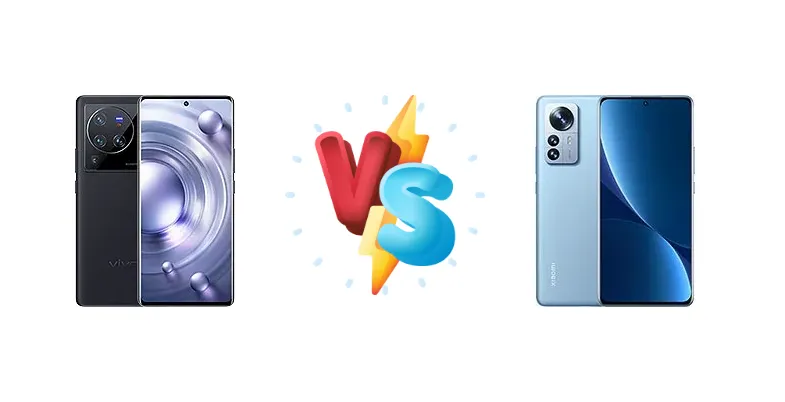
vivo X80 Pro vs Xiaomi 12 Pro: A Detailed Showdown
| Phones Images | |||||
|---|---|---|---|---|---|
|
🏆 Quick Verdict
The Xiaomi 12 Pro takes the lead with its blazing-fast 120W charging and slightly brighter display. However, the vivo X80 Pro offers a unique chipset option and potentially better camera versatility. Ultimately, the choice depends on your priorities: speed and brightness versus camera flexibility.
| PHONES | ||
|---|---|---|
| Phone Names | vivo X80 Pro | Xiaomi 12 Pro |
| Network | ||
|---|---|---|
| 2G bands | GSM 850 / 900 / 1800 / 1900 | GSM 850 / 900 / 1800 / 1900 |
| 3G bands | HSDPA 800 / 850 / 900 / 1700(AWS) / 1900 / 2100 | HSDPA 800 / 850 / 900 / 1700(AWS) / 1900 / 2100 |
| 4G bands | 1, 2, 3, 4, 5, 7, 8, 12, 13, 17, 18, 19, 20, 26, 28, 32, 38, 39, 40, 41, 42, 66 - International | 1, 2, 3, 4, 5, 7, 8, 12, 13, 17, 18, 19, 20, 25, 26, 28, 32, 38, 39, 40, 41, 42, 48, 66 - International |
| 5G bands | 1, 2, 3, 5, 7, 8, 20, 28, 38, 40, 41, 66, 77, 78 SA/NSA - International | 1, 3, 5, 7, 8, 20, 28, 38, 40, 41, 66, 77, 78, 79 SA/NSA - International |
| Speed | HSPA, LTE, 5G | HSPA, LTE, 5G |
| Technology | GSM / CDMA / HSPA / EVDO / LTE / 5G | GSM / CDMA / HSPA / EVDO / LTE / 5G |
| 1, 3, 5, 7, 8, 12, 20, 28, 66, 38, 40, 41, 77, 78, 79 SA/NSA - China | 1, 3, 5, 8, 28, 38, 40, 41, 77, 78, 79 SA/NSA - China | |
| Launch | ||
|---|---|---|
| Announced | 2022, April 25 | 2021, December 28 |
| Status | Available. Released 2022, April 29 | Available. Released 2021, December 31 |
| Body | ||
|---|---|---|
| Build | Glass front (Schott Xensation Up), glass back or ceramic back or eco leather back, aluminum frame | Glass front (Gorilla Glass Victus), glass back, aluminum frame |
| Dimensions | 164.6 x 75.3 x 9.1 mm (6.48 x 2.96 x 0.36 in) | 163.6 x 74.6 x 8.2 mm (6.44 x 2.94 x 0.32 in) |
| SIM | Nano-SIM + Nano-SIM | Nano-SIM + Nano-SIM |
| Weight | 215 g / 219 g (7.58 oz) | 204 g or 205 g (7.20 oz) |
| IP68 dust/water resistant (up to 1.5m for 30 min) | - | |
| Display | ||
|---|---|---|
| Protection | Schott Xensation Up | Corning Gorilla Glass Victus |
| Resolution | 1440 x 3200 pixels, 20:9 ratio (~517 ppi density) | 1440 x 3200 pixels, 20:9 ratio (~521 ppi density) |
| Size | 6.78 inches, 111.4 cm2 (~89.9% screen-to-body ratio) | 6.73 inches, 109.4 cm2 (~89.6% screen-to-body ratio) |
| Type | LTPO3 AMOLED, 1B colors, 120Hz, HDR10+, 1500 nits (peak) | LTPO AMOLED, 1B colors, 120Hz, Dolby Vision, HDR10+, 1000 nits (HBM), 1500 nits (peak) |
| Platform | ||
|---|---|---|
| CPU | Octa-core (1x3.00 GHz Cortex-X2 & 3x2.50 GHz Cortex-A710 & 4x1.80 GHz Cortex-A510)Octa-core (1x3.05 GHz Cortex-X2 & 3x2.85 GHz Cortex-A710 & 4x1.80 GHz Cortex-A510) | Octa-core (1x3.00 GHz Cortex-X2 & 3x2.50 GHz Cortex-A710 & 4x1.80 GHz Cortex-A510) |
| Chipset | Qualcomm SM8450 Snapdragon 8 Gen 1 (4 nm)Mediatek Dimensity 9000 (4 nm) | Qualcomm SM8450 Snapdragon 8 Gen 1 (4 nm) |
| GPU | Adreno 730Mali-G710 MC10 | Adreno 730 |
| OS | Android 12, upgradable to Android 14, Funtouch 14 (Global), OriginOS Ocean (China) | Android 12, MIUI 13 |
| Memory | ||
|---|---|---|
| Card slot | No | No |
| Internal | 256GB 8GB RAM, 256GB 12GB RAM, 512GB 12GB RAM | 128GB 8GB RAM, 256GB 8GB RAM, 256GB 12GB RAM |
| UFS 3.1 | UFS 3.1 | |
| Main Camera | ||
|---|---|---|
| Features | Laser AF, color spectrum sensor, Zeiss optics, Zeiss T* lens coating, Pixel Shift, dual-LED dual-tone flash, HDR, panorama | Color spectrum sensor, Dual-LED dual-tone flash, HDR, panorama |
| Quad | 50 MP, f/1.6, (wide), 1/1.3", PDAF, OIS 8 MP, f/3.4, (periscope telephoto), 1/4.4", 1.0µm, PDAF, OIS, 5x optical zoom 12 MP, f/1.9, 50mm (telephoto), 1/2.93", 1.22µm, dual pixel PDAF, 2x optical zoom, gimbal OIS 48 MP, f/2.2, 114˚ (ultrawide), 1/2.0", AF | - |
| Single | 32 MP, f/2.5, 24mm (wide), 1/2.8", 0.8µm | 32 MP, f/2.5, 26mm (wide), 0.7µm |
| Triple | - | 50 MP, f/1.9, 24mm (wide), 1/1.28", 1.22µm, dual pixel PDAF, OIS 50 MP, f/1.9, 48mm (telephoto), PDAF, 2x optical zoom 50 MP, f/2.2, 115˚ (ultrawide) |
| Video | 8K@30fps, 4K@30/60fps, 1080p@30/60fps, gyro-EIS | 8K@24fps (HDR), 4K@30/60fps (HDR10+), 1080p@30/120/240/960fps, 720p@1920fps, gyro-EIS |
| Selfie camera | ||
|---|---|---|
| Features | HDR | HDR, panorama |
| Single | 32 MP, f/2.5, 24mm (wide), 1/2.8", 0.8µm | 32 MP, f/2.5, 26mm (wide), 0.7µm |
| Video | 1080p@30fps | 1080p@30/60fps, 720p@120fps, HDR10+ |
| Sound | ||
|---|---|---|
| 3.5mm jack | No | No |
| 35mm jack | No | No |
| Loudspeaker | Yes, with stereo speakers | Yes, with stereo speakers (4 speakers) |
| 32-bit/192kHz audio | 24-bit/192kHz audio Tuned by Harman Kardon | |
| Comms | ||
|---|---|---|
| Bluetooth | 5.2 (Snapdragon)/ 5.3 (Dimensity), A2DP, LE, aptX HD, aptX Adaptive, aptX Lossless | 5.2, A2DP, LE, aptX HD, aptX Adaptive |
| Infrared port | Yes | Yes |
| NFC | Yes | Yes (market/region dependent) |
| Positioning | GPS (L1+L5), GLONASS, BDS, GALILEO, QZSS, NavIC | GPS (L1+L5), GLONASS (L1), BDS (B1I+B1c+B2a), GALILEO (E1+E5a), QZSS (L1+L5), NavIC (L5) |
| Radio | No | No |
| USB | USB Type-C 3.1 (Global)/ 3.2 (China), OTG | USB Type-C 2.0, OTG |
| WLAN | Wi-Fi 802.11 a/b/g/n/ac/6, dual-band, Wi-Fi Direct | Wi-Fi 802.11 a/b/g/n/ac/6 or 6e (market dependent), dual-band, Wi-Fi Direct |
| Features | ||
|---|---|---|
| Sensors | Fingerprint (under display, ultrasonic), accelerometer, gyro, proximity, compass | Fingerprint (under display, optical), accelerometer, gyro, compass, barometer |
| - | Virtual Proximity Sensing | |
| Battery | ||
|---|---|---|
| Charging | 80W wired, 100% in 38 min 50W wireless, 100% in 50 min Reverse wired | 120W wired, PD3.0, QC4, 100% in 18 min 50W wireless, 100% in 42 min 10W reverse wireless |
| Type | 4700 mAh | Li-Po 4600 mAh |
| Misc | ||
|---|---|---|
| Colors | Cosmic Black, Blue, Orange | Gray, Blue, Purple, Green |
| Models | V2185A, V2145 | 2201122C, 2201122G |
| Price | About 850 EUR | € 317.40 / $ 349.99 / £ 364.66 / ₹ 41,999 |
| SAR | - | 1.09 W/kg (head) 1.05 W/kg (body) |
| SAR EU | - | 0.60 W/kg (head) 1.00 W/kg (body) |
| Tests | ||
|---|---|---|
| Battery life | Endurance rating 79h | Endurance rating 74h |
| Camera | Photo / Video | Photo / Video |
| Display | Contrast ratio: Infinite (nominal) | Contrast ratio: Infinite (nominal) |
| Loudspeaker | -25.1 LUFS (Very good) | -29.5 LUFS (Average) |
| Performance | - | AnTuTu: 985226 (v9) GeekBench: 3682 (v5.1) GFXBench: 46fps (ES 3.1 onscreen) |
vivo X80 Pro
- Excellent camera versatility
- Choice of Snapdragon or Dimensity chipset
- Longer endurance rating
- Fast 80W wired charging
- Reverse wired charging
- Slower charging compared to Xiaomi 12 Pro
- Software experience can be polarizing
Xiaomi 12 Pro
- Blazing-fast 120W wired charging
- Slightly brighter display
- Clean Android experience
- Powerful Snapdragon 8 Gen 1 chipset
- 10W reverse wireless charging
- Camera versatility slightly less than vivo X80 Pro
- Endurance rating slightly lower
Display Comparison
Both phones feature stunning AMOLED displays with excellent color accuracy and contrast. The Xiaomi 12 Pro edges out the vivo X80 Pro with a slightly higher peak brightness of 1050 nits versus 1014 nits, making it a bit more visible in direct sunlight. Both offer a smooth 120Hz refresh rate for fluid scrolling and animations. The contrast ratio is listed as 'Infinite' for both, which is a nominal value indicating excellent contrast.
Camera Comparison
Both phones boast impressive camera systems. The vivo X80 Pro is known for its excellent image processing and versatile lens setup, often praised for its natural-looking colors and strong low-light performance. The Xiaomi 12 Pro delivers vibrant and detailed photos, with a focus on capturing bright and punchy images. The vivo X80 Pro's camera system is generally considered more versatile due to its unique lens configurations and computational photography capabilities.
Performance
Performance is a complex area. The vivo X80 Pro offers a choice of Snapdragon 8 Gen 1 or Mediatek Dimensity 9000, both powerful chipsets. The Xiaomi 12 Pro is exclusively powered by the Snapdragon 8 Gen 1. While both offer flagship-level performance, the Dimensity 9000 is generally considered to have a slight edge in sustained performance and efficiency. Real-world usage will likely feel very similar on both devices for most tasks.
Battery Life
The vivo X80 Pro boasts a slightly higher endurance rating of 79 hours compared to the Xiaomi 12 Pro's 74 hours. However, the Xiaomi 12 Pro's 120W wired charging is a game-changer, allowing for a full charge in just 18 minutes, significantly faster than the vivo X80 Pro's 38 minutes. Both offer 50W wireless charging.
Buying Guide
The vivo X80 Pro is ideal for photography enthusiasts who value camera versatility and a potentially more refined software experience. The Xiaomi 12 Pro is perfect for users who prioritize incredibly fast charging and a vibrant, bright display, and appreciate a clean Android experience.