
vivo X80 Lite vs. Samsung Galaxy S21 FE 5G: A Detailed Comparison
| Phones Images | |||||
|---|---|---|---|---|---|
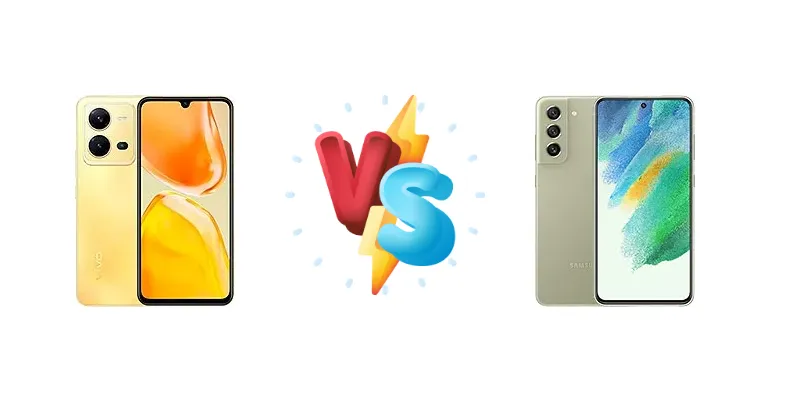
|
🏆 Quick Verdict
For most users, the Samsung Galaxy S21 FE 5G emerges as the stronger choice. While the vivo X80 Lite boasts impressive battery endurance, the S21 FE’s more powerful Snapdragon 888 (or Exynos 2100) chipset delivers a noticeably smoother and more responsive experience, justifying its slightly higher price.
| PHONES | ||
|---|---|---|
| Phone Names | vivo X80 Lite | Samsung Galaxy S21 FE 5G |
| Network | ||
|---|---|---|
| 2G bands | GSM 850 / 900 / 1800 / 1900 | GSM 850 / 900 / 1800 / 1900 |
| 3G bands | HSDPA 850 / 900 / 1700(AWS) / 1900 / 2100 | HSDPA 850 / 900 / 1700(AWS) / 1900 / 2100 |
| 4G bands | 1, 2, 3, 4, 5, 7, 8, 12, 17, 20, 28, 32, 38, 40, 41 | 1, 2, 3, 4, 5, 7, 8, 12, 17, 20, 26, 28, 32, 38, 40, 41, 66 - International |
| 5G bands | 1, 3, 5, 7, 8, 20, 28, 38, 40, 41, 77, 78 SA/NSA | 1, 3, 5, 8, 20, 28, 38, 40, 41, 66, 78 SA/NSA/Sub6 - International |
| Speed | HSPA, LTE, 5G | HSPA 42.2/5.76 Mbps, LTE (5CA) Cat19 1600/200 Mbps, 5G |
| Technology | GSM / HSPA / LTE / 5G | GSM / CDMA / HSPA / EVDO / LTE / 5G |
| - | 41, 66, 71, 260, 261 SA/NSA/Sub6/mmWave - USA | |
| Launch | ||
|---|---|---|
| Announced | 2022, September 22 | 2022, January 04 |
| Status | Available. Released 2022, September 22 | Available. Released 2022, January 07 |
| Body | ||
|---|---|---|
| Build | Glass front, glass back | Glass front (Gorilla Glass Victus), plastic back, aluminum frame |
| Dimensions | 159.2 x 74.2 x 7.8 mm (6.27 x 2.92 x 0.31 in) | 155.7 x 74.5 x 7.9 mm (6.13 x 2.93 x 0.31 in) |
| SIM | Nano-SIM + Nano-SIM | · Nano-SIM· Nano-SIM + Nano-SIM |
| Weight | 186 g (6.56 oz) | 177 g (6.24 oz) |
| - | IP68 dust/water resistant (up to 1.5m for 30 min) | |
| Display | ||
|---|---|---|
| Protection | - | Corning Gorilla Glass Victus |
| Resolution | 1080 x 2404 pixels, 20:9 ratio (~409 ppi density) | 1080 x 2340 pixels, 19.5:9 ratio (~403 ppi density) |
| Size | 6.44 inches, 100.0 cm2 (~84.7% screen-to-body ratio) | 6.4 inches, 100.5 cm2 (~86.7% screen-to-body ratio) |
| Type | AMOLED, 90Hz, HDR10+, 1300 nits (peak) | Dynamic AMOLED 2X, 120Hz, HDR10+ |
| - | Always-on display | |
| Platform | ||
|---|---|---|
| CPU | Octa-core (2x2.4 GHz Cortex-A78 & 6x2.0 GHz Cortex-A55) | Octa-core (1x2.84 GHz Cortex-X1 & 3x2.42 GHz Cortex-A78 & 4x1.80 GHz Cortex-A55) - Version 1Octa-core (1x2.9 GHz Cortex-X1 & 3x2.80 GHz Cortex-A78 & 4x2.2 GHz Cortex-A55) - Version 2 |
| Chipset | Mediatek Dimensity 900 (6 nm) | Qualcomm SM8350 Snapdragon 888 5G (5 nm) - Version 1Exynos 2100 (5 nm) - Version 2 |
| GPU | Mali-G68 MC4 | Adreno 660 - Version 1Mali-G78 MP14 - Version 2 |
| OS | Android 12, Funtouch 12 | Android 12, up to 4 major Android upgrades, One UI 8 |
| Memory | ||
|---|---|---|
| Card slot | microSDXC (uses shared SIM slot) | No |
| Internal | 256GB 8GB RAM | 128GB 6GB RAM, 128GB 8GB RAM, 256GB 6GB RAM, 256GB 8GB RAM |
| Main Camera | ||
|---|---|---|
| Features | LED flash, HDR, panorama | LED flash, auto-HDR, panorama |
| Single | 50 MP, f/2.0, (wide), AF | 32 MP, f/2.2, 26mm (wide), 1/2.74", 0.8µm |
| Triple | 64 MP, f/1.8, (wide), 0.7µm, PDAF, OIS 8 MP, f/2.2, 16mm, 120˚ (ultrawide), 1/4.0", 1.12µm 2 MP (macro) | 12 MP, f/1.8, 26mm (wide), 1/1.76", 1.8µm, dual pixel PDAF, OIS 8 MP, f/2.4, 76mm (telephoto), 1/4.5", 1.0µm, PDAF, OIS, 3x optical zoom 12 MP, f/2.2, 13mm, 123˚ (ultrawide), 1/3.0", 1.12µm |
| Video | 4K@30fps, 1080p@30fps | 4K@30/60fps, 1080p@30/60/120/240fps, HDR10+, gyro-EIS |
| Selfie camera | ||
|---|---|---|
| Features | HDR | HDR |
| Single | 50 MP, f/2.0, (wide), AF | 32 MP, f/2.2, 26mm (wide), 1/2.74", 0.8µm |
| Video | 4K@30fps, 1080p@30fps, HDR | 4K@30/60fps, 1080p@30/60fps, gyro-EIS |
| Sound | ||
|---|---|---|
| 3.5mm jack | No | No |
| 35mm jack | No | No |
| Loudspeaker | Yes | Yes, with stereo speakers |
| 24-bit/192kHz audio | 32-bit/384kHz audio | |
| Comms | ||
|---|---|---|
| Bluetooth | 5.2, A2DP, LE | 5.0, A2DP, LE |
| NFC | Yes | Yes |
| Positioning | GPS, GLONASS, BDS, GALILEO, QZSS | GPS, GLONASS, BDS, GALILEO |
| Radio | No | Unspecified |
| USB | USB Type-C 2.0, OTG | USB Type-C, OTG |
| WLAN | Wi-Fi 802.11 a/b/g/n/ac, dual-band, Wi-Fi Direct | Wi-Fi 802.11 a/b/g/n/ac/6, dual-band, Wi-Fi Direct |
| Features | ||
|---|---|---|
| Sensors | Fingerprint (under display, optical), accelerometer, gyro, proximity, compass | Fingerprint (under display, optical), accelerometer, gyro, proximity, compass |
| Color changing back panel color | Bixby natural language commands and dictation Samsung Pay (Visa, MasterCard certified) Samsung DeX (desktop experience support) | |
| Battery | ||
|---|---|---|
| Charging | 44W wired, 61% in 30 min | 25W wired, PD3.0, 50% in 30 min 15W wireless Reverse wireless |
| Type | 4500 mAh | Li-Ion 4500 mAh |
| Misc | ||
|---|---|---|
| Colors | Diamond Black, Sunrise Gold | White, Graphite, Lavender, Olive |
| Models | V2208 | SM-G990B, SM-G990B/DS, SM-G990U, SM-G990U1, SM-G990W, SM-G990E, SM-G9900, SM-G990B2, SM-G990U2, SM-G990W2, SM-G990U3 |
| Price | - | € 199.00 / $ 143.95 / £ 154.99 / ₹ 29,990 |
| SAR | - | 0.77 W/kg (head) 0.90 W/kg (body) |
| SAR EU | - | 0.95 W/kg (head) 1.48 W/kg (body) |
| Tests | ||
|---|---|---|
| Battery life | Endurance rating 120h | Endurance rating 92h |
| Camera | Photo / Video | Photo / Video |
| Display | Contrast ratio: Infinite (nominal) | Contrast ratio: Infinite (nominal) |
| Loudspeaker | -28.3 LUFS (Average) | -26.9 LUFS (Good) |
| Performance | AnTuTu: 461428 (v9) GeekBench: 2023 (v5.1) GFXBench: 21fps (ES 3.1 onscreen) | AnTuTu: 566529 (v8), 719696 (v9) GeekBench: 3049 (v5.1) GFXBench: 56fps (ES 3.1 onscreen) |
vivo X80 Lite
- Exceptional battery life (120h endurance)
- Faster wired charging (44W)
- Bright display (781 nits)
- Less powerful processor (Dimensity 900)
- Lacks wireless charging
- Limited camera details
Samsung Galaxy S21 FE 5G
- More powerful processor (Snapdragon 888/Exynos 2100)
- Wireless and reverse wireless charging
- Potentially superior camera system
- Shorter battery life (92h endurance)
- Slower wired charging (25W)
- Potential for thermal throttling (Exynos variant)
Display Comparison
Both phones feature 'Infinite' contrast ratio displays, a marketing term indicating excellent black levels. However, the Samsung Galaxy S21 FE 5G marginally edges out the vivo X80 Lite with a measured peak brightness of 792 nits versus 781 nits. This difference, while subtle, will be more noticeable in direct sunlight. Both likely utilize AMOLED panels, but Samsung’s experience in display technology often translates to slightly more accurate color calibration. Neither spec sheet details refresh rate, but the S21 FE is known to have a 120Hz panel, a significant advantage for smoother scrolling and gaming, while the X80 Lite is likely 60Hz.
Camera Comparison
Both phones offer capable camera systems, but details are limited to 'Photo / Video' in the provided data. The S21 FE likely benefits from Samsung’s advanced image processing algorithms and potentially larger sensor sizes. While both phones likely feature multiple lenses, the S21 FE’s flagship heritage suggests a more refined camera experience, particularly in low-light conditions. The X80 Lite may focus on delivering vibrant, social media-ready images, while the S21 FE aims for more natural and detailed results. Without specific sensor details, it’s difficult to make a definitive judgment, but Samsung’s track record suggests a more versatile camera system.
Performance
The performance gap is the most significant differentiator. The Samsung Galaxy S21 FE 5G, depending on the region, ships with either the Qualcomm Snapdragon 888 (5nm) or the Exynos 2100 (5nm) chipset. Both are considerably more powerful than the vivo X80 Lite’s Mediatek Dimensity 900 (6nm). The Snapdragon 888’s Cortex-X1 prime core, clocked at up to 2.9 GHz, provides a substantial performance boost over the Dimensity 900’s Cortex-A78 cores. While the Dimensity 900 is efficient, the Snapdragon 888’s Adreno 660 GPU offers a far superior gaming experience. The Exynos 2100 is comparable to the Snapdragon 888, though historically has shown slightly more thermal throttling under sustained load. The S21 FE also benefits from potentially faster LPDDR5 RAM, while the X80 Lite’s RAM speed is unspecified.
Battery Life
The vivo X80 Lite shines in battery endurance, achieving a remarkable 120-hour rating compared to the S21 FE’s 92 hours. This suggests a more efficient chipset and potentially better software optimization. However, the S21 FE compensates with faster charging – 25W wired (50% in 30 minutes) plus 15W wireless and reverse wireless charging, features absent on the X80 Lite. The X80 Lite’s 44W charging is faster, reaching 61% in 30 minutes, but lacks the convenience of wireless options. The S21 FE’s lower endurance is a trade-off for its more powerful processor and added charging features.
Buying Guide
Buy the vivo X80 Lite if you prioritize exceptional battery life and a consistently bright display for outdoor use, and are willing to trade some processing power. Buy the Samsung Galaxy S21 FE 5G if you demand superior performance for gaming and demanding applications, appreciate Samsung’s One UI software, and value the convenience of wireless charging and reverse wireless charging.